
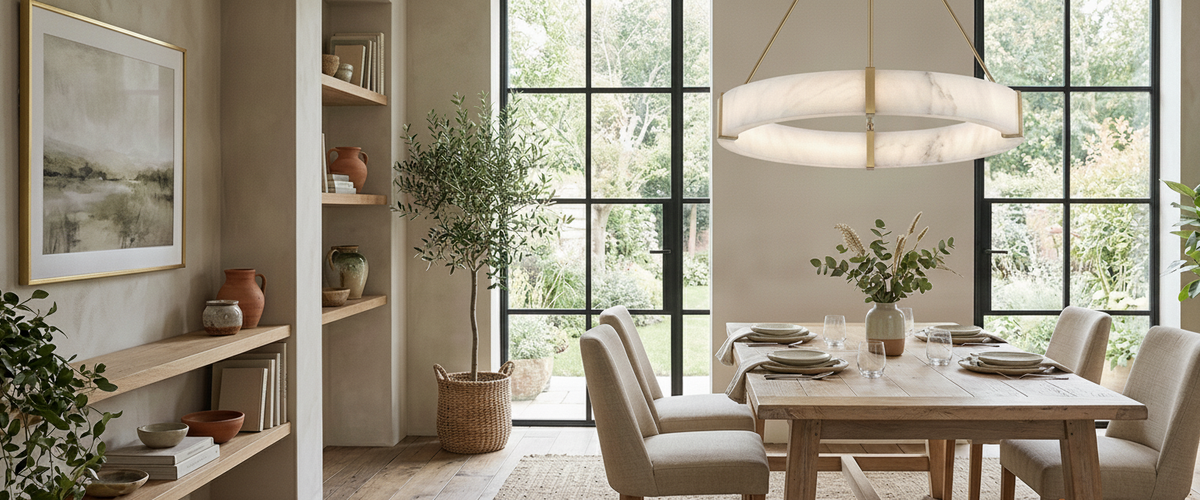

The short answer on dining room chandelier crystals: size the fitting to roughly half to two-thirds the width of the table, hang it 76cm to 86cm (30 to 34 in) above the tabletop on a standard 2.4m (8 ft) ceiling, specify 2700K dimmable lamps on a compatible trailing-edge dimmer, and have the ceiling fixing checked before you order, because crystal is heavy. Get those four decisions right and dining room chandeliers with crystals look as good at 9pm with six people seated underneath as they do in the product photo. Get them wrong and you get glare at seated eye level, a frame hung off-center over an old ceiling rose, and refraction gone flat after a year of cooking grease.
A chandelier over a dining table gets judged twice: once in the product photo, and again with the plates cleared and the conversation still going. Crystal almost always wins the first round. The second is harder, and this guide covers it. Sizing dining room chandelier crystals to the table rather than the room, how high to hang them, how many lamps you need, what color temperature and dimming to specify, what the weight means for your ceiling, and the point where translucent stone such as alabaster does the job better.
Be honest about how much sparkle your room can actually reflect back. Crystal can be exceptional over a table. It can also throw hard, scattered light at your guests at the moment you most want them relaxed. Dining room chandelier crystals reward planning more than almost any other fitting in the house.

At a Glance
Sparkle versus glow: cut dining room chandelier crystals refract light into sharp points; alabaster and onyx diffuse it into an even, warm wash.
Size: aim for a fitting roughly half to two-thirds the width of the table, leaving at least 15cm (6 in) clear on each long side.
Height: 76cm to 86cm (30 to 34 in) from tabletop to the lowest point of the fitting, on a standard 2.4m (8 ft) ceiling.
Dimming is not optional where dining room chandelier crystals are involved. Specify dimmable lamps and a compatible trailing-edge dimmer from the start.
Weight and fixing matter more than any other technical detail. Crystal is heavy. Get the ceiling checked before you order.

What Dining Room Chandelier Crystals Actually Mean, and Who They Suit
The term covers a wide field. At one end sit traditional multi-arm fittings dressed with cut drops, octagons and swags. At the other are contemporary pieces where a few faceted elements are used sparingly against brass, blackened steel or stone. Both get sold as dining room chandelier crystals, and both behave very differently in a room.
Worth knowing what you are buying. Historically, lead crystal contained lead oxide, which raised the refractive index and gave glass that dense, prismatic flash; most modern production uses barium or zinc alternatives to achieve similar optical clarity. The Corning Museum of Glass sets out the distinction clearly, and it is a useful reference when a listing for dining room chandelier crystals simply says "crystal effect". Molded glass, K9 optical glass and hand-cut crystal all sparkle. They do not sparkle equally, and the price gap between them is real.
Dining room chandelier crystals suit period properties, formal dining rooms, tall Georgian and Victorian ceiling heights, and any space where you want the light fitting to be the event. They are less forgiving in low-ceilinged cottages, open-plan kitchen-diners with a lot of hard reflective surfaces, or rooms where the table doubles as a homework desk. That is often where clients start looking at alabaster instead.
How to Compare Dining Room Chandelier Crystals Before You Buy
Six decision criteria, in the order they actually matter:
Light quality at eye level. Sit down. Anything below roughly 76cm (30 in) above the table, with exposed lamps and no shading, will glare. Look for fittings with candle sleeves, frosted shades, or crystal arranged to shield the lamp rather than expose it.
Weight and fixing point. Ask for the fitting weight and check whether your ceiling has a joist or a suitable brace above the intended position. A frame dressed with dining room chandelier crystals can be several times the weight of a simple pendant.
Number of lamps and total output. Twelve small lamps at low output beat three bright ones for evenness over a long table.
Dressing time. Some fittings arrive with hundreds of drops to hang individually. Budget the hours, or the electrician's hours.
Cleaning access. If you cannot reach it with a household step ladder, you will not clean it. Dust dulls refraction fast on dining room chandelier crystals.
Finish compatibility. Chrome and clear dining room chandelier crystals read cool and formal. Aged brass, bronze and warm-toned glass read softer and sit better alongside timber and stone.
Key Materials, Finishes and Scale Decisions
Crystal is not the only material that makes light interesting over a table. Alabaster does something no faceted drop can: because it is genuinely translucent, light travels through the stone body itself, so the fitting reads as a soft luminous mass rather than a cluster of bright points. Veining shows as faint amber and honey shadows. Onyx pushes further, with stronger banding and more color. Marble, being largely opaque, works as a structural or decorative element rather than a diffuser.
Finish direction matters as much as the crystal itself. In a room built around oak, limewash and linen, dining room chandelier crystals in cool chrome and clear drops can feel imported from somewhere else, whereas a frame in warm distressed timber and old bronze such as the Aberdeen 6 Light Chandelier keeps the sparkle but grounds it in the same palette as the table below. Aged brass does similar work in more formal rooms, holding the reflected light warm rather than silver.
In practice we see designers pairing the two. A pair of alabaster wall lights flanking a sideboard, with a cut-crystal fitting over the table, gives you sparkle where you want it and a calm background wash everywhere else. It beats dimming dining room chandelier crystals so low that the refraction disappears altogether. If you want to see how translucent stone behaves before committing, the alabaster lighting collection is the quickest way to compare veining and form across pendants, chandeliers and wall lights.
Getting Diameter and Drop Right
Two rules, used together when you are sizing dining room chandelier crystals. For the fitting diameter against the room, add the room's length and width in feet and treat that number as a diameter in inches; a 12 ft by 14 ft room (3.7m by 4.3m) suggests roughly a 26 in (66cm) fitting. Then sanity-check it against the table: the chandelier should be about half to two-thirds the table width, never wider, with clearance so nobody catches a drop while passing a serving dish.
Lamp count follows table length rather than taste. A round table for four is usually well served by a three or four light fitting on the smaller side of the calculation, closer in spirit to the Kristy 3 Light Chandelier, where the frame stays open and sightlines across the table are undisturbed. A 2.2m table asks for the opposite: more lamps at lower individual output, which is why a wider ten light frame like the Marvele 10 Light Chandelier spreads illumination to the ends of the table instead of pooling it in the middle.
Long tables over about 2.4m (8 ft) rarely suit a single fitting. Splitting dining room chandelier crystals across two smaller frames, or centering one chandelier with a pair of stone pendants either side, distributes light far more evenly. We supply matched pairs of pendants for exactly this reason: on a 3m oak table, one central fitting almost always leaves both ends in shadow.
How High to Hang a Chandelier Over a Dining Table
The working figure for dining room chandelier crystals is 76cm to 86cm (30 to 34 in) between the tabletop and the lowest point of the fitting, assuming a 2.4m (8 ft) ceiling. Add roughly 7.5cm (3 in) of drop for every additional foot of ceiling height, so a 3m (10 ft) ceiling generally takes the fitting up to around 91cm (36 in) above the table.
Two adjustments are worth making. If the chandelier is visually heavy or wide, hang it slightly higher so sightlines across the table stay open. If the room is tall and the fitting is delicate, hang lower than the rule suggests, otherwise it floats and loses its relationship with the table. Always dry-fit: have someone hold the fitting at height, sit down, and look across at the person opposite. Your eyes will tell you faster than a tape measure.
Chandeliers over a table are also the one case where the fitting can sit lower than general circulation clearance, because nobody walks under it. That freedom disappears the moment the table moves.
Where to Place Dining Room Chandelier Crystals for the Strongest Impact
Center the fitting on the table, not the room. This is the single most common installation error, and it is almost always caused by an existing ceiling rose left over from a previous layout. Moving the fixing point is a small job compared with living with a chandelier that sits 30cm off-center for a decade.
Placement beyond the dining room is worth thinking about too. Dining room chandelier crystals perform best where there is something to reflect: a mirrored wall, polished plaster, a glazed cabinet, a dark lacquered table. In a matte, textural room they can look oddly inert. Alabaster is the opposite; it reads beautifully against limewash, timber and linen, and holds its presence even when switched off. Hospitality clients often use stone pendants over banquette seating and reserve crystal for the entrance or private dining room, where guests see it briefly and at full effect.
For sloped or vaulted ceilings, check that the canopy is rated for the pitch and use a sloped-ceiling adaptor rather than forcing a standard fixing. Browse the broader lighting range if you need matching wall lights or table lamps to build layers around the main fitting.
Bulbs, Dimming and Wiring
Specify 2700K warm white lamps. Anything cooler makes dining room chandelier crystals look glassy and blue, and makes food look worse. Clear candle lamps sharpen refraction; frosted lamps soften it and cut glare. Choose based on how close your guests sit to the fitting.
Dimming needs planning. Many LED lamps are non-dimmable, and dimmable ones need a matched trailing-edge dimmer to avoid flicker and buzz; the Energy Saving Trust covers the basics of LED selection and compatibility. Test one lamp with your intended dimmer before buying twelve. All installation and any alteration to the ceiling fixing should be carried out by a qualified electrician, particularly with heavier crystal or stone fittings.
Care Checklist for Crystal and Stone Fittings
Switch off at the circuit and let lamps cool completely before touching anything.
Dust dining room chandelier crystals with a dry microfiber cloth every few weeks; refraction dulls surprisingly quickly in a room where food is cooked nearby.
For a deeper clean, use a barely damp cloth and dry immediately. Never spray liquid onto the fitting.
Photograph the dressed chandelier before removing drops so you can rebuild the pattern accurately.
Alabaster and onyx are soft and porous. Use a soft dry brush or dry cloth only, and keep acidic cleaners, vinegar and proprietary glass sprays well away from the stone.
Check suspension fixings and chain links annually on any heavy fitting.
Budget, Quality and Delivery
Cost on dining room chandelier crystals moves with material grade, hand-cutting versus molding, metalwork quality, size, and the engineering required to hang the finished weight safely. Stone fittings vary for the same reasons plus block selection, since translucency and veining differ from one piece of alabaster to the next. Rather than working to a vague figure, tell us the table size, ceiling height and finish direction and ask for a tailored quote.
On lead times, natural stone pieces are cut and finished to order more often than mass-produced crystal, so build that into your program if you are working to a completion date. Confirm the lead time in writing before you commit.
How Niori Can Help
Niori specializes in alabaster and natural-stone lighting: pendants, chandeliers, wall lights, table lamps and floor lamps, usually with brass or blackened metal detailing. We ship worldwide and work regularly with interior designers, architects and hospitality clients on dining spaces where the light over the table has to do a lot of work.
If you are weighing dining room chandelier crystals against stone, send through the room dimensions, table size, ceiling height and a photograph or two. We will tell you honestly which will look better in that specific room, including when the answer is crystal. Start with the main collection and narrow from there.