
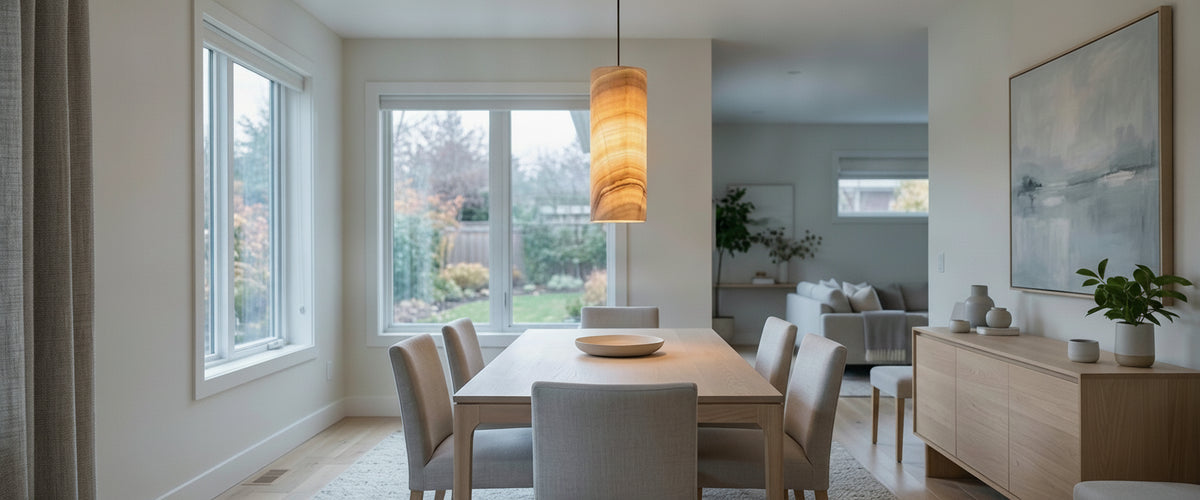

Most onyx pendants look superb in the showroom at full output and disappointing at nine o'clock at night, which is exactly when you bought them to shine. Getting dimmable onyx pendant lighting right is a small engineering problem as much as a style choice. The stone is dense and banded, and it filters light unevenly. As you turn the output down, it can either deepen into a rich, ember-like glow or flatten into a dull brown disc with a hot spot in the middle. The difference comes down to the slab, the bulb, the dimmer and where you hang it.
Quick Answer
Onyx is more translucent than marble but less forgiving than alabaster. Veins block light, so slab selection matters more than shade shape.
Use a trailing-edge dimmer matched to the LED lamp's compatibility list, and check the dimmer's minimum load against your total wattage.
Choose 2700K, high-CRI lamps (CRI 90 or above), or dim-to-warm lamps for honey and green onyx.
Hang 30 to 36 inches (75 to 90 cm) above a table and keep the shade's diameter well inside the table edge.
Ask for photos of your actual slab backlit before the pendant ships.

Why Onyx Behaves Differently From Alabaster, Travertine and Frosted Glass
The onyx used in lighting is almost always banded calcite, often sold as onyx marble. It forms in layers from mineral-rich water, which is why you see those flowing stripes and cloudy zones. The mineral data for calcite explains much of what you see: a crystalline, semi-translucent structure that lets light through in some bands and scatters it in others.
Alabaster sits at the other end of the spectrum. Its fine, even grain diffuses light into a soft, milky wash, so a thin alabaster bowl glows almost uniformly. Travertine is porous and mostly opaque, so it works for bases and canopies, not for shades. Frosted glass spreads light evenly but has no depth; it looks the same at 100 percent as at 20 percent, only dimmer.
Onyx is the dramatic one. Light passes through the clear bands, stalls in the dense ones, and picks up the stone's color as it travels. That gives you a glow with real depth, and it also means a bad slab cannot be rescued by a better bulb. If you want an even, gentle wash over a whole room, the alabaster lighting collection is often the better starting point. Choose onyx when you want the stone itself to be the event.

Veins and Thickness Set the Color Temperature Before the Bulb Does
Here is the part most buyers miss. A 2700K lamp behind a pale, thin onyx panel reads close to 2700K. The same lamp behind a thicker, heavily veined honey slab can read closer to candlelight, because the stone absorbs the cooler end of the spectrum before the light reaches you.
In the studio we test offcuts by holding them over a phone torch. It is crude, but it shows two things at once: how much light gets through, and what color it comes out. Two pieces from the same block can differ by a surprising margin. Dense, dark veins act like tiny blinds; cloudy white bands scatter light and brighten the surface; clear amber zones glow like resin.
Clear amber bands glow while dense veins block light, even within a single slab.
Thickness compounds all of this. Thinner stone transmits more light and shows more pattern, but it is more fragile in transit and handling. Thicker stone is sturdier and warmer in tone, yet it needs more output to come alive. So when you specify dimmable onyx pendant lighting, treat the lamp's color temperature as a starting point. The stone has the final word.
What Dimmable Onyx Pendant Lighting Asks of Your Dimmer Circuit
Because onyx eats a share of the output, you are usually running dimmable onyx pendant lighting at higher wattage equivalents than you would behind glass, then dimming it hard. That combination exposes weak dimmer setups fast: flicker at the bottom of the range, a buzz from the lamp, or a sudden drop from glowing to off.
Get these right and the stone behaves:
Dimmer type. Most modern LED lamps prefer trailing-edge (phase-cut) dimmers. Older leading-edge dimmers designed for halogen loads are a common cause of flicker.
Minimum load. A single low-wattage LED pendant can fall below a dimmer's minimum load. Check the figure, especially on one-light fixtures.
Compatibility lists. Good lamp manufacturers publish tested dimmer pairings. Use them.
Bottom-end trim. Many dimmers let an electrician set the lowest level so the lamp does not flicker out before it reaches darkness.
Dim-to-warm lamps. These shift warmer as they dim, mimicking filament behavior. They suit honey and green onyx particularly well.
One real lesson from a project we supplied: a restaurant fitted six honey onyx pendants on an existing halogen-era dimmer. At about a fifth of full output, the stone went from amber to a flat, sulky orange with a visible pulse. A trailing-edge dimmer and high-CRI 2700K lamps fixed both problems in an afternoon. The pendants were never the issue.
Any change to dimmers, switches or ceiling wiring should be carried out by a qualified electrician. In the UK, much domestic electrical work falls under Part P of the Building Regulations, so this is not a weekend job.
Drop Height, Shade Diameter and When the Stone Takes Over
Onyx is visually heavy. Even unlit, a large shade carries the color and pattern of a stone wall, so sizing dimmable onyx pendant lighting needs more restraint than sizing a glass or fabric shade.
Over a Dining Table or Island
Hang onyx pendant lights 30 to 36 inches (75 to 90 cm) above the surface. Lower than that and diners stare into the hot spot; higher and the glow detaches from the table. For a single pendant, keep the shade diameter at roughly a third to half of the table's width. For an island, two or three smaller pendants usually look calmer than one oversized drum. Where you would rather have that rhythm from a single canopy, a three-light fixture such as the Esparta 3 Light Pendant in Aged Gold Leaf spreads the light along the run, and its warm metal finish sits comfortably beside honey stone and aged brass.
In Hallways and Stairwells
Keep at least 7 feet (about 2.1 m) of clearance beneath the shade in walkways. Stairwells reward a long drop: seen from below, a backlit onyx bowl shows its veining far better than a side view does. In a double-height void where a single shade would look lost, a tiered cluster such as the Ovila 13 Light Glass Cluster Pendant fills the height at several levels, its brandy-toned glass echoing the amber of honey onyx, and the remote control is practical where switches sit awkwardly far from the landing.
Bedrooms and Snugs
This is where dimmable onyx pendant lighting earns its keep at low output. A smaller pendant dimmed right down gives a warm, firelit glow that alabaster cannot quite match. Pair it with a lamp or wall light so the pendant is never the only source. Where you are not yet sure which the room needs, a convertible fitting such as the Niva 1 Light Convertible Wall Light & Pendant can be mounted beside the bed or hung as a second, lower pendant, and its plain black form lets the stone stay the focus.
The tipping point is easy to spot. If the shade is the first thing you notice when the light is off, and the room feels darker when it is on, the stone is overwhelming the space. Go smaller, paler or thinner. Browse the wider lighting range for companion wall lights and lamps that share the load.
Honey, Green and Dark Onyx Under Low Output
Tone decides how gracefully a pendant dims.
Honey onyx. The most forgiving. A honey onyx pendant light holds its amber character down to very low levels and shifts toward candlelight rather than mud. It suits dining rooms, bars and bedrooms, and pairs naturally with aged brass.
Green onyx. Lovely at medium to high output, where its jade and cream bands read clearly. At low levels it can drift toward olive or gray, so dim-to-warm lamps and a slightly higher minimum setting help. Best in kitchens and garden rooms with good daylight.
Dark onyx (smoky, brown or heavily veined). Dramatic, and the least tolerant of dimming. It needs generous output to glow at all, and below about a third it can look unlit. Use it as an accent where it will mostly run bright, such as a feature stairwell or hotel lobby.
White and pale onyx. Closest to alabaster in behavior. Bright, even, and easy to dim, with subtler veining.
Honey onyx keeps its amber warmth at low output, which is why it suits dining rooms.
If you plan to run dimmable onyx pendant lighting low most evenings, choose honey or pale stone. Save darker slabs for spaces where the light stays up.
Before It Ships: Batch, Sealing and Wiring Checks
Onyx is a natural material, and no two slabs match exactly. That is part of the appeal, but on multi-pendant runs it can also cause regret. Run through this list before you sign off an order for dimmable onyx pendant lighting.
Batch consistency. For two or more pendants, ask whether the shades are cut from the same block, and request backlit photos of each.
Backlit approval. Photos in daylight tell you little. Ask to see the shade lit, ideally at full and reduced output.
Sealing. Calcite stones are sensitive to acids and moisture. Ask what sealer was used and how often it needs renewing in kitchens and bathrooms. The Stone Federation Great Britain is a useful reference on natural-stone care.
Lamp holder and wattage. Confirm the lamp holder type, the maximum rated wattage and whether an integrated LED driver is dimmable.
Driver and dimmer pairing. If the pendant has a driver, get its dimming protocol and check it against your switches.
Weight and fixing. Ask for the finished weight so your electrician can confirm the ceiling fixing is suitable.
Packing. Stone shades should travel crated or heavily braced. Ask how the shade is protected.
Day-to-Day Care
Dust with a soft, dry cloth. Avoid vinegar, citrus and bleach-based cleaners, which can etch calcite. Turn the light off and let the stone cool before cleaning, and never spray liquid near the lamp holder.
Getting the Glow Right
Good dimmable onyx pendant lighting is a sequence of small decisions made in the right order: choose the slab, then the lamp, then the dimmer, then the drop. At Niori we work with alabaster, onyx and other natural stones every day, and the pendants that please clients most are rarely the largest or darkest. They are the ones specified for how the room is actually used after dark. If you are planning a project, browse the lighting range or ask us for backlit slab photos and a tailored quote before you commit.