
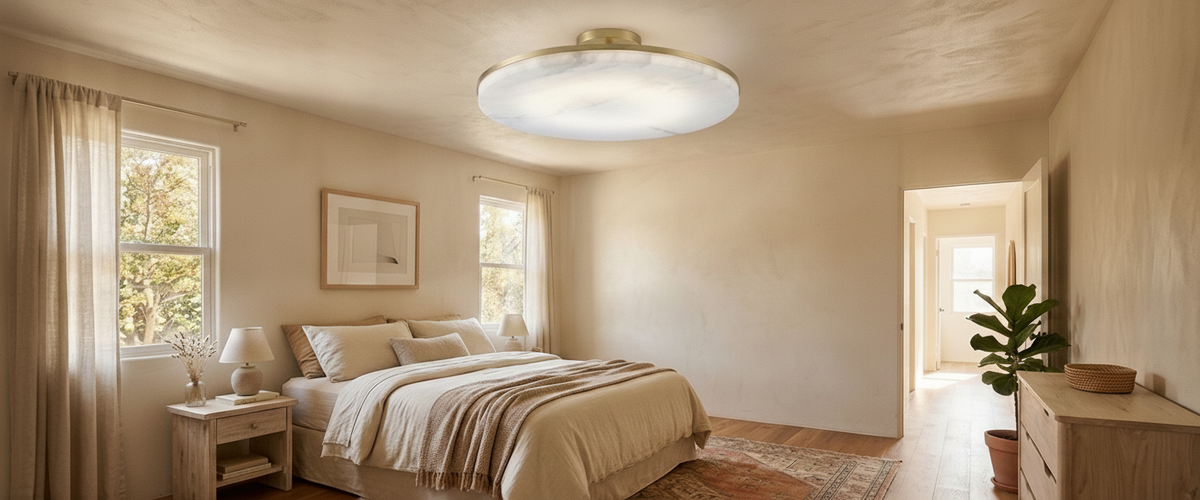

Fit the same flush ceiling light in a hallway and a bedroom and you will get two very different results. In the hall it reads as calm and generous. In the bedroom, mounted low over the bed, that same output turns flat and clinical the moment you lie down and stare straight into it. A dimmable LED ceiling fitting solves half the problem; placement solves the rest. Get both right and a room reads warm at night and workable by day.
At Niori we spend most of our time on alabaster and natural-stone pieces, where the light is softened by the material itself. A dimmable LED ceiling fixture works differently. The diffuser is doing the heavy lifting, so where you put the fitting, how high it sits, and how far you can dim it decide almost everything.
The same fitting reads generous in a hall and harsh over a bed; placement decides which.

Key Takeaways
Not every LED ceiling light is dimmable; check the driver, not just the bulb.
Mounting height and ceiling colour change the spread of light more than wattage does.
A wide dimming range (down to around 5 to 10 percent) is what separates a warm evening from a strip-lit one.
Recessed LEDs near insulation need a fire-rated, IC-rated fitting and a qualified electrician.
Placement mistakes leave a room evenly lit but oddly lifeless; layering fixes it.

Why the Same Fitting Feels Generous in a Hall and Harsh in a Bedroom
A hallway is a passing space. You want even, shadow-free light so nobody trips on the stairs, and you rarely stop long enough to look up. A bedroom is the opposite. You spend time on your back, at eye level with the ceiling, and any glare reads as harsh. The fitting has not changed. The angle you view it from has.
This is why a single dimmable LED ceiling light rarely does a whole room justice on its own. In the hall it can be the only source and still feel right. In the bedroom it wants company: a pair of table lamps, a wall light, something with an alabaster or stone shade to soften the corners. The overhead dimmable LED ceiling fitting becomes the general wash, dimmed low, while the warmth comes from lower down.
Mounting Height and Ceiling Colour Change the Spread of Light
Two things quietly control how far your light travels: how high the fitting sits and what colour surface it bounces off. A flush dimmable LED ceiling fitting on a 7 foot 6 inch (2.3 m) ceiling throws a tighter, brighter pool than the same fitting on a 10 foot (3 m) ceiling, where the light has room to spread and soften before it reaches you.
Ceiling colour matters just as much. A bright white ceiling reflects light back into the room and lifts the overall level; a dark or heavily coloured ceiling absorbs it, so you lose output and the fitting itself becomes the focal point rather than the glow around it. If you have painted a bedroom ceiling in a deep tone, expect to run the dimmable LED ceiling brighter, or add a second source, to hit the same comfort level.
Scale follows the same logic. On a broad open-plan ceiling a small disc looks lost, and this is where the size step between something like the Gale 60cm LED Circular Ceiling Light and the Gale 80cm LED Circular Ceiling Light becomes a real decision rather than a detail. Semi-flush dimmable LED ceiling fittings that drop a few inches from the ceiling behave differently again. The gap lets light escape upward and wash the ceiling, which reads as softer and taller. It is worth browsing the full niori lighting range with this in mind, because the drop and diffuser style tell you more about the final effect than the headline lumen figure ever will.
Kitchen, Living Room, Bathroom: Where a Ceiling LED Earns Its Place
The kitchen is where a dimmable LED ceiling light earns its keep. You need bright, even task light for chopping and cooking, then a lower setting for eating and relaxing. A 4 foot (1.2 m) linear LED fixture or a run of recessed downlights covers the worktop; the dimmer lets you drop it back once dinner is on the table. Aim the general light at the room and reserve tighter beams for over the counters.
A wide dimming range takes a kitchen from bright task light to a relaxed evening level.
In the living room, treat the overhead dimmable LED ceiling as a base layer, never the star. A single bright disc on full output flattens a sitting room and kills the mood. Dimmed to a third and paired with lamps, it fills in the shadows without drawing attention. This is exactly where warm, diffused sources sit well; an alabaster wall light or table lamp adds the glow the ceiling cannot. Our alabaster lighting collection is built for that lower, softer layer.
In the bathroom, the rules tighten. Any fitting near a shower or bath must carry the correct IP rating for its zone, and that is not optional. Guidance on bathroom zones is worth reading before you commit; the Electrical Safety First resources set out which ratings belong where. A suitably rated dimmable LED ceiling fixture gives you bright light for the mirror and a gentler level for a late soak.
The Dimming Range That Decides Whether Evenings Feel Warm or Clinical
Dimmable is a spectrum, not a yes or no. A cheap fitting might only drop to 20 or 30 percent before it stutters, flickers, or cuts out. That is still technically adjustable, and it will still feel too bright at 9pm. The dimmable LED ceiling fittings worth buying dim smoothly down to around 5 to 10 percent, so the room can settle into something genuinely restful. Where you want to reach for that lower setting from the sofa rather than the wall, a fitting such as the Frodeno LED Remote Control Dome Ceiling Light lets you tune both level and warmth without getting up.
Colour temperature is the other half of this. Many quality overhead LEDs now offer a warm-dim feature, where the light shifts toward a warmer, more amber tone as you dim it, mimicking the way a traditional filament bulb behaves. That warm shift is what stops a dimmed dimmable LED ceiling looking grey and lifeless. If the colour stays cool as you dim, the room reads clinical no matter how low you go. The CIBSE guidance on lighting quality is a sound technical reference here; the CIBSE material explains why colour and level need to move together for comfort.
Matching the Dimmer to the Driver
Most dimming faults come from a mismatch between the wall dimmer and the LED driver, not the light itself. A dimmer designed for old incandescent loads will often hum, flicker, or refuse to dim a modern dimmable LED ceiling cleanly. Check whether the fitting wants a trailing-edge dimmer and whether the driver is genuinely adjustable, then match the two. When in doubt, ask the manufacturer for the compatible dimmer list rather than guessing.
Contrast and Backdrop: Reading the Fitting Against Dark Versus Pale Ceilings
A matt black or anthracite dimmable LED ceiling light almost disappears against a dark ceiling and shows itself as a crisp, graphic circle against a pale one. The same fitting on a dark ceiling reads as a soft ring of light with the body dissolving into the background. Neither is wrong; you just need to decide which effect you want before you order.
Gold, brass, and platinum finishes behave differently again. They catch and hold a little of their own reflected glow, so they read warmer and more present in the room even when switched off. If you want the fitting to be part of the scheme rather than a discreet source, a metallic finish such as the Darvin 2 Light LED Circular Ceiling Light in Gold against a light ceiling gives you the most contrast. If you want it to recede, match the finish closer to the ceiling tone.
Placement Mistakes That Leave a Room Evenly Lit but Strangely Flat
The commonest error we see is over-relying on one central overhead fitting. It lights everything equally, which sounds ideal and looks dead. Rooms need contrast to feel alive: brighter pools where you work and read, softer edges everywhere else. A grid of recessed downlights spaced too evenly does the same thing on a larger scale.
A few practical fixes:
Do not centre the fitting on the room if the furniture is off-centre. Centre it on the space people actually use, such as the seating group or the island.
Layer at least three heights. Ceiling for the wash, wall lights for mid-level, lamps for the glow. This is where alabaster and stone shades pull their weight.
Keep beam angles varied. A wide flush fitting plus a couple of narrower accents reads far richer than a room of identical downlights.
Test the dimmer before you decorate. Live with the lowest setting for an evening and see whether it holds warmth.
Get the placement and the dimming right, and a modest dimmable LED ceiling does far more than its spec sheet suggests. Get either wrong, and the most expensive dimmable LED ceiling in the room still feels like an office.