
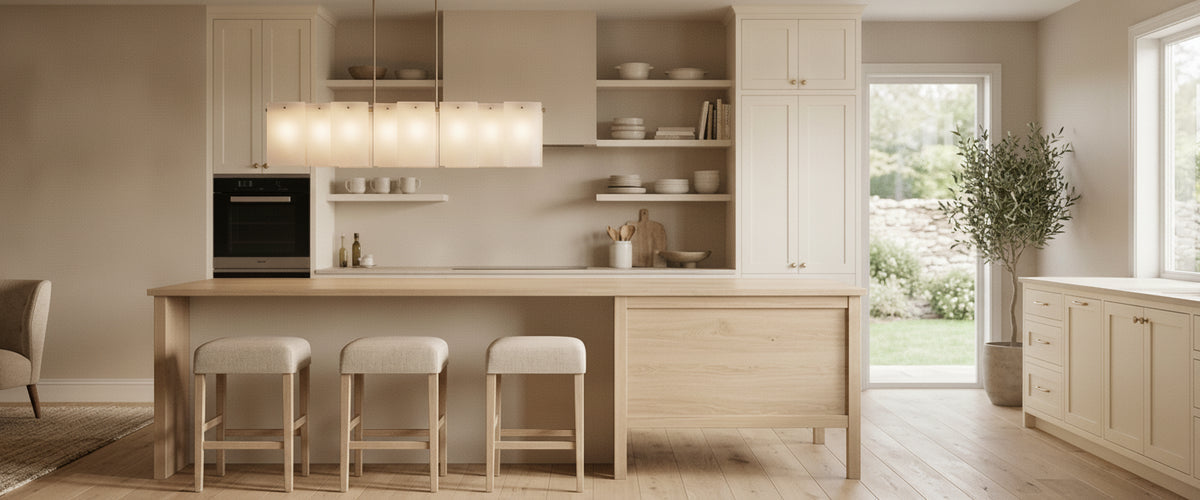

Most kitchen lighting mistakes happen at the island, and a crystal chandelier makes them easy to see. Hang the wrong piece and every guest perched on a stool gets a faceted prism glinting straight into their eyes while the chopping board stays in shadow. A well-planned crystal chandelier kitchen scheme fixes both problems. It throws sparkle across the room, keeps glare off the worktop, and sits in proportion to the island instead of the ceiling.
Hung over the seating end, a crystal kitchen chandelier adds sparkle without throwing glare across the worktop.
At Niori we spend most of our time with alabaster and natural stone, materials that soften light. Crystal does the opposite. It splits light and scatters it. Knowing how those two behaviors differ is the quickest way to choose a kitchen crystal chandelier well, or to decide against one.

Key Takeaways
Size a crystal kitchen chandelier to the island, not the room. Leave at least 12 inches (30 cm) of clear worktop beyond each end of the fixture.
Hang the bottom of the fixture 30 to 36 inches (76 to 91 cm) above the worktop as a starting point, then adjust for seated sightlines.
Low ceilings suit smaller, tighter prisms or a semi-flush crystal design. They do not suit long cascading drops.
A crystal chandelier in the kitchen is ambient and decorative light. Task light should come from separate shielded downlights or under-cabinet strips.
Use a qualified, registered electrician and confirm ceiling load, joist position and heat from the hob before anyone cuts the plaster.

Why a Crystal Chandelier Over an Island Follows Different Rules
A dining table chandelier lives in a room where people sit, relax and look up occasionally. The light can be theatrical because nobody is slicing an onion under it. A crystal chandelier over an island works harder. People stand at it, lean across it and sit at it, often in the same evening. Their eye line moves between roughly 4 and 5.5 feet (1.2 to 1.7 m) from the floor, which is exactly where a low-hung prism lives.
The island is also usually long and narrow, while dining tables tend toward square or oval. A round crystal chandelier that looks generous above a 6-seat table can look like a single fried egg on a 9-foot (2.7 m) island. For long islands, consider a linear or oval crystal island chandeliers, or a pair of matched smaller pieces, so the light follows the shape of the surface below it.
Then there is grease. When an island hob sits under an extractor that rarely gets switched on, the prisms of a kitchen crystal chandelier nearest the cooking zone pick up a faint amber film and lose most of their fire, often within months. The rule we pass on to every buyer: if the hob sits in the island, the chandelier belongs over the prep or seating end, never directly above the burners.
Lower Ceilings and Which Crystal Actually Transmits Light Well
Plenty of UK kitchens, especially extensions and newer builds, sit at around 8 feet (2.4 m). That changes the crystal chandelier kitchen decision more than most people expect.
Lead crystal has a higher refractive index than ordinary glass, so it bends light more sharply and throws stronger rainbow flashes. The Corning Museum of Glass explains how lead oxide in the batch gives the glass its brilliance and weight. Optical glass, often sold as K9 crystal, is lead-free, lighter and very clear, and still sparkles well. Pressed glass beads are the least lively of the three.
Under a low ceiling, more fire is not always better. A heavy lead crystal drop hung at eye level becomes a glare source rather than a jewel. In that situation we would usually point buyers of a crystal kitchen chandelier toward smaller faceted elements clustered close to the canopy, a semi-flush profile, or a fixture where the crystal surrounds a shaded light source so the bulb is never in direct view. With 10-foot (3 m) ceilings or more, you have room for longer cascades and larger prisms, because the sparkle happens above head height.
If even a compact crystal kitchen chandelier feels too busy for a low room, this is where alabaster earns its place. A stone pendant gives the same sense of occasion with a matte, diffused glow and no hot spots. Our alabaster lighting collection is worth a look before you commit to a cut-glass silhouette in a tight space.
Sizing a Crystal Chandelier to the Kitchen Island Footprint
Forget the old rule of adding a room's length and width to get a fixture diameter. Over an island, the only measurements that matter for a crystal chandelier in the kitchen are the island's length, its width, and the ceiling height.
Length: keep the fixture, or the span of a group of fixtures, at least 12 inches (30 cm) short of each end of the island. On a compact island, 6 inches (15 cm) is the bare minimum.
Width: the fixture should be narrower than the island by about 12 inches (30 cm) in total, so nobody clips it when leaning in.
Number of pieces: one linear crystal chandelier over the kitchen island reads as a single statement. Two or three smaller pieces read as rhythm. Pick odd numbers for long islands and pairs for islands under about 7 feet (2.1 m).
Visual weight: a dense, ball-shaped crystal design looks larger than its stated diameter. An open frame with spaced drops looks smaller.
An oval crystal kitchen chandelier follows the shape of a long island and leaves clear worktop at both ends.
On a longer island where a single elongated piece suits the space better than a group, an oval design offered in more than one size, such as the Royal Oval Crystal Chandelier, lets you match the span to the worktop rather than settling for whichever diameter happens to be closest.
Before ordering any crystal chandelier for the kitchen, cut a cardboard template to the fixture outline and hold it up at the planned height. Sit on a stool, stand at the sink, look across from the doorway. Five minutes of that saves a lot of regret.
Balancing Sparkle with Task Light Above the Worktop
Glare is the main enemy of kitchen island crystal chandeliers. Crystal sparkles because it reflects a bright point source, so the bulb choice decides whether you get pleasant glints or a squint.
Bulbs and Color Temperature
Use clear, small LED filament or candle lamps in a crystal kitchen chandelier; frosted bulbs flatten the crystal. Choose 2700K for a warm evening kitchen and, if you want slightly crisper light, go no higher than 3000K. Cooler 4000K lamps can look clinical against oak or painted cabinetry. Look for a color rendering index (CRI) of 90 or above so food, stone worktops and timber read true.
Dimming
Put the kitchen crystal chandelier on its own dimmer, separate from the task lights. Check that the LED lamps and the dimmer are listed as compatible; mismatches cause flicker and buzzing, which are far more noticeable in a quiet kitchen at night. Running crystal at around half output often gives the best sparkle with the least glare.
Layering
Let shielded recessed downlights or slim spots handle chopping and reading recipes. Under-cabinet strips cover the perimeter runs. The island crystal chandelier then becomes the mood layer you leave on after the cooking is done. You can browse fixtures for every layer across the full niori lighting range, from pendants to wall lights.
Frame Finishes to Pair with Hardware and Stone
Crystal is mostly transparent, so on a crystal chandelier in the kitchen the metal frame does the color work. Match it to the hardware you touch every day, not the hardware you see once. The tap matters more than the hinge.
Polished nickel and chrome sit happily with white marble, pale quartz and stainless appliances. Polished nickel is slightly warmer and kinder to cream cabinetry.
Brushed or natural brass works with dark green, navy or deep gray units and with honed stone. Unlacquered brass will patina near steam, which some clients love and others do not.
Gold-tone finishes need restraint. Pair them with one other metal at most, ideally a dark bronze or black.
Black frames give crystal a graphic outline and suit industrial or Shaker kitchens, but show dust and greasy fingerprints quickly.
For a smaller island in a darker kitchen, where you want brass warmth but a quieter shimmer than cut crystal, a three-light design in seeded glass such as the Winslow 3 Light Chandelier in Natural Brass will often suit the room better than a fully dressed crystal fixture.
Busy veined marble already provides plenty of movement. Over a strongly figured worktop, a simpler crystal kitchen chandelier often looks more expensive than an elaborate one.
Buyer Checklist: Choosing an Island Chandelier, Crystal or Stone
Measure the island length and width, and the ceiling height at the exact fixing point.
Decide whether you want one linear piece or a group, based on island length.
Match crystal type to ceiling height: smaller, tighter elements below 9 feet (2.7 m).
Keep the fixture away from the hob, or confirm a ducted extractor that will actually be used.
Choose clear 2700K to 3000K dimmable lamps with high CRI.
Match the frame finish to the tap and main handles.
Check how the crystals detach for cleaning; hooked prisms are far easier than fixed ones.
Ask for the fixture weight and confirm the ceiling can carry it.
For bespoke sizing or finishes, request a tailored quote, since budget depends on material, scale, engineering and installation.
What to Confirm Before an Electrician Cuts Into the Ceiling
Hanging a crystal chandelier in the kitchen is a job for a qualified, registered electrician, and kitchen ceilings bring extra variables. Work should follow the IET Wiring Regulations, BS 7671, and new circuits may need to be notified under building regulations. Before work starts, confirm:
Joist position. The island center rarely lines up with a joist. Plan noggins or a load-rated fixing plate in advance.
Weight. Glass and lead crystal fittings can be heavy. The fixing must be rated for the fixture, not just a standard ceiling rose.
Heat and steam. Agree the extractor position first, then the chandelier.
Existing services. Ceilings below bathrooms often hide pipework. A quick survey avoids a flooded kitchen.
Switching. Separate circuits or channels for chandelier, downlights and under-cabinet light, each with suitable dimmers.
Drop adjustment. Leave enough chain or cable to fine-tune height after the stools arrive.
Care for a Crystal Chandelier in the Kitchen
Kitchen crystal needs more frequent attention than living room crystal. Switch off and let the lamps cool. Remove prisms where possible and wash them in warm water with a drop of dish soap, rinse, and dry with a lint-free cloth. Spray cleaners can creep into lamp holders, so apply them to a cloth instead. Every few months is realistic over a busy island.
Alabaster is a different story. It is porous and should never be washed; a soft dry brush is enough, which is one reason buyers with open-plan kitchens sometimes choose stone over a crystal chandelier for the kitchen. Either way, the right fixture over the island should look deliberate at 8 a.m. and at midnight. Size it to the island, keep the bulb out of your eyes, and it will.