
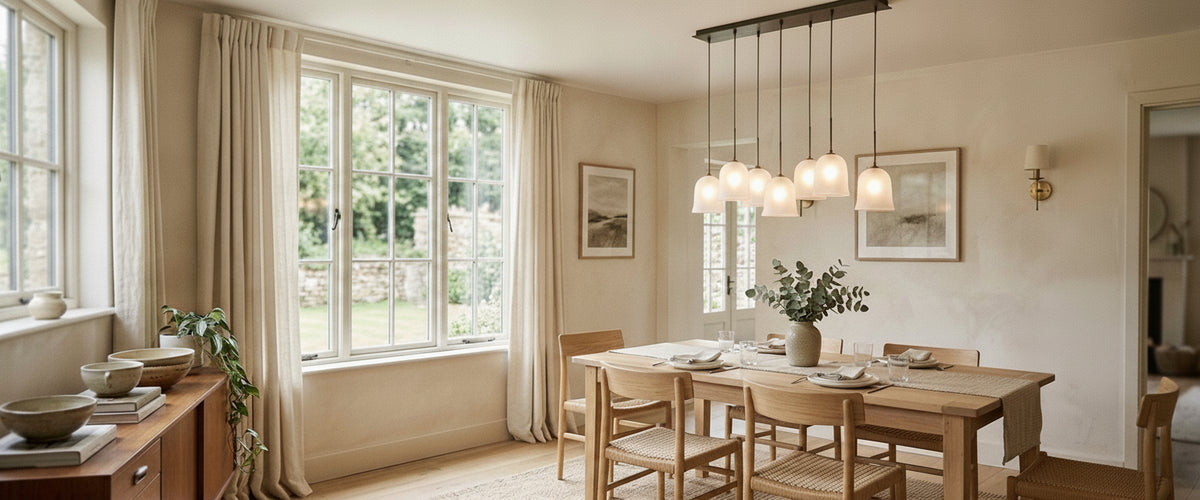

The short answer for any crystal chandeliers dining room: hang the fitting so its lowest crystal sits 30 to 36 in (75 to 90 cm) above the table, size it to roughly half to two-thirds of the table's width, fit clear warm-white bulbs on a dimmer, and keep it away from large mirrors. Get those four things right and a crystal chandelier over the table delivers candlelit warmth and a table that glitters when the plates come out. Hang it 6 inches (15 cm) too low, fit the wrong bulbs, or put it in front of a mirror, and your guests will spend the evening squinting past it. We sell alabaster and natural-stone lighting at Niori, so we spend a lot of time thinking about the opposite effect: light that glows rather than sparkles. That contrast is useful here. Once you understand why crystal behaves the way it does, placement becomes a set of measurable decisions rather than a gamble.
At a Glance
Width: aim for a dining room crystal chandelier roughly half to two-thirds the width of your table, and keep it at least 12 in (30 cm) inside the table edge on each side.
Drop: in a room with a ceiling of about 8 ft (2.4 m), the lowest crystal should sit around 30 to 36 in (75 to 90 cm) above the tabletop.
Bulbs: use clear, warm-white bulbs at around 2200K to 2700K. Frosted lamps kill the sparkle.
Control: in a crystal chandelier dining room, a dimmer is essential. Crystal at full output reads as glare.
Backdrop: matte, mid-toned walls flatter crystal. High-gloss walls and large mirrors multiply every point of light.

Why a Crystal Chandelier Reads as Theater Overhead but as Glare at Eye Level
Crystal works by breaking light up. Each facet bends and splits light from a small, bright source, throwing hundreds of tiny highlights and flecks of color across the room. Above your head, that scatter is what makes a crystal chandelier dining room feel lively. At seated eye level, the same bright points sit directly in your line of sight, and the eye reads them as glare. The Society of Light and Lighting treats uncomfortable brightness contrast as a core design problem for exactly this reason. A bare, bright source against a darker background is tiring to look at, however beautiful the fitting.
Alabaster does the reverse. Its fine, translucent grain spreads light through the whole body of the stone, so there is no hot spot to catch the eye. You can look straight at a glowing alabaster pendant across a dinner table and feel nothing more than warmth. Crystal gives you drama. Alabaster gives you comfort. A well-placed crystal chandelier in a dining room lets you have the drama without paying for it in comfort.

Table Diameter, Drop Height and the Zone Where Refracted Light Lands
Think of a dining room crystal chandelier as a projector aimed at the table. The refracted highlights fall in a rough cone beneath and around it, and you want that cone to land on the linen, glassware and cutlery rather than on faces.
In a crystal chandelier dining room, start with the table, not the room. For a rectangular table of around 35 to 39 in (90 to 100 cm) wide, a chandelier of 20 to 26 in (50 to 65 cm) across usually sits well. Long tables seating eight or more often look better with an elongated fitting or a pair of smaller pieces than with one oversized round chandelier that overhangs the chairs. Keep any crystal at least 12 in (30 cm) inside the table edge so nobody stands up into a prism.
Drop height matters more than most crystal chandelier dining room buyers expect. At 30 to 36 in (75 to 90 cm) above the table, the bulbs sit above seated eye level and the crystals throw their color downward onto the cloth. Hang it higher and the sparkle drifts onto the ceiling and upper walls, which looks lovely from the doorway and does nothing for the meal. Hang it lower and you are looking through the lights at the person opposite.
At 30 to 36 in (75 to 90 cm) above the table, refracted color lands on the cloth and glassware rather than on faces.
One habit from our studio: we judge any crystal chandelier dining room setup over a plain white cloth before we form an opinion. Crystal shows its character immediately. A good cut leaves a soft field of small rainbow flecks around the place settings. A poor one leaves a few harsh white blotches and a dark center.
Strass, Egyptian and Domestic Crystal: How the Cut Changes What Hits the Tablecloth
Not all crystal behaves alike, and the grade you pick shapes the whole crystal chandelier dining room effect. The name tells you something about where and how it was made. The cut and polish tell you how it will light your table.
Strass Crystal
The term goes back to the eighteenth-century jeweler Georg Friedrich Strass, who made brilliant paste stones. Today it is used for premium, precision machine-cut crystal with very sharp facets and a fine polish. The result is crisp, consistent sparkle and clean color separation. It suits a formal crystal chandelier dining room where the fitting is the main event.
Egyptian Crystal
Egyptian crystal is machine-cut and often hand-finished, with good clarity at a more accessible level than the top Strass grades. The facets can be slightly softer, which spreads the light a little more gently. Some buyers prefer it for an everyday dining room crystal chandelier because it sparkles without shouting.
Domestic and Standard Glass Crystal
Standard molded crystal glass has rounder edges and less precise facets. It catches light rather than splitting it, so you get a gentler shimmer and fewer colored flecks. That is not automatically a downside. In a small dining room or an eat-in kitchen, a crystal chandelier with a softer cut can be easier to live with than a showpiece that dominates every meal.
As a rule, higher lead content and sharper cutting mean more color and more brilliance. Decide how much sparkle your crystal chandelier dining room actually wants before you choose the grade, rather than assuming the most brilliant crystal is always the right one.
Color Temperature and Dimming: The Two Levers for an Intimate Dinner
Bulbs decide whether a crystal chandelier dining room feels intimate or interrogated. Crystal needs a point source to sparkle, so choose clear filament-style LED lamps, often in a candle shape on E14 or B15 fittings. Frosted or opal bulbs turn the source into a soft blob, and the crystal goes flat and gray.
Keep color temperature warm. Around 2700K suits most crystal chandeliers in dining rooms. Go down to 2200K if you want a candlelit feel for evening entertaining. Cooler 4000K lamps make crystal look clinical and turn skin tones sallow. Look for a high color rendering index, ideally 90 or above, so food and faces look natural.
Dimming is the second lever, and you should treat it as essential. A dining room crystal chandelier that flatters at 30 percent output can be harsh at full power. Check that your LED lamps are dimmable and that the dimmer suits LED loads; trailing-edge dimmers generally give smoother results with fewer flicker or buzzing problems. Have a qualified electrician fit the dimmer and the chandelier. Ceiling fixings must carry the full weight, and Electrical Safety First is clear that this is not a job to improvise.
Ceiling Height and Backdrop Finish: Why the Same Chandelier Flatters One Room and Fights Another
With higher ceilings, a crystal chandelier dining room can take a taller fitting, but the bottom of the fitting should still sit within the same 30 to 36 in (75 to 90 cm) band above the table. In a room of 10 ft (3 m) or more, the extra height goes into the length of the drop and the body of the fitting, not into raising it out of reach. A tiered or cascading design fills that vertical space well; in a tall room, a stacked ring form such as the Celine LED 6 Tier Ring Chandelier in gold uses the height without lifting the lowest crystal out of that band. In a standard-height room, a flatter, wider fitting keeps the crystal close to the table without crowding the ceiling, which is why a single ring such as the Celine LED Single Ring Crystal Chandelier is closer to the right proportion than a tiered piece. With integrated LED designs like these, confirm the color temperature and dimmer compatibility before you buy, because you cannot swap the lamps later.
Walls matter just as much in a crystal chandelier dining room. Crystal throws light everywhere, so every reflective surface becomes part of the effect. Last year we worked with a client whose Georgian townhouse dining room had antique mirrored panels on two walls. The crystal chandelier she had bought looked magnificent in the showroom and chaotic at home, because each mirror doubled the sparkle into a wall of glints. The fix was to keep the chandelier for occasions, set it low on the dimmer, and add a pair of alabaster wall lights for everyday dinners. The mirrors then reflected a soft glow instead of a hundred hot points.
Matte or eggshell walls in mid to deep tones, such as greens, clays and warm grays, give a crystal chandelier in the dining room a background to sparkle against. Very pale gloss walls bounce the light back and wash out the effect. Dark lacquered walls make the sparkle vivid, but they also exaggerate glare, so dimming becomes even more important.
Matte, mid-toned walls give crystal something to sparkle against, while wall lights let the chandelier run lower.
The Placement Habits That Neutralize an Expensive Fitting
Most crystal chandelier dining room disappointments we hear about come down to placement rather than the chandelier itself.
Centering on the room instead of the table. If the table sits off-center, move the ceiling point or use a swag hook. A chandelier hanging over half the table and half the floor looks like a mistake.
Relying on one light source. A crystal chandelier dining room lit by the fitting alone leaves the room edges dark and pushes everyone to turn it up. Add wall lights or a lamp on the sideboard so the chandelier can run lower.
Mixing bulb types. Different color temperatures or shapes in one fitting make the crystal look patchy.
Forgetting the cleaning routine. Dusty crystal stops sparkling surprisingly quickly. Plan for a gentle clean with cotton gloves and a dry or barely damp lint-free cloth, with the power off and the lamps cool.
Ignoring sightlines from the doorway. Check how the fitting reads from the entrance and from each chair, not just from directly below.
Choosing a Crystal Chandelier for Your Dining Room: Buyer Checklist
Before you commit to a crystal chandelier dining room scheme, run through these decision points:
Measure the table first. Width and length set the size of your dining room crystal chandelier, and the ceiling height sets its drop.
Decide how much sparkle you want. Formal entertaining suits sharper Strass-grade crystal. Everyday family dining often suits a softer cut.
Check the lamp holders. Confirm the bulb cap type and that clear, warm, dimmable LED candles are available for it.
Confirm weight and fixing. Ask for the fitting weight and have your electrician confirm the ceiling can take it.
Plan the supporting light. Choose wall lights or lamps at the same time, so the room works with the chandelier dimmed.
Ask about budget honestly. Cost depends on material, scale, cut quality, engineering, installation and finish. Request a tailored quote rather than guessing.
If, after all that, you find you want the glow more than the glitter, an alabaster or natural-stone pendant may suit your dining room better than a crystal chandelier. It gives a warm, even light that is kind to faces at any drop height, and it pairs well with brass detailing in traditional and contemporary rooms. You can compare forms and finishes across our alabaster lighting collection. Many of our clients settle on a mix for their crystal chandelier dining room: crystal overhead for occasions, stone on the walls for every other night. The wider lighting range makes it easier to plan both layers together.