
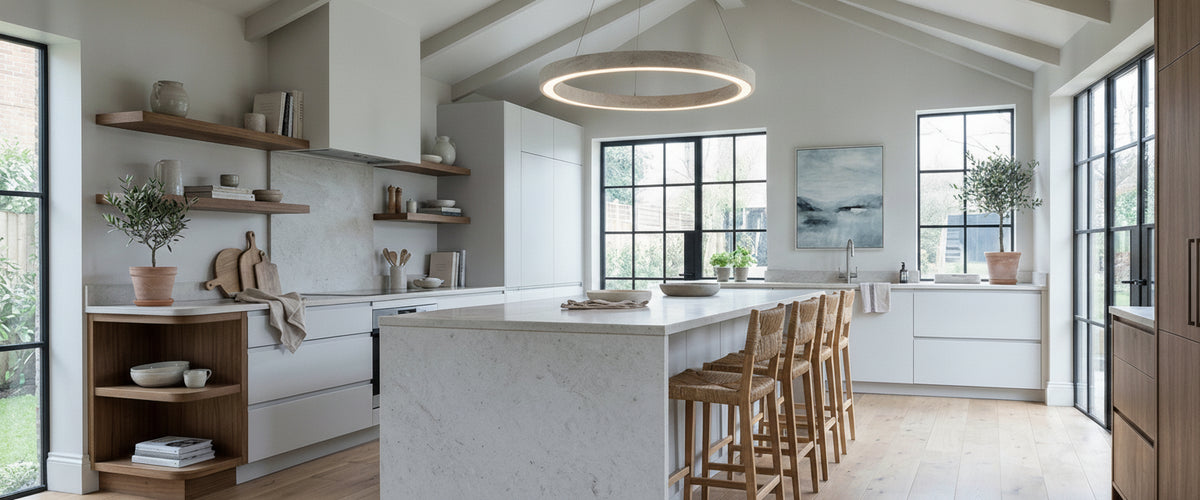

Chrome hides nothing. It picks up the reflection of your tap, the smear of a fingerprint, the exact shape of a hot filament, and it throws all of it back at eye level. That is the honest starting point for anyone shopping for chrome pendant lights: the finish is a mirror first and a decorative choice second, so every decision after that (bulb, glass, height, spacing) has to account for what the metal will reflect.
Handled well, chrome pendant lights are one of the sharpest tools in a lighting scheme. They read crisp rather than cosy, they hold their own against stainless steel and polished stone, and they suit rooms with a bit of architectural discipline. Handled badly, chrome pendant lights glare. The difference is almost always in the specification rather than the design.

Chrome Pendant Lights at a Glance
Best for: kitchens with steel or stone worktops, modernist and mid-century rooms, bars, hotel lobbies, bathrooms with the correct IP rating.
Light quality: cool and directional. Chrome pendant lights reflect rather than diffuse, so the shade or glass does the softening work.
Height over an island: roughly 75 to 90cm (30 to 35in) from worktop to the base of the shade, adjusted for ceiling height and sightlines across the island.
Bulbs: 2700K, CRI 90 or above, opal or frosted rather than clear, and dimmable throughout.
Pairs well with: alabaster and marble, which absorb and scatter light exactly where chrome bounces it.
Watch for: chrome-effect plastic, visible bulbs at seated eye level, and budget chrome pendant lights with thin plating that clouds in a steamy kitchen.

What Chrome Pendant Lights Suit, and Who They Are For
Polished chrome has a slightly blue-grey cast. Put it next to polished nickel and the nickel looks warmer and softer; put it next to antique brass and the chrome looks almost clinical. That coolness is a feature when the rest of the room is cool: quartz or granite worktops, stainless appliances, smoked glass, black-framed glazing, concrete or terrazzo floors. In a room built from oak, lime plaster and wool, chrome pendant lights tend to sit apart from everything else.
Designers reach for chrome pendant lights in three situations more than any other. Over a kitchen island where the fittings need to survive heat, steam and cleaning. In bathrooms and wet rooms, where a properly rated chrome fitting resists corrosion better than an untreated brass one. And in hospitality, where a row of reflective pendants over a bar catches movement and glassware and gives the space energy after dark. Venue owners like the maintenance case too: a chrome shell wipes clean between services.
Who should think twice? Anyone lighting a room that is meant to feel soft. A snug, a bedroom, a dining room used mostly at night at low light levels. Those rooms want a material that glows rather than glints, and chrome pendant lights glint by nature, which is where alabaster earns its keep. Compare a mirrored metal shade against a stone one in our alabaster lighting collection and the difference is immediate: the light appears to come from inside the material rather than off its surface.
Sizing, Height and Placement That Works
Most disappointing chrome pendant light installations are sizing failures, not taste failures. A shade that looked generous in a photograph arrives and reads like a bottle cap under a 2.7m (9ft) ceiling.
Over an Island or Peninsula
Work to the width of the island, not the width of the room. Two or three chrome pendant lights should occupy roughly two thirds of the island length, with even gaps at each end. As a rule of thumb, allow around 60 to 75cm (24 to 30in) between the centres of medium pendants, and more for wide shades so they do not visually merge. On a narrow island or a galley run where three fittings are competing for the same metre of ceiling, a compact shade such as the Arden 1 Light Mini Pendant keeps the spacing legible where a wide reflective bowl would crowd it. Hang so the base of the shade sits above the sightline of anyone standing on the far side; if guests seated at bar stools can see the lamp itself, you have hung too low or chosen the wrong glass.
Over a Dining Table
A single larger pendant or a cluster arrangement usually beats a row of small ones, because the pool of light needs to land on the table rather than scatter across the floor. Where you want that clustered effect from a single fixing point, a multi-arm fitting such as the Sabina 4 Light Pendant spreads light across the table width without four separate drops to align. Keep the base around 70 to 80cm (28 to 32in) above the table top. Raise it if the ceiling is above 3m (10ft), and be ruthless about glare, because chrome pendant lights punish a clear bulb by bouncing it straight into the eyes of the person opposite.
Halls, Stairwells and Bathrooms
Double-height stairwells are where chrome pendant lights perform best, because you see them from several levels and the metal keeps catching daylight. In hallways, a compact chrome pendant works if it clears head height by a comfortable margin. In bathrooms, zone ratings decide everything; a fitting above a bath or within the shower zone needs the correct IP rating and a qualified electrician to sign off the circuit, and Electrical Safety First publishes plain-English guidance on why bathroom zones are treated so strictly.
Materials, Finishes and Light Quality
Not all chrome pendant lights are plated to the same standard. Polished chrome is the mirror finish most people picture. Brushed or satin chrome has a fine directional grain that scatters reflections and hides fingerprints far better, which makes it the sensible choice for a busy family kitchen. Both are usually electroplated over brass or steel; plating thickness and the quality of the base metal determine whether the finish stays bright or develops a milky bloom after a few years of steam and spray cleaners. Chrome-effect plastic is a false economy and always looks it under a raking beam of light.
On chrome pendant lights the glass matters as much as the metal. Clear glass shows off a decorative bulb and creates hard shadows. Opal glass diffuses evenly and is the safest choice above a table. Ribbed or fluted glass breaks the light into vertical strands and softens the reflection of the chrome collar. Smoked glass cuts output noticeably, so plan for extra layers elsewhere in the room. Where a room needs the same crisp glass silhouette but the mirror finish would throw too much back at eye level, a matt-framed fitting like the Hampton 1 Light Glass Pendant in Graphite is closer to the right design language, because the metalwork recedes and the glass does all the work.
Bulbs and Dimming for Chrome Pendant Lights
Specify 2700K for domestic rooms and no cooler than 3000K anywhere you want skin tones to look healthy. Choose a colour rendering index of 90 or above; chrome pendant lights and pale stone both reveal poor colour rendering instantly, turning warm woods flat and gray. Use opal-coated lamps rather than clear ones in any open-bottomed shade. Put the circuit on a trailing-edge LED dimmer matched to the lamps you actually bought, and test the combination before the ceiling is decorated. We have lost count of the projects where a beautiful pendant flickered at low output because the dimmer was chosen by someone who never saw the bulb.
Chrome and Stone: Pairing Shine with Alabaster
The most convincing rooms rarely use one finish alone. Chrome pendant lights give you the highlight; alabaster, marble and onyx give you the glow. Because alabaster is a translucent gypsum stone, light passes through it and is scattered by the crystal structure, producing that honeyed, veined luminosity prized in windows and lamps since antiquity. The British Museum holds Egyptian and Mesopotamian alabaster vessels and carvings that show exactly why the material was chosen for anything meant to be lit from within.
A practical way to combine the two: use chrome pendant lights or polished nickel over the working surfaces, where you want crisp task light and easy cleaning, then put alabaster on the layers you see at rest. An alabaster wall light in the same room, a stone table lamp on the console, a marble-shaded floor lamp beside the sofa. The metal handles precision; the stone handles atmosphere. If you want the pendant itself to bridge both worlds, look for stone shades held in slim polished metalwork, which reads as jewellery rather than hardware. Browsing the wider lighting range by fixture type is the quickest way to see how those pairings sit together.
Common Mistakes and How to Avoid Them
Buying by picture, not by scale. Cut a paper circle to the shade diameter and tape it up. Live with it for a day.
Mixing three or more metals without a hierarchy. Chrome plus brass can work beautifully when one is clearly dominant and the other appears as detail. When both fight for attention, the room looks unresolved.
Ignoring reflections. Stand where people will sit. If you can see a bright lamp reflected in the chrome bowl above, change the bulb or the shade.
Hanging everything at the same height. Staggered heights suit stairwells and vaulted ceilings; a level run suits islands and bars. Choose deliberately.
Forgetting the ceiling rose. On a sloped or beamed ceiling, ask about swivel canopies and adjustable rod suspension before ordering.
Cleaning chrome with abrasives. The plating on chrome pendant lights is thin. One pass with a scouring pad and the damage is permanent.
Installation and Care Checklist
Confirm ceiling construction and fixing points, and check the weight capacity of any existing rose or joist.
Use a qualified electrician for all new circuits, dimmer changes and bathroom installations. Never treat mains wiring as a weekend project.
Check the drop adjustment method: rod suspension gives a fixed, architectural line; cable allows on-site fine tuning.
Dry fit the chrome pendant lights before final tightening so you can judge spacing from the doorway, not from the ladder.
Clean chrome with a soft damp cloth and a drop of mild detergent, then buff dry to avoid water marks. No solvents, no bleach, no abrasive cream.
Treat alabaster and marble differently: dust with a dry soft brush, avoid water and household sprays entirely, and keep stone shades away from steam.
Let LED lamps cool before handling, and keep a spare set from the same batch so colour temperature stays consistent.
How Niori Can Help with Lighting Projects
Niori works in alabaster and natural stone, so the advice we give on chrome pendant lights comes from seeing how metal and stone behave side by side in real rooms. We ship worldwide and regularly work with interior designers, architects and hospitality clients on multi-room schemes: pendants and chandeliers over the tables, wall lights along circulation routes, table and floor lamps to fill in the low-level glow after dark.
One recent kitchen project stuck with us. The client had specified three polished chrome pendants over a long island and could not work out why the room felt harsh in the evening. The fittings were fine. The scheme was not; there was nothing else lit below ceiling height. We added a pair of alabaster wall lights on the return wall and a stone table lamp at the end of the run, and the same chrome pendant lights suddenly read as sparkle rather than glare.
The budget for a lighting scheme depends on material, scale, complexity, engineering, installation and finishing, whether you need one chrome pendant light or twenty, so we price per project rather than publishing a range that would mean nothing without your drawings. Send through plans, ceiling heights and a sense of the mood you want, and we will come back with a tailored recommendation.