
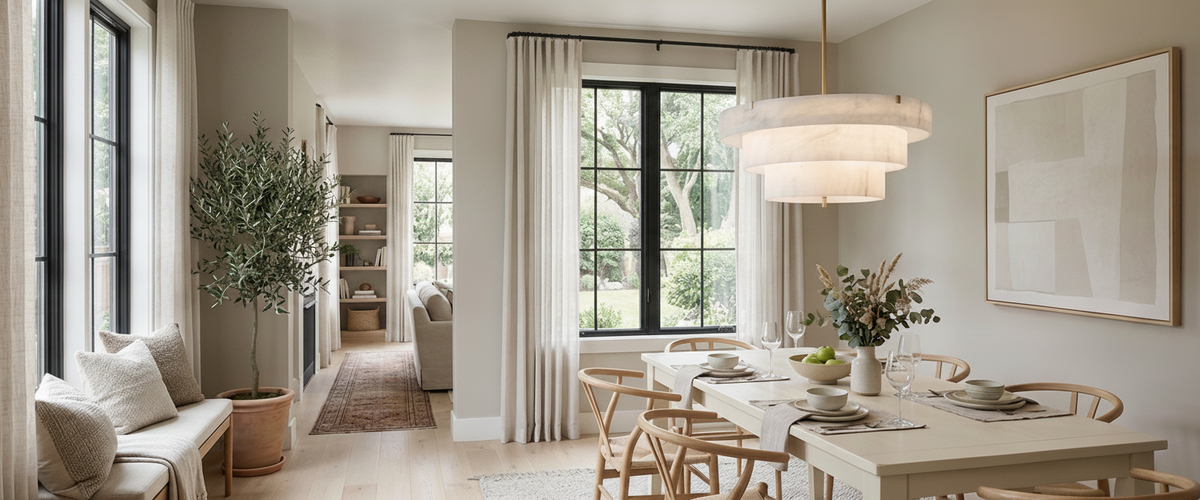

A chandelier that looks lost over a table, or one that grazes the top of a tall guest's head, almost always traces back to two numbers someone skipped. Getting the diameter and drop right is not guesswork, and this chandelier size guide walks through the maths we actually use in the studio before style ever enters the conversation. Alabaster and natural stone add a wrinkle to that maths, because weight and opacity behave differently from glass, and we will get to that too.
Most sizing regret is measurable, which is the good news. Any solid chandelier size guide starts here: nail the room-width sum, respect the ceiling height, and you rarely go far wrong.
The two numbers that decide whether a fixture reads right: diameter and drop.

Key Takeaways for Sizing a Chandelier
Diameter: add the room's length and width in feet, then read the total in inches. A 14 by 16 foot room wants roughly a 30-inch (76 cm) fixture.
Drop over a table: hang the bottom 30 to 36 inches (76 to 91 cm) above the surface, with a taller ceiling nudging you higher.
Foyers and entryways: keep at least 7 feet (2.1 m) of clearance from the floor, more over a stair.
Linear fixtures: size to the table or island, not the room. Aim for one-half to two-thirds of its length.
Stone weight: a solid alabaster piece is heavier than a glass one of the same span, so confirm the fixing and back box early.

The Room-Width Sum That Gets Diameter Into the Right Ballpark
Start with the oldest reliable trick in any chandelier size guide. Measure the room's length and width in feet, add them together, and treat that sum as inches of diameter. A 12 by 12 foot sitting room points you toward a 24-inch (61 cm) fixture. A generous 16 by 20 foot great room lands near 36 inches (91 cm).
That number is a starting point, not a verdict. If the chandelier hangs over a specific piece of furniture rather than floating in open floor, size to the furniture instead, which we cover below. And if two people in the studio disagree by a couple of inches, the larger option almost always wins. Undersized fixtures are the more common mistake, and they read as timid the moment they go up.
Alabaster changes the visual weight of that diameter, which is why a stone chandelier size guide reads differently from a glass one. A carved stone body reads as more substantial than an open brass frame of the same span, so a 28-inch alabaster piece can hold a room that a 28-inch wire cage cannot. For a great room where the diameter needs presence rather than filigree, a substantial fixture such as the Carisbrooke 12 Light Chandelier holds the space in a way a thinner frame of the same span cannot. When you browse our alabaster lighting range, judge presence by the solidity of the stone, not just the listed width.
Foyers and Entryways: The Drop That Clears a Door, a Stair, a Head
A foyer chandelier size guide lives or dies on clearance. The bottom of any entryway fixture should sit at least 7 feet (2.1 m) above the floor so nobody ducks and no door swing catches it. In a single-storey entry, that ceiling is often around 8 feet (2.4 m), which leaves a modest window to work with; choose a compact drop and let the diameter do the talking. For a standard-height entry where you want scale without a long drop, a piece like the Annie 6 Light Chandelier sits in the right proportion, letting the width carry the entry rather than the height.
Double-height foyers are where an entryway chandelier size guide earns its keep. With a two-storey void, you want the fixture to occupy the vertical space without dropping into the sightline from the upper landing. A rough working rule: the chandelier should fill the middle third of the void, so on a 20-foot (6.1 m) ceiling the fixture body sits somewhere in that central band, well clear of the door below.
Over a stair, measure clearance from the step below the light, not the entry floor.
Over a staircase the reference point shifts. Measure clearance from the highest step the fixture hangs above, not the entry floor, so a guest climbing the stairs never meets stone at eye level. We once shipped a tall linear alabaster piece into an entry where the client had measured only from the ground floor; a quick second measurement from the third stair saved a very awkward reinstall.
Linear Fixtures: Why You Size to the Table and Ignore the Room
A linear chandelier size guide throws out the room-width sum entirely. Over a long dining table or a kitchen island, the fixture answers to the surface beneath it, full stop. Aim for a length between one-half and two-thirds of the table or island. A 96-inch (2.4 m) table sits comfortably under a linear fixture of roughly 48 to 60 inches (122 to 152 cm).
Width matters as much as length here, and this is the part of a linear chandelier size guide people skip. The fixture should never overhang the table edge; keep at least 6 inches (15 cm) of table on either side of the light so nobody clips it standing up. Centre the fixture on the table, not the room, because those two centre points rarely line up once you account for a sideboard or a run of cabinetry.
Alabaster linear pieces bring a soft, banded glow across a long surface, which suits dining better than a single bright source. If you are weighing a linear form against a cluster of pendants, our full lighting collection shows how the same table can be lit either way, and the linear route usually reads calmer over stone.
How Ceiling Height Quietly Rewrites Every Measurement You Just Took
Ceiling height is the variable that undoes tidy diameter maths, and no chandelier size guide is complete without it. A common starting rule adds 2.5 to 3 inches of drop for every foot of ceiling height, so a standard 8-foot ceiling suggests a fixture around 20 to 24 inches (51 to 61 cm) tall, while a 10-foot ceiling supports 25 to 30 inches (64 to 76 cm).
Over a table, the drop rule and the ceiling rule work together. Keep the bottom of the chandelier 30 to 36 inches (76 to 91 cm) above the tabletop for an 8-foot ceiling, then add roughly 3 inches of clearance for every extra foot of height. Taller rooms want the light lifted so the glow spreads, not so it hovers.
In open-plan spaces with no table below, the 7-foot floor clearance from the foyer section applies again. The Chartered Institution of Building Services Engineers publishes lighting guidance that reinforces why usable clearance and glare control matter as much as raw brightness in a well-lit room (see CIBSE). Stone diffuses that light kindly, but it still needs to hang where it can do the work.
Stone Versus Glass: Why Weight and Opacity Shift the Spacing
Here is where a natural-stone chandelier size guide diverges from a glass one. Solid alabaster is dense, so a stone fixture usually weighs more than a glass piece of the same span. That changes nothing about the diameter maths, but it changes everything about the fixing. Confirm the ceiling can carry the load and that your electrician is installing to an appropriate back box before you fall for a design. Any hard-wired fixture should be fitted by a qualified electrician, and the guidance from Electrical Safety First is worth a read before the ladder comes out.
Opacity shifts the spacing too, so read this part of the chandelier size guide before you settle on a count. Alabaster and marble are translucent rather than transparent, so light glows through the stone as a soft wash instead of throwing sharp points the way cut glass does. That softer spread means you can often place stone fixtures slightly closer together, or lean on fewer of them, without the room feeling patchy. Onyx, with its stronger veining, reads as more decorative even unlit, so give it room to be seen.
One practical note from the studio: because stone carries its own visual mass, a heavily veined alabaster piece can feel a size larger than the tape measure says. When two options straddle your target diameter, the busier stone is the one to size down slightly.
The Three Sizing Mistakes People Make Before Style Even Enters
Style choices get all the attention, but the errors that ruin a room happen at the measuring stage. These three break a chandelier size guide more than any others.
Sizing to the room when a table is involved. The room-width sum is for open floor. Over a table or island, always size to the furniture, or the fixture floats adrift.
Measuring foyer clearance from the wrong point. Over a stair, measure from the step below the light, not the entry floor. That single oversight forces more reinstalls than any other.
Ignoring the drop that ceiling height demands. A fixture sized for an 8-foot ceiling looks stranded under a 12-foot one. Lift it, or scale the whole piece up.
Get those three right and the rest is preference. For a mixed project, the Niori homepage is a sensible place to start scoping across pendants, chandeliers, wall lights, and table lamps in the same stone family so the whole scheme reads as one hand.
A Quick Sizing Checklist Before You Buy
Add room length and width in feet; read the sum as inches of diameter for open floor.
Over a table, size the fixture to one-half to two-thirds of the table length instead.
Keep the bottom 30 to 36 inches (76 to 91 cm) above any tabletop.
Hold at least 7 feet (2.1 m) of floor clearance in a foyer, measured from a stair step where relevant.
Add 2.5 to 3 inches of drop for every foot of ceiling height.
Confirm weight, fixing, and a qualified electrician before committing to a solid-stone piece.
Sizing is where a chandelier succeeds or fails, long before anyone notices the finish. Treat this chandelier size guide as your first pass, then judge the piece against your own room. If you are unsure whether a particular stone fixture will read correctly at your ceiling height, our team can talk through diameter, drop, and weight against your space, and quote against the specific material and scale you have in mind.