
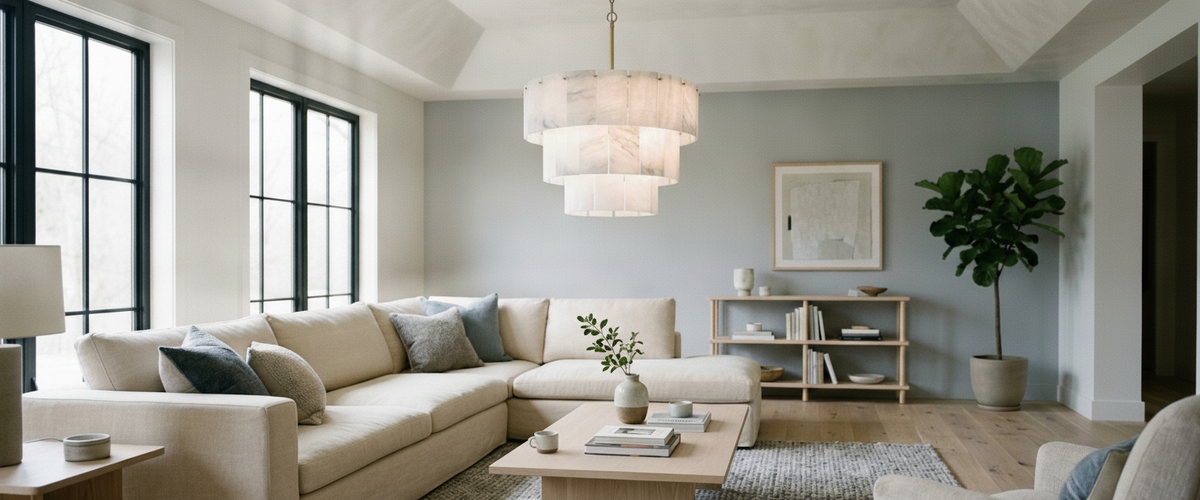

A chandelier in living room settings earns its place when three things line up: its scale suits the space, its height clears the sightlines, and its glow falls softly over the seating rather than glaring down at it. Get those right and the fixture reads as ceiling jewellery, the thing your eye finds first before anyone sits down. Most fail for one quiet reason: they hang there doing a job a downlight could do, adrift in the middle of the ceiling with nothing around them to give them scale. This guide walks through sizing, hanging height, and layered light so a chandelier in living room schemes looks considered instead of marooned.
So a chandelier in living room terms is less about the object and more about proportion, height, and the light it throws down onto the room. That is where an alabaster or natural-stone piece earns its keep, because the material softens the glow instead of firing it straight into your eyes. A stone shade diffuses the light so the source becomes a soft field rather than a hot point.

Key Takeaways
Size it to the room, not the ceiling: add the room's length and width in feet, and that number in inches is a sensible diameter for a chandelier in living room spaces.
Hang height matters more than most people think: the bottom of the fixture usually sits around 7 feet (2.1 m) above the floor over open space.
Never light from the top alone: pair the chandelier in the living room with table and floor lamps so the room has layers.
Alabaster diffuses: stone shades give a warm, flattering downward glow rather than harsh point-source glare.
Put it on a dimmer: a chandelier in living room settings that only has one brightness is one you will get tired of.

Why a Chandelier Reads as Ceiling Jewellery, Not Just a Light Source
A pendant lights a task. A chandelier makes a statement and happens to light a room while it does so. That difference is the whole point. When you choose a chandelier in living room settings, you are buying a focal point that the furniture, the rug, and the sightlines will organise themselves around.
Alabaster changes how that statement lands. The stone is naturally translucent, so light passes through it and picks up the veining rather than bouncing off a hard surface. You get a warm, honeyed glow and a fixture that still looks like a considered object when it is switched off. That daytime presence is something a plain glass or metal fitting rarely manages. You can see the range of stone-led pieces across our alabaster lighting collection, where the material does the heavy lifting.
How the Fixture Shifts the Room's Centre of Gravity
Hang a chandelier in the living room and you have just told the space where its middle is. This is useful and easy to get wrong. In an open-plan area, the fixture should sit over the seating group or the coffee table, not the geometric centre of the ceiling. A fixture stranded dead-centre reads as a corridor with furniture in it; move it to sit over the sofas and the zone finally reads as a room to relax in. In a mid-sized space where a single fixture needs to anchor the seating without overwhelming it, a five-arm piece such as the Abbey 5 Light Chandelier in Silver Sand gives enough presence to hold the centre while keeping the frame quiet.
Sightlines follow the same logic. Sit in the main seat and look across the room. If the chandelier in the living room interrupts the line between you and the window or the fireplace, drop it or shift it. If it floats above every sightline with nothing anchoring it, it will look marooned. The fix is usually a low object below it: a coffee table, a substantial ottoman, a round rug that echoes the fixture's footprint.
The Glow It Casts Downward: Flattering, Harsh, or Barely There
Three things decide whether the light feels good: the shade material, the bulb, and the dimmer.
Exposed bulbs on a bare metal frame throw sharp shadows and make people squint. Alabaster and marble shades do the opposite. The stone scatters the light, so the source becomes a soft field rather than a hot point. That is the single biggest reason a natural-stone chandelier in living room spaces flatters people where bare candelabra bulbs would not.
Position the fixture over the seating, not the geometric centre of the ceiling.
Bulb choice does the rest. Aim for warm white in the region of 2700K for a living room; it keeps skin tones and timber looking rich rather than clinical. Colour rendering matters too. A high CRI bulb, ideally 90 or above, shows the true color of your walls, art, and the stone itself. The Chartered Institution of Building Services Engineers publishes lighting guidance that backs up why colour rendering and controlled brightness matter so much in rooms people actually relax in.
What Size Chandelier for a Living Room
Here is the rule worth memorising. Measure the room's length and width in feet, add them together, and read the total as inches. A room that is 16 by 20 feet (roughly 4.9 by 6.1 m) gives you 36, so a chandelier in living room proportions of around 36 inches (about 90 cm) in diameter will hold the space without shouting.
That is a starting point, not a law. Adjust for these:
Ceiling height: tall or double-height ceilings can carry a larger, deeper fixture.
Furniture scale: a big sectional and an oversized coffee table can take a wider chandelier in the living room than the maths suggests.
Whether it sits over a table: if it hangs over a specific piece of furniture, size it to that piece, not the whole room. Keep it a few inches narrower than the table beneath it.
Where a generous, high-ceilinged room needs a fixture with genuine reach rather than a fitting that reads as a placeholder, a larger multi-arm design such as the Marvele 8 Light Chandelier in Aged Brass carries the volume that the smaller-room maths would underestimate.
Can you put a chandelier in the living room at all? Yes, and it is one of the best rooms for one, precisely because you spend evenings there and want the light to feel considered. The old idea that these fittings belong only in dining rooms and entrance halls is long gone.
How High Should a Chandelier Hang in a Living Room
Over open floor where people walk, the bottom of the fixture should clear head height comfortably. Around 7 feet (2.1 m) from the floor to the lowest point is the standard for an 8-foot (2.4 m) ceiling. For every extra foot of ceiling, you can lower a chandelier in the living room by roughly 3 inches, so a taller room lets it drop and command more presence.
Over a coffee table or an ottoman that no one stands on, you have more freedom. There you can hang lower to draw the eye down and make the seating area feel intimate. The mistake is hanging every fixture high because you are nervous about clearance; a living room chandelier stranded near the ceiling loses all its drama and starts to look like an oversized flush light.
If in doubt, cut a cardboard disc the diameter of the fixture, tape it to a broom, and hold it at different heights while someone stands back. It looks daft. It also saves you from a hang height you will resent every evening.
Pairing the Chandelier With Lamps So the Room Isn't All Top-Light
A living room lit only from overhead feels like a waiting area. The chandelier in the living room sets the mood; it should not do the whole job. Layer in table lamps on side tables and a floor lamp reading over the main chair, all on their own switches. When the overhead light drops to 20 or 30 percent on the dimmer and the lamps carry the room, you get the low, pooled light that makes an evening feel calm.
Alabaster table lamps sit beautifully alongside a stone chandelier in living room schemes because the materials speak to each other; the glow at eye level echoes the glow overhead. If you want to build a coherent scheme rather than a set of unrelated fittings, it helps to browse a single natural stone lighting range and pick pieces that share a finish, whether that is aged brass, bronze, or a pale silver-sand stone.
Common Mistakes That Leave a Chandelier Looking Marooned
Centring it on the ceiling instead of the seating. Furniture defines where a chandelier in living room settings belongs.
Going too small. An undersized fixture in a generous room looks like a placeholder. When you hesitate between two sizes, the larger one is usually right.
Hanging it too high. Clearance is real, but strand a chandelier in the living room near the ceiling and it disappears.
No dimmer. A single brightness kills the flexibility that makes the piece worth owning.
No lamps below. Without lower light sources, the fixture floats with nothing to hold it in the composition.
Cold bulbs. A crisp 4000K bulb turns warm alabaster gray and drains the room.
Care and Installation Notes for Stone Fixtures
A stone chandelier in the living room carries real weight, so it must be fixed to a suitable ceiling point by a qualified electrician, ideally into a joist or a properly rated brace. This is not a job to improvise from a ladder. For the electrical side, follow current safety guidance rather than guesswork; bodies such as Electrical Safety First set out why competent installation matters for heavier fittings.
Alabaster is a soft, porous stone, so treat it gently. Dust with a dry, soft brush or a clean microfibre cloth. Skip water, sprays, and any household cleaner; moisture and acids can mark the surface over time. Let the bulbs cool before you handle any shade, and check the fixings occasionally, since a heavy fixture works loose faster than a light one.
Budget for a stone chandelier in living room spaces depends on the material, its scale, the number of lights, the metalwork, and the installation involved, so the honest answer is to request a tailored quote rather than assume a figure. What you are paying for is a chandelier in living room settings that sets the whole space and keeps doing it for years.