
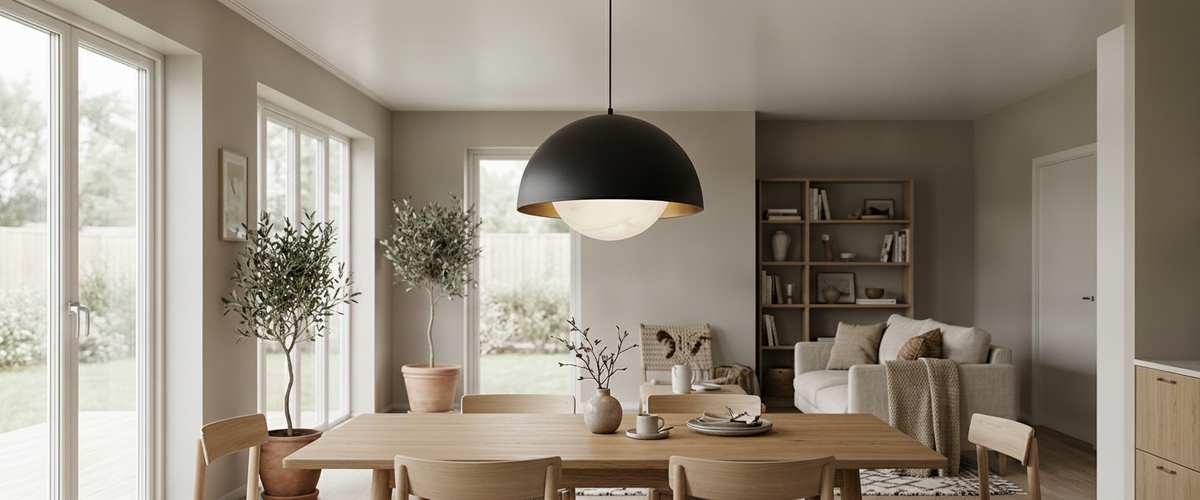

A black pendant is the fastest way to give a ceiling some backbone. It reads as a deliberate line in the room, it flatters brass and oak and pale plaster, and it stays looking clean where polished chrome collects fingerprints within a week. The catch is simple physics: black pendant lights absorb light rather than bounce it, so a fixture that looks sharp in a showroom can leave a kitchen island feeling like a stage with one spotlight and no fill. Choose the shape, the interior finish and the bulb properly and none of that happens.

Quick Answer: What to Get Right First
- Interior finish matters more than the exterior. A white, ivory, brass or alabaster-lined shade throws usable light. A black lining gives you a tight pool and little else.
- Hang height: roughly 75 to 90cm (30 to 36in) above a worktop or island, 70 to 85cm (28 to 34in) above a dining tabletop.
- Scale: combined shade width around one third of the table or island length, never more than half.
- Bulbs: 2700K, CRI 90 or higher, fully dimmable, matched to a trailing-edge dimmer.
- Balance: pair black pendant lights with a second, softer source. Alabaster wall lights or a stone table lamp stop the black reading as a hole in the ceiling.
- Finish choice: matt black hides fingerprints and softens reflections; gloss and bronze-black catch highlights and suit period rooms.

What Black Pendant Lights Suit, and Who They Are For
Black works hardest where a room needs an outline. Pale kitchens with handleless cabinetry, plaster-pink walls, limewashed dining rooms, warehouse conversions with steel windows: all of them benefit from a dark fixed point at eye level. Black pendant lights also survive busy backgrounds. Against veined marble and open shelving, a dark shade sits quietly on top of the visual noise instead of competing with it.
Where black struggles is in rooms that are already dark or low. A north-facing snug with 2.3m (7ft 6in) ceilings and deep green walls does not want three black shades absorbing what little daylight there is. In those spaces we steer clients toward a translucent stone pendant, or a hybrid: black metalwork with an alabaster or opal diffuser, so the fixture keeps its graphic outline while the shade itself glows.
Sizing, Height and Placement That Works
Over an Island or Dining Table
Two large black pendant lights usually beat three small ones over an island under about 2.4m (8ft) long. For a longer run, three works, spaced 60 to 75cm (24 to 30in) apart centre to centre, with the outer shades set in from the island ends by at least 25cm (10in). Centre the run on the island itself, not on the ceiling, and check it against your extractor and downlight grid before the electrician chases anything.
Height is where most people flinch. They hang too high, worried about head clearance, and the light spills sideways into the eyes of anyone standing opposite. Keep the bottom of the shade 75 to 90cm (30 to 36in) above the worktop and the beam stays where you want it. Over a table you can go slightly lower, because nobody stands under it, and a faceted glass shade such as Windsor 1 Light Pendant Light in black with clear faceted glass throws light far more forgivingly than a solid opaque one.
Hallways, Stairwells and Bedsides
In circulation space the rule is clearance: the bottom of the shade should sit at least 2.1m (7ft) above the floor. Stairwells are the exception and the opportunity, and black pendant lights earn their keep there. A single long drop, or a cluster stepped at different heights, gives a tall void a sense of scale no ceiling light can match. Where the void is narrow, a slim vertical form like the DUOline Tube Pendant in matt black keeps the drop reading as a line rather than an obstruction.
Beside a bed, swapping lamps for a pair of small pendants frees the whole nightstand. Drop them so the shade bottom sits 50 to 60cm (20 to 24in) above the table top, on their own dimmer circuit. If the shade is fully opaque, angle matters: you want the light on the book, not on the wall behind your partner's head.
Materials, Finishes and Light Quality
Not all black is the same black. Most of the black pendant lights we ship are powder-coated matt: even, low sheen, forgiving with fingerprints, and it photographs well. Textured or hammered finishes add grain and suit older buildings. Blackened or patinated brass has warmth and slight variation across the surface, which reads as expensive up close. Gloss behaves almost like a mirror, picking up every highlight in the room, which is either the point or a problem.
The inside of the shade is the part buyers forget. A brass or gold lining warms the downward light and gives a glint when you glance up, which is the logic behind the DUOline Dome Pendant in black and gold. A white interior is the most efficient and neutral. A black interior looks purist and cuts usable output significantly, so choose it only where the fixture is decorative. Clear or smoked glass with an exposed bulb gives sparkle rather than task light, so keep it above tables rather than chopping boards.
Where Alabaster Changes the Equation
Alabaster is the natural counterweight to black. Because it is a translucent gypsum stone, light passes through and softens as it goes, so the shade glows across its whole surface. Set a black frame with an alabaster diffuser over a dining table and you get the graphic outline and the warm wash at once. That is why so many schemes we quote pair dark metalwork above the island with alabaster lighting in the adjoining sitting area.
Denser marble reads as solid and gives form rather than glow, which suits a base or canopy. Onyx carries dramatic banding and comes alive when backlit, though every piece is unique, so buy the one you have seen. Alabaster is the softest diffuser of the three and the most water-sensitive, worth knowing before hanging it above a hob. Conservation guidance from bodies such as the National Trust is consistent: dry dusting with a soft brush, no damp cloths, no household sprays.
Bulbs and Dimming for Black Pendant Lights
Specify the lamp at the same time as the fixture, not afterwards. For black pendant lights, 2700K warm white is the default; go to 2400K if the room is heavily oak-lined and you want candlelight. Colour rendering should be CRI 90 or better, otherwise food, skin tones and stone veining go flat.
Output depends on the shade. An opaque black shade with a white lining needs a brighter lamp than a translucent stone one to reach the same working light, because you lose everything that would otherwise bounce off the exterior. Where a pendant is purely decorative, keep lumens low and let downlights or under-cabinet strips carry the task load.
Dimming is where installations go wrong. LED lamps generally want a trailing-edge dimmer, and its minimum load has to be met, which is easy to miss with two low-wattage fittings on a circuit. Buy dimmable lamps from one batch and brand so they track together. Any new circuit, chased cable or added dimmer is work for a qualified electrician; notifiable domestic work sits under Part P, and registered installers are listed by bodies such as NICEIC.
Common Mistakes and How to Avoid Them
- Buying black pendant lights as the only dark element. One dark fixture in an otherwise pale scheme looks accidental. Repeat the tone somewhere else: a window frame, a tap, a floor lamp base.
- Undersizing. The most common error we see. A shade that looks generous in a photograph often measures 25cm (10in) across. Mock the diameter up in card and tape it to the ceiling first.
- Ignoring the canopy. Sloped or beamed ceilings need an adjustable canopy or a hook and swag. Check before ordering, not on installation day.
- Forgetting the view from below. Seated guests see the inside of the shade and the bulb. If the lamp is visible, use a decorative filament or frosted lamp at modest wattage.
- Mixing five metal finishes. Black plus one warm metal is a scheme. Black plus chrome plus brass plus nickel is a shopping list.
- Cleaning with the wrong thing. A dry microfibre cloth, occasionally barely damp with plain water, is enough. Never use solvents on painted finishes or any water on alabaster.
A Practical Buying Checklist
- Measure the surface below and set total shade width at about a third of its length.
- Confirm ceiling height, then set drop length so the shade lands at your target height.
- Decide whether the fitting is task light or decoration, and specify the interior finish accordingly.
- Check the fixing: flat ceiling, sloped, joist position, adjustable canopy.
- Choose the lamp: cap type, 2700K, CRI 90+, dimmable, with a matched dimmer.
- Decide your second layer so the black is never working alone.
- Book a qualified electrician for new circuits or dimmer changes, and ask for finish samples if you are matching black across joinery and ironmongery.
How Niori Can Help with Lighting Projects
Niori is an alabaster and natural-stone lighting brand, and that background shapes how we talk about dark fixtures. We spend our days watching how light behaves inside stone, so we are quick to spot a scheme with plenty of contrast and no warmth. On a recent barn conversion the client had specified black pendant lights along a 3m island and nothing else; a pair of alabaster wall lights on the return wall changed the whole feel at night, and the pendants suddenly looked intentional rather than severe.
If you are working through a full scheme, treat pendants, chandeliers, wall lights, table lamps and floor lamps as one family rather than separate purchases. Browsing the wider lighting collection is a quick way to test whether dark metalwork, brass detailing and stone diffusers hang together across a floor plan. For trade, hospitality and multi-room projects, ask us for a tailored quote; cost depends on material, scale, complexity, engineering, installation and finishing.
Black pendant lights deserve their popularity. They give a ceiling a purpose, they age well, and they let quieter materials do the glowing. Get the height, the interior finish and the second layer right, and they will keep looking sharp long after the trend that introduced them has moved on.