
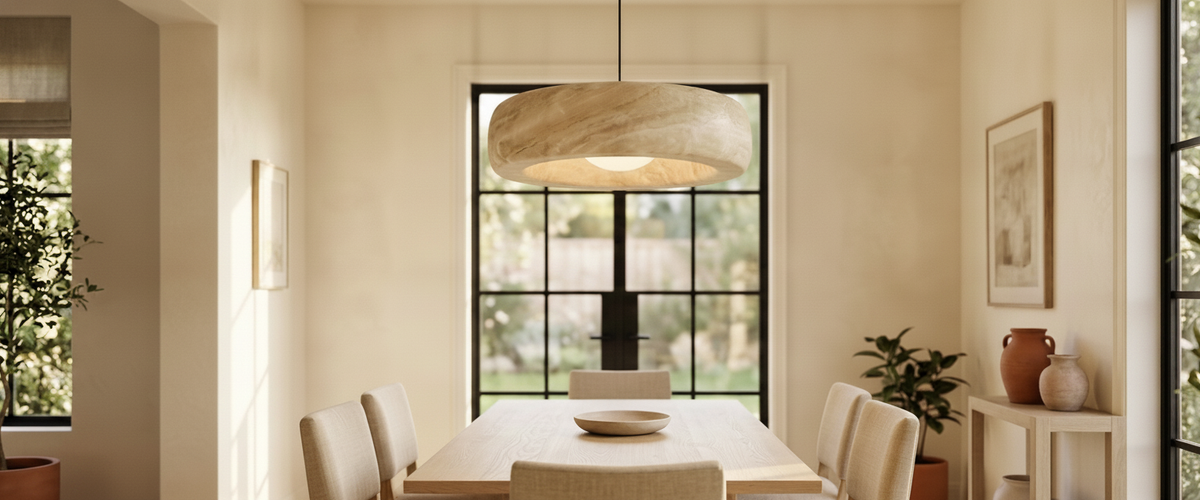

The best type pendant is rarely the one that photographs best on a white background; it is the one whose material controls light the way your room actually needs, whether that means a soft wash over a dining table or a directed pool over a kitchen island. Two pendants can look almost identical in a photograph and behave like completely different fixtures once they are switched on, and that is the trap buyers fall into.
We make and ship alabaster and natural-stone lighting, so we spend a lot of time explaining why the same bulb reads warm and glowing through one shade and harsh through another. The material is the fixture. Everything else is fitting, which is why the best pendant type for you starts with the shade, not the socket.

Key Takeaways
Stone diffuses, metal directs, glass sits in between. Pick the behaviour first, the look second when you weigh up the best type pendant.
Alabaster glows from within because it is translucent; veining and thickness decide how evenly.
Living-room pendant sizing: add the room's length and width in feet, and that number in inches is a sensible fixture diameter guide.
Hang a living-room pendant so the base sits roughly 7 feet (2.1 m) above the floor in a walkway, lower over a table.
Price follows craft: stone selection, hand-carving, and finishing move the number far more than the metal colour.

Stone, Glass or Metal: How Each Pendant Type Handles the Light Inside It
Start with what the shade does to the bulb. A metal pendant is opaque, so all the light exits the open ends. That gives you a bright, focused downward beam and near-total darkness on the shade itself. It is a working light, ideal over a kitchen island or a desk where you want the task lit and little spill. A compact opaque fixture such as the Arden 1 Light Mini Pendant Light, Matt Black shows this behaviour clearly, throwing its light down and leaving the shade dark. If task light is the brief, this is the best type pendant for the job.
Stone diffuses, metal directs, and glass sits in between.
Glass is partly transparent. Clear glass lets the bulb read directly, which looks lovely but can glare; opal and frosted glass scatter the light and calm it down. The tone stays fairly neutral and cool unless you correct it with the bulb, so a glass pendant type suits rooms where you want brightness without heavy warmth.
Alabaster is the outlier. It is translucent rather than transparent, so light travels a short way into the stone and then radiates back out through the surface. The whole shade becomes the light source, and the stone warms the colour as it passes through. That is why an alabaster pendant glows softly across the entire piece instead of throwing a hard cone. If you want ambient, flattering light that fills a room rather than spotlights one spot, stone is the best type pendant to reach for. You can see the range of forms this makes possible across our alabaster lighting collection.
Why Veining and Translucency Decide Whether a Stone Pendant Glows
Not all stone glows equally, and this is where a specialist earns their keep. Alabaster is a form of gypsum, prized for centuries precisely because it passes light; medieval window panels were cut from it before glass was common, a use the Metropolitan Museum of Art documents in its collections. That translucency is the feature you are buying, and it is what makes stone the best pendant type for a soft, whole-surface glow.
Three things govern how a stone shade reads when lit:
Thickness. Thin sections glow readily; thick carved bases stay solid and shadowed. Good makers vary wall thickness on purpose to control where the piece lights up.
Veining. The mineral veins that make alabaster and onyx beautiful also block and channel light. Dense veining creates dramatic contrast; finer, more even stone glows smoothly. Neither is wrong, but you should choose deliberately.
Stone selection. Two blocks from the same quarry can behave differently. On a lit fixture, a cheap offcut looks muddy and a well-chosen slab looks alive.
Judge a stone shade lit, not just held to a window.
One lesson from the studio: a client once approved a stone sample held up to a window in daylight, then queried the fitted pendant because the veining looked bolder lit from behind. Daylight passes through stone differently from a warm LED inside it. Always judge a stone shade lit, not just held to a window.
Craft Decisions Behind a Good Pendant That Quietly Move the Price
Buyers often ask why two stone pendants of similar size are priced worlds apart. The metal colour and the bulb are the cheap part. The cost sits in decisions you cannot see in a thumbnail, and those decisions are what separate the best type pendant from a lookalike.
Hand-carving versus machine-turning. A block turned quickly on a lathe is uniform and fast. Hand-shaping to follow the veining or to thin specific zones for glow takes skilled hours.
Stone yield. Selecting and matching blocks means rejecting a lot of material. That waste is real cost, and it is why the finest stone pendants are never the cheapest.
Metalwork and finishing. Solid brass fittings, hand-applied finishes and properly weighted canopies feel different from plated pressings. They also age better.
Electrical build. Quality wiring, correct heat management around the bulb, and dimmable-ready drivers protect both the stone and the light quality.
Because so much depends on material and complexity, we do not publish a single flat price for stone lighting. Scale, carving, the stone chosen, the metalwork and installation all shift the figure, so the honest answer is to request a tailored quote for the piece you have in mind rather than trust a headline number.
Matching the Pendant Type to the Room It Will Actually Hang In
The best type pendant changes room by room. Work backwards from what the space needs to do.
Living room
Living rooms want atmosphere over task light. A single alabaster pendant, or a pair over a coffee table, gives a warm ambient glow that a metal down-light cannot. Because stone lights its whole surface, it reads well from the sofa without glare in your eyes, which makes it the best pendant type for a relaxed room.
Kitchen and island
Here you often want directed light on the worktop. Metal or opal-glass pendants earn their place over an island; you can pair them with softer stone or alabaster fixtures elsewhere in an open-plan space so the room does not feel clinical. Where a run of island lights needs to feel considered rather than scattered, a multi-light fixture such as the Cassius 8 Light Pendant Light, Champagne Bronze keeps the spacing coherent while still directing light onto the worktop. For focused task light, this is the best type pendant over a busy island.
Dining table
A dining pendant should flatter faces and food. Alabaster excels because the diffused, warm light is kind to skin tones and never spotlights the tablecloth, so a stone pendant type is the one to hang here. Hang it low, since nobody walks under a dining table.
Hallway and stairwell
Sightlines matter more than task light. A sculptural stone pendant reads as an object by day and a soft lantern by night. For a covered porch or an exterior sightline that still wants some warmth, a rattan-and-black fixture such as the Arlen 1 Light Large Outdoor Pendant Light, Black & Rattan carries the same lantern language outdoors. Browse forms across the full lighting range to see what suits a double-height void versus a low hall.
Sizing and Hanging a Living-Room Pendant
Two questions come up more than any other, so here are working rules rather than vague guidance.
How big should the fixture be? Add the room's length and width in feet. A 14 ft by 16 ft (4.3 m by 4.9 m) living room gives 30, so a pendant around 30 inches (76 cm) in diameter suits the space. Go smaller for a cluster of two or three, larger for a single statement piece over a big room.
How low should it hang? Over open floor and walkways, keep the base of the fixture at roughly 7 feet (2.1 m) so people pass beneath it comfortably. Over a coffee table or console where nobody walks, you can drop it lower for intimacy. Over a dining table, aim for about 30 to 36 inches (76 to 91 cm) above the tabletop. In rooms with high ceilings, raise the piece and lengthen the drop rather than leaving it stranded near the ceiling; guidance from the Chartered Institution of Building Services Engineers is a useful reference on lighting levels if you are planning a whole scheme.
From Workshop to Install: The Process That Separates Good From Cheap
A well-made stone pendant is a sequence of careful steps. Blocks are selected and inspected lit, not just dry. Shaping follows the veining. Walls are thinned where glow is wanted. The metalwork is fitted, wired to standard, and tested with the intended bulb before anything ships. Cheap production skips the lit inspection and the hand-thinning, which is exactly why the finished light looks flat instead of like the best type pendant you were promised.
On installation, treat stone with respect. It is heavier than glass or metal of the same size, so mounting points and fixings must suit the weight. Any hard-wiring should be done by a qualified electrician; the guidance from Electrical Safety First is clear that fixed wiring is not a DIY job.
Red Flags to Raise With Any Maker Before You Commit
They will not show the stone lit. If a seller only has daylight photos, ask for a lit image of the exact piece or stone type. Glow is the whole point.
No mention of dimming. Stone rewards a warm, dimmable LED. If the fixture is not dimmable-ready, the light will be one flat setting forever.
Vague on weight and fixings. A maker who cannot tell you how the piece mounts has not thought about your ceiling.
A flat price for anything. Genuine stone lighting varies with material and carving. A one-size price often means machine-turned stone and thin metal.
No care guidance. Alabaster is porous and dislikes water and harsh cleaners. A specialist will tell you to dust gently and avoid soaking it.
Choose the material behaviour first, size to the room second, and hang it at the right height, and the light will look right for years rather than photogenic for a week. That is the difference between buying any fitting and buying the best type pendant for the room you actually live in.