

The socket is never where you want it. You picture a soft pool of light on the far end of a mantel, or a hall table sitting proud in the middle of a room, then reality arrives: the nearest outlet is three feet (about a meter) away and the cord has to loop across something you would rather not look at. That gap between where you want light and where the electrics allow it is exactly what a good battery table lamp is built to close.
Cordless lamps have grown up. The early ones were dim, plasticky, and ran flat by the end of dinner. The current generation, especially pieces built around real materials, holds its own as considered lighting rather than a novelty. Below is how to judge whether a battery table lamp suits your room, and where a wired fixture still deserves the win.
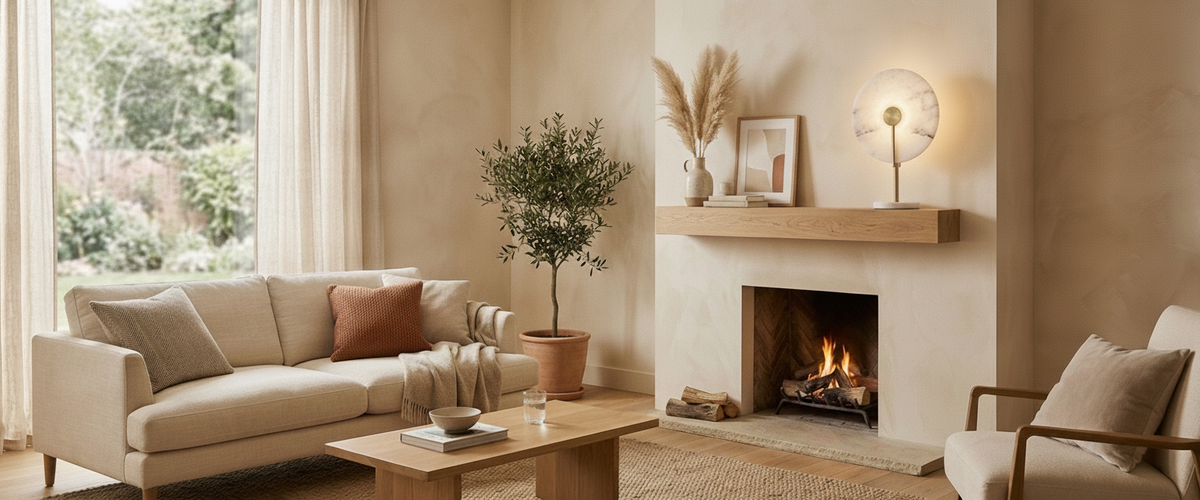
A battery table lamp in alabaster lights a mantel with no visible cable.

Key Takeaways for Battery Table Lamp Buyers
Best for: shelves, mantels, hall tables, and any surface far from a socket.
Watch: run time and brightness trade off against each other; more lumens means shorter hours.
Stone bases: weight is a feature, not a fault, but it changes how you charge and move a battery table lamp.
Warm light matters: aim for roughly 2700K for a lived-in glow, dimmable if the model allows.
Stay wired for a lamp you switch on every single evening and rely on for reading.

What Going Cordless Actually Frees Up
The obvious win is no trailing cord. No gaffer tape along a skirting board, no cable snaking across a console, no socket hunt behind furniture that never quite reaches. The less obvious win is placement freedom. A battery table lamp tends to end up somewhere a wired one simply cannot go: the center of a dining table, a windowsill with no outlet, a bathroom shelf, the middle of a long kitchen island.
That freedom is the whole point. It lets you light a spot for the way you actually live in a room rather than the way the electrician wired it a decade ago. In our studio we had a client in a period flat where every reception-room socket sat below dado height; a pair of battery table lamps let her light the mantelpiece and a bookcase alcove without a single visible cable. That is the case cordless makes best.
Shelves, Mantels and Hall Tables: Where a Battery Table Lamp Earns Its Place
Some surfaces were made for cordless light. A mantel is the classic one. You want a warm glow bracketing a fireplace, but running power up to a chimney breast is fiddly and rarely tidy. A short battery table lamp at each end solves it cleanly.
Hall tables are the next obvious home. Halls often have one awkward socket by the door and nothing where the console actually sits. A battery table lamp gives you a welcoming pool of light the moment you walk in, without an extension lead. A narrow surface with drawers, such as the Actenna 2 Drawer Narrow Console Table, is exactly the kind of placement where cordless light matters most, since a hall console rarely sits near a usable outlet. Open shelving works the same way: a small rechargeable lamp tucked between books or ceramics reads as intentional styling, not a lighting compromise.
Bathrooms and dressing areas deserve a mention too. A battery table lamp lets you add soft, flattering light near a mirror without touching the electrics, which in a UK bathroom means staying well clear of the zoned wiring rules a qualified electrician has to follow. Off a stone shelf, that light reads as calm rather than clinical.
On a hall console far from any socket, a battery table lamp does the work of a wired one.
Run Time, Charging and the Brightness Trade-Off
Here is the thing buyers underestimate most. Brightness and run time pull against each other. A battery only holds so much energy, so a lamp running bright will run flat faster than the same lamp dimmed low. Many cordless designs give you eight to twenty-odd hours depending on the setting, which is plenty for evening ambience but not for a lamp blazing at full output all day.
Treat a battery table lamp as mood lighting rather than a workhorse. It shines as a second or third light layer in a room: a low warm accent that softens the corners while an overhead or a wired lamp does the heavy lifting. Charging is usually USB-C now, and the sensible rhythm is to top it up on a schedule, say one evening a week, rather than waiting for it to die mid-dinner. If a model offers a lower-brightness eco mode, that setting is where these lamps feel most at home.
Can a Stone Base Go Cordless? The Weight Question Answered
People assume a heavy stone or alabaster base and a battery table lamp are a bad match. The opposite is often true. A low center of gravity means the lamp sits planted on a shelf and will not tip if a cat brushes past. Weight is a stability feature here, not a flaw.
What weight does change is handling. A dense alabaster or marble base is not something you unplug and carry to the kitchen to charge every night, so look for a battery table lamp that charges in place, ideally with the port sensibly positioned. Alabaster brings a second reward: it is genuinely translucent, so light passes through the stone itself and glows from within rather than only spilling from the shade. That warm, diffused quality is what draws people to natural-stone lighting in the first place. If you want to see how that glow reads across different forms, the alabaster lighting collection is the clearest place to start.
One practical note. Alabaster is a softer stone than marble and dislikes standing water, so a cordless version near a basin should be wiped, not left damp. The Victoria and Albert Museum's guidance on caring for sculpture is a useful primer on how gently soft stone should be handled and cleaned.
Warm Bulbs, Animal Shapes, and Dimming Within a Battery's Limits
Color temperature makes or breaks a battery table lamp. Aim for a warm white around 2700K. Cooler light looks fine in a photo and cold in a real room at night. Most quality rechargeable lamps use an integrated LED tuned to a warm output, and the better ones let you step the brightness down, which also stretches run time.
Novelty shapes are having a moment, and searches for a cat table lamp UK or animal table lamps UK have climbed. There is nothing wrong with character; a cordless animal lamp on a child's shelf or a playful cat form on a hall table can be charming. Just judge a battery table lamp on the same terms as any lamp: warm bulb, decent diffusion, and a base heavy enough to stay put. A translucent stone or frosted-glass body will always flatter a room more than a bright plastic one, whatever the silhouette. And if you are browsing the wider Amazon UK table lamps sort of listings, that same test, warm light, real material, stable base, is the fastest way to separate the keepers from the throwaways.
Where a Wired Lamp Still Wins
A battery table lamp is not the answer for every surface. A lamp you switch on every single evening, and lean on for reading or work, is better wired. Mains power gives you unlimited run time, steady brightness, and full control from an in-line dimmer, none of which a battery can match over a long night.
Reading corners, bedside tables you use for an hour before sleep, and a main sitting-room lamp all belong on the wall socket. Here the tables for lamps UK conversation matters too: match a substantial wired lamp to a table solid enough to carry it, and route the cord down the back leg so it disappears. A grounded piece like the Amalfi Wooden Side Table gives a nightly reading lamp the visual weight and stability it needs, and its solid form hides a trailing flex better than a glass or open-frame table. For these anchor pieces, browse the full lighting collection and think about the light you rely on nightly rather than the light you switch on for effect.
The smart approach in most UK homes is a mix. Wired lamps do the dependable work; a couple of battery table lamps fill the spots the electrics forgot. Get that balance right and a room lights in layers instead of one flat glare from the ceiling.
Quick Buyer Checklist
Decide the job first: accent glow (a battery table lamp) or nightly reading (wired).
Check stated run time at the brightness you will actually use, not the maximum.
Confirm the charging port position works for a heavy base that stays in place.
Choose roughly 2700K warm white, dimmable if offered.
Favor a translucent alabaster, marble, onyx, or frosted-glass body for softer light.
Make sure the base weight suits the shelf and will not tip.
For a wired anchor lamp, plan cord routing and pick a table that carries the weight.