
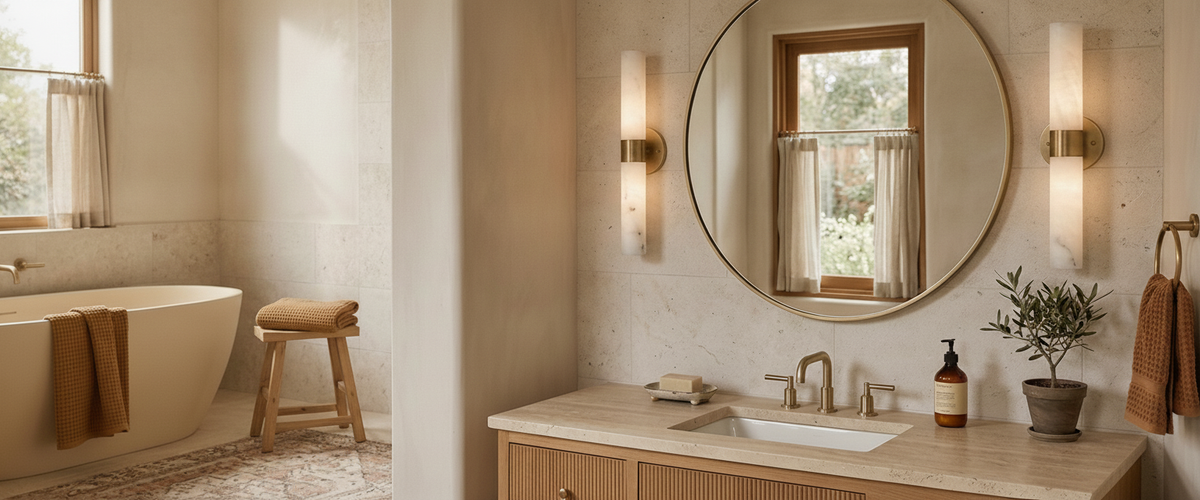

Stand at your bathroom mirror on a grey morning and you can usually tell within a second whether the lighting was thought through. A single fixture stuck high above the glass throws light down onto your brow and nose, then leaves the eye sockets, jaw and neck in shadow. The sink glows. Your face sulks. Getting a bathroom wall sconce right is mostly about height and position, and once you understand why, the rest of the decisions fall into place.
We spend a lot of time at Niori, an alabaster and natural-stone lighting studio, talking clients out of the ceiling-only approach for washrooms. Stone diffusers give a soft, low-glare wash that suits close-up tasks like shaving and applying make-up far better than a hard downlight ever will. Here is how to place your bathroom wall lights so the glow works for the face, not the basin.
A flanking pair set at eye level lights both sides of the face evenly.

Key Takeaways
Mount your bathroom wall sconce at eye level, roughly 60 to 66 inches (150 to 168 cm) from the floor, flanking the mirror rather than above it.
Flanking pairs cancel under-eye shadow; a single unit above the mirror rarely does.
Tile colour and finish change how much light bounces back, so a dark wall needs more output.
Frosted, clear and stone diffusers each soften the light differently; stone gives the gentlest glow.
Choose a warm bulb around 2700K to 3000K and put it on a dimmer for morning grooming and late-night calm.
Any fixture near a basin or bath must carry the correct IP rating and be fitted by a qualified electrician.

Why Sconce Height at the Mirror Decides Everything
The single most common fault we see with a bathroom wall sconce is height. Fix a light too high and it rakes downward across the face, deepening every line and hollow. Fix it at roughly eye level and the light meets the face straight on, filling shadow instead of casting it. Good bathroom wall lighting starts with this one number, not with the finish.
As a working rule, aim for the centre of the light source at about 60 to 66 inches (150 to 168 cm) from the finished floor, which usually lands the glow near eye height for an adult standing at the basin. If two people of very different heights share the mirror, split the difference and lean on a diffuser that spreads light vertically rather than a tight spot. A tall, slim alabaster bathroom wall sconce does this well because the whole face of the stone emits light rather than a single point.
Flanking vs Above: The Placement That Kills Under-Eye Shadow
Given the choice, flank the mirror. A matched pair of sconces set on either side, roughly 28 to 36 inches (71 to 91 cm) apart depending on the glass, lights both sides of the face evenly and cancels the shadow that a single overhead source drops under the eyes and chin. Portrait photographers and theatre make-up rooms have used this side-lit arrangement for generations for exactly that reason. A slim single-lamp fitting such as the Concord 1 Light Bathroom Wall Light works well used as a pair here, since its compact form sits close to the glass without crowding it.
A single bathroom wall sconce above the mirror is not wrong, and sometimes the wall simply will not take a pair, but it asks more of the fixture. You want a wide, generously diffused unit that pushes light forward and down at a shallow angle, not a narrow spot. If you are working with a single point, a multi-lamp horizontal bar mounted just above the frame beats a compact fitting every time; something like the Concord 3 Light Bathroom Wall Light spreads its output along the width of the mirror rather than dropping it from one place. When you are weighing up wall lights for the bathroom, our alabaster lighting pieces tend to read as soft vertical bars of light, which is why they pair so neatly either side of a mirror.
How the Backdrop Tile and Colour Change What the Sconce Shows
Light does not just fall on your face; it bounces off everything behind you first. A pale, matte tile behind the mirror acts as a soft reflector and lifts the whole scene, so you can often run a lower-output bathroom wall sconce. A dark, glossy wall swallows light and throws hard highlights, so you will need more lumens and a wider spread to stop the face looking underlit against a heavy backdrop.
Stone diffusers transmit a warm, even light that flatters skin at close range.
This feeds two questions buyers always ask. Should bathroom cabinets be lighter or darker than the walls? Generally a touch lighter, or at least matched, so the cabinet face near the mirror keeps bouncing light back toward you rather than absorbing it. And should the bathroom floor be lighter or darker than the walls? A floor a shade or two darker than the walls grounds the room and hides everyday marks, while very dark walls above a dark floor can leave the space feeling cave-like unless the fittings are doing real work. None of this is a rule you must obey; it is simply how reflected light behaves.
Frosted, Clear or Stone Diffusers, and the Softness Each Gives
The diffuser decides how kind the light is at close range.
Clear glass: crisp and bright, but it shows the bulb and can glare in a mirror. Best where the bathroom wall sconce sits out of the direct sightline.
Frosted glass: the workhorse of bathroom wall light fixtures. It hides the filament and softens the edge of the beam without losing much brightness.
Alabaster and natural stone: the gentlest option. Light travels through the mineral and comes out warm and even, with faint veining that reads as texture rather than distraction. The Victoria and Albert Museum notes how alabaster has been carved and lit for centuries precisely because it transmits a soft, translucent glow.
For a room where you want calm as much as function, a stone bathroom wall sconce is the one we steer people toward. It flatters skin, cuts glare in the mirror, and looks like a considered object even when switched off. Marble and onyx behave similarly, with onyx carrying more dramatic banding if you want the fixture to be a feature.
Bulb Warmth and Dimming for Morning Grooming and Late-Night Calm
Colour temperature sets the mood before you have touched a single tap. For bathrooms we recommend a warm white in the 2700K to 3000K range. It renders skin honestly without the clinical blue cast of cooler bulbs, and it reads as restful late at night. Look for a colour rendering index (CRI) of 90 or above so make-up colours and skin tones look true; the Chartered Institution of Building Services Engineers publishes lighting guidance worth a look if you want the technical background on rendering and levels.
Put the bathroom wall light sconces on a dimmer. The same pair that gives you a bright, even wash for shaving at seven in the morning should drop to a low, candle-like glow for an unwinding bath at eleven. Confirm the bulb and driver are dimmable before you commit, because not every LED plays nicely with every dimmer. If you like the idea of scenes without rewiring, a compatible smart bulb behind a stone bathroom wall sconce is a tidy way to shift from task to calm at a tap.
Placement Mistakes That Leave the Sink Lit and the Face in Gloom
Mounting too high. The classic error. Light lands on the basin, shadows drag on the face. Drop the bathroom wall sconce to eye level.
Relying on one overhead sconce. Fine for a downstairs cloakroom, weak for a grooming mirror. Flank where you can.
Ignoring the wall colour. A dark, glossy backdrop needs more output than a pale matte one. Test before you finalise.
Cold bulbs. 4000K and above makes skin look tired. Stay warm.
Skipping the IP rating. Fixtures near a basin or bath sit in defined zones and must be rated accordingly, and the wiring is a job for a qualified electrician, not a weekend project.
Buying a spot when you need a wash. Narrow beams carve shadow. You want a soft, spread source at the face.
If you are still mapping out fixtures across the whole room, it helps to see how the lighting on the bathroom wall, ceiling fittings and lamps work together before you buy. When you shop for bathroom lights, wall lights and bathroom lighting wall lights alongside overhead pieces, our full lighting collection is a useful place to compare forms and finishes side by side.
A Quick Buyer's Checklist
Decide flanking or above based on wall space and mirror width.
Set the mounting height of the bathroom wall sconce at 60 to 66 inches (150 to 168 cm) to the centre of the light.
Match the IP rating to the fixture's zone near water.
Choose a diffuser: stone for the softest glow, frosted for a bright all-rounder.
Specify a 2700K to 3000K bulb at CRI 90 or above.
Confirm the fixture, bulb and dimmer are all compatible.
Book a qualified electrician for installation.
Get the height and the diffuser right and a bathroom wall sconce stops being an afterthought fixed wherever the old one was. It becomes the reason your reflection looks like you on your best day rather than your worst.