

Stand under a single cold downlight at 7am and you will see every flaw the mirror can find. That is the problem most bathroom ceiling lights ideas fail to solve: the fitting is chosen for looks, then wired in without a thought for how it lands on skin, on tile, or in a shower zone that needs proper sealing. The best bathroom ceiling lighting ideas start with that gap in mind. Get the overhead layer right and the whole room reads calmer, warmer, and a good deal more expensive than it cost.
The trick behind good bathroom ceiling lighting ideas is to treat the ceiling as one layer of light, not the only one, and to match the fitting to the room's height, its wet zones, and the mood you want at either end of the day.
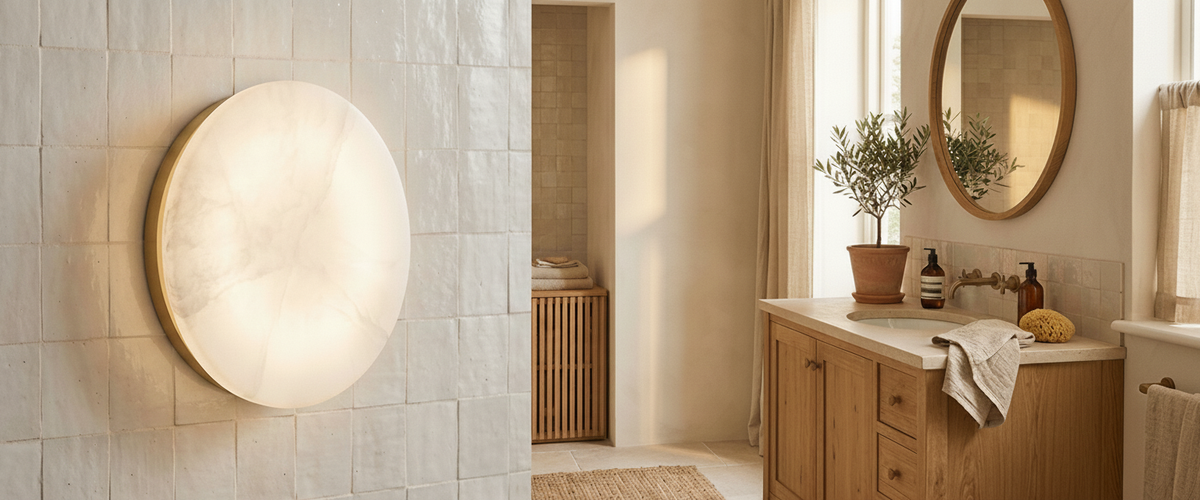
A warm alabaster flush fitting softens glare across a tiled bathroom.

Key Takeaways
Measure ceiling height and mark your wet zones before you shortlist anything.
IP44 is the usual minimum for bathroom ceiling fittings; zones directly over the bath or shower can need more.
Warm white around 2700K to 3000K flatters skin; anything cooler drifts clinical.
In a small bathroom, one well-placed central fitting often beats a scatter of spots.
Alabaster and natural-stone diffusers soften glare in a way plain glass rarely matches.

Read the Ceiling Height and Wet Zones First
Before you fall for a fitting, get up a ladder with a tape measure. The best bathroom ceiling lighting ideas begin here, not with the catalog. Ceiling height decides whether a hanging piece is even an option, and the position of your bath, shower and basin decides which parts of the ceiling need a higher IP rating. Sketch the room from above and mark those three fixtures. That rough plan tells you where light needs to fall and where a fitting must be sealed against moisture and steam.
Low ceilings, common in loft conversions and older terraced homes, rule out most pendants. A drop of even eight inches can put a fitting in your eyeline over the basin. Tall or newly extended bathrooms give you room to play, but the same rule holds: light should reach the tasks, chiefly the mirror and the shower, not just pool in the middle of the floor.
Flush and Semi-Flush for Low or Sloped Ceilings
When headroom is tight, a flush ceiling light sitting close to the plaster is the honest answer. It keeps the sightline clean and throws light wide. A semi-flush, dropping a few inches on a short stem, adds a little presence without stealing height, which suits a room with a bit more air above. These are among the most useful bathroom ceiling lighting ideas for cramped spaces.
This is where material earns its place. A flush fitting with an alabaster or frosted-stone diffuser spreads a soft, even wash rather than the hard disc of light you get from bare glass. In a narrow Victorian bathroom with a sloped ceiling, a pair of compact alabaster flush fittings can catch the low light in the stone's natural veining and give the room a warmth that chrome downlights never manage. Where a low ceiling needs a warm, close-mounted glow rather than a hard downlight, a compact piece such as the Brompton Flush Ceiling Light in Brushed Brass sits closer to the right design language. You can see the range of stone diffusers across our alabaster lighting collection if you want a sense of how the veining reads once lit.
For sloped ceilings specifically, look for fittings rated for angled mounting, or set them on the flatter section near the ridge. A qualified electrician should confirm the mount is sound and correctly earthed before anything goes live.
IP Ratings Decoded: What Each Zone Demands Overhead
Matching each fitting to its moisture zone keeps overhead light safe and sealed.
Bathrooms are split into moisture zones, and the IP rating on a fitting tells you how well it resists water and dust. This is the safety half of any bathroom ceiling lighting ideas shortlist. The two digits matter: the second one covers water, and it is the one to watch overhead. As a working rule for ceiling fittings, IP44 handles splashes and is the common minimum across the main bathroom ceiling, while positions directly above a bath or open shower can call for a higher rating. For a zone that catches steam and the occasional splash, an IP44-rated fitting such as the Paulson 3 Light Flush Ceiling Light in Chrome is built for exactly that placement. The official BSI standards for electrical installations underpin the zoning most bathrooms follow, and your electrician will apply them to your specific layout.
Steam is the quiet killer. Even outside the direct splash zone, a poorly sealed fitting over a hot shower will fog and, over time, corrode. Choose sealed fittings with proper gaskets for any bathroom, and treat the manufacturer's IP figure as a floor, not a target to just scrape past.
Colour Temperature That Flatters Skin
Colour temperature, measured in kelvin, is the single biggest lever on how a bathroom feels, and it is where plenty of bathroom ceiling lighting ideas fall down. Warm white between 2700K and 3000K keeps skin looking healthy and the room restful; it is the range that suits early mornings and late soaks alike. Push past 4000K and you drift into a cool, clinical light that reads more like a dental surgery than a place to unwind.
Alabaster and natural stone do quiet work here. The stone's density warms and softens whatever bulb sits behind it, taking the edge off any glare and lending the light a faint honeyed cast. Pair a 2700K LED with a stone diffuser and you get a glow that flatters without turning muddy. Add a dimmer, wired by an electrician for bathroom use, so you can drop the level for a bath and lift it for grooming. Consistency matters too: keep every bulb in the room to the same colour temperature so the ceiling layer and the mirror lights don't fight each other.
Light Blue and Light Green Bathrooms: A Note on Colour
Cool wall colours change how your lighting reads, so weigh them into your bathroom ceiling lighting ideas early. Lighting blue bathroom ideas lean crisp and coastal, and a too-cool bulb can tip that palette icy; a warm 2700K fitting keeps the blue fresh rather than cold. The same holds for a light green scheme, where warm light stops sage and eucalyptus tones sliding grey. If you are matching soft furnishings, a shower curtain in a warm off-white, natural linen, or a deeper accent drawn from the wall colour tends to sit better under warm light than a stark bright white, which can glare back at you.
Lifting a Small Bathroom With One Central Fitting
Small bathroom lighting ideas often go wrong by over-fitting: four downlights punched into a tiny ceiling create a busy grid of shadows and glare. One considered central fitting, sized to the room, usually does more. Among small-room bathroom ceiling lighting ideas, a single flush alabaster or opal-glass piece throws an even wash that makes a small space feel taller and calmer, with none of the visual clutter. Where a compact ceiling needs balanced light without a heavy footprint, a two-lamp fitting like the Malibu 2 Light Flush Ceiling Light in Brushed Brass spreads the glow more evenly than a single central point.
Scale it honestly. A large fitting overwhelms a compact room; too small and it looks lost. Aim for a diameter that reads in proportion to the floor, and centre it over the open floor rather than tight against the shower. If you need extra task light at the mirror, add a discreet wall light rather than more holes in the ceiling. When you weigh up ceiling bathroom lighting ideas for a tight space, remember that fewer, better fittings almost always win. Browse the wider niori lighting range if you want to plan the ceiling and mirror layers as a set.
Layering So the Ceiling Isn't the Only Source
The best bathrooms rarely rely on a single overhead fitting, and the smartest bathroom ceiling lighting ideas plan for that. Ceiling light is the base layer; wall lights either side of the mirror kill the under-eye shadows that overhead light casts, and a low-level or plinth light gives a soft glow for a midnight visit without the full glare. Put each layer on its own switch or dimmer and the room flexes from bright and practical to low and restful.
Natural stone helps tie those layers together. A flush ceiling fitting and a pair of alabaster wall lights, all drawing warm light through stone, read as one considered scheme rather than a collection of parts. That coherence is what separates a bathroom that feels designed from one that was simply wired.
A Quick Buyer's Checklist
Height: measure before shortlisting; low ceilings mean flush or semi-flush.
Zones: map bath, shower and basin, then match IP ratings to each.
IP: IP44 as the usual ceiling minimum; higher directly over water.
Colour: 2700K to 3000K warm white, matched across the room.
Dimming: fit a bathroom-rated dimmer, wired by a qualified electrician.
Material: alabaster or stone diffusers for soft, glare-free light.
Layers: pair the ceiling fitting with mirror and low-level light.
Work through your bathroom ceiling lighting ideas in that order and the fitting almost picks itself. Start with the ceiling and the zones, hold to warm light, and let the stone do the softening. That is how a bathroom moves from merely lit to genuinely well lit.