
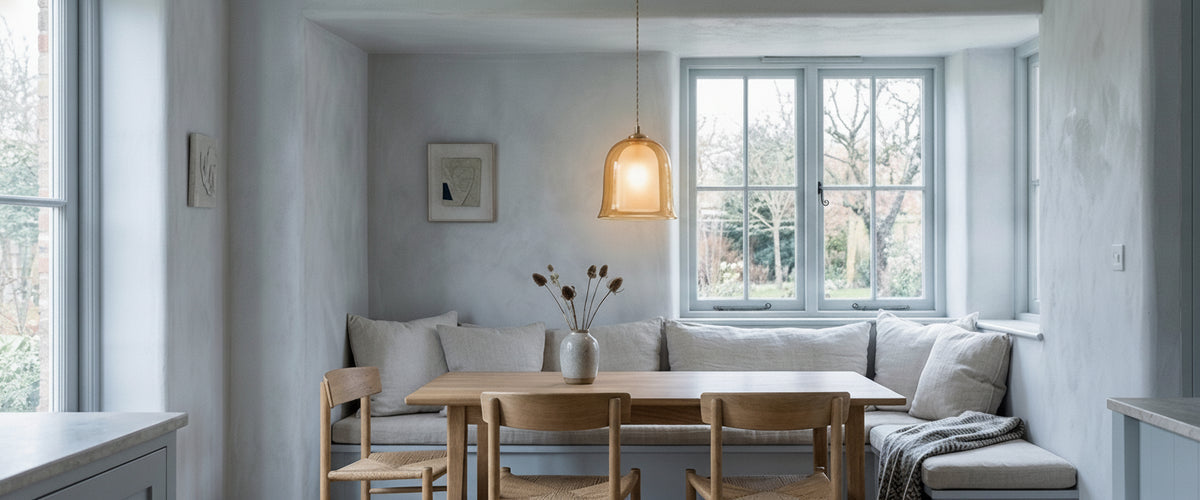

Every amber glass pendant lights makes a trade. It gives up some of its brightness in exchange for a honeyed, low glow that makes a dining table feel like the warmest spot in the house. Buyers who understand that trade love the result. Buyers who expect amber to light a room the way clear or opal glass does usually add a floor lamp within a month. This guide is for the first group, and it should keep you out of the second.
At a Glance
- Output: amber glass absorbs a noticeable share of visible light, so plan it as mood and accent lighting, not your only source.
- Glass matters: thicker, bubbled, hand-blown glass gives a softer, more textured glow than thin machine-pressed shades.
- Best rooms: dining areas, bars, snugs and evening spaces. Be cautious in north-facing rooms and task-heavy kitchens.
- Bulbs: a 2700K source reads closer to candlelight through amber. Choose dimmable LEDs with good colour rendering.
- Pairings: warm timbers, plaster, aged brass and warm-veined stone flatter amber. Cool greys and chrome fight it.

What an Amber Glass Pendant Light Does to Lumen Output
Clear glass lets nearly all of a bulb's light through. Opal glass scatters it, losing some output but spreading the glow evenly so the whole shade becomes the light source. Amber works differently: it is a colour filter. The tint absorbs much of the blue and green end of the spectrum and passes the reds and yellows, which is exactly why the light looks so warm. A pale honey tint costs you relatively little. A deep cognac shade can swallow a large share of the bulb's output, and depending on the glass, you may lose a third or more of what a clear shade would deliver.
The practical upshot is simple. If you are replacing a clear or opal pendant with an amber glass pendant light over the same table, expect the room to feel dimmer and plan for a brighter bulb or a supporting source. Amber also shifts what you see on the table. Reds and wood tones look rich; blues and greens look muted. That is lovely for a candlelit supper and less helpful when you are trying to match paint samples.

Wall Thickness, Bubbles and the Character of the Light
Two amber shades of the same colour can light a room in very different ways. Thin, pressed glass behaves like a tinted window: the bulb is clearly visible, and the light falls in a fairly crisp pool. Thick, hand-blown glass slows and bends the light. You get a deeper, more uneven glow, with colour pooling where the glass is heaviest, usually at the base of a globe.
Bubbles (often called seeds) add another layer. Each one catches the light and throws tiny points of brightness across the shade, so a seeded, hand-blown glass amber pendant lights sparkles faintly even when dimmed low. Hand-blown glass has a long craft history, and the V&A's glass collection is a good place to see how makers have used colour, thickness and imperfection on purpose for centuries.
Expect variation between hand-blown pieces. Under the same 2700K bulb, two amber shades from different batches can differ visibly in depth of colour. If you are hanging a row of three or more, buy them together so they are more likely to come from the same batch, and accept a little variation as part of the appeal, much as no two alabaster shades share the same veining.
Where Amber Earns Its Place, and Where It Struggles
Amber rewards rooms that are used mostly in the evening. Over a dining table, an amber glass pendant light pulls people in and flatters faces. In a home bar, snug or reading corner, it makes the space feel enclosed and private. Hallways and landings also suit a single amber pendant, where it acts as a warm marker rather than a working light.
It struggles where light quality matters for tasks. A kitchen island where someone is chopping vegetables needs clear, even light, so if you love the look, pair amber pendants with recessed downlights or under-cabinet strips. Home offices are another poor fit.
North-facing rooms need the most thought. Their daylight is cool and indirect, and a dark amber shade can turn a corner of that room murky by late afternoon. Take a north-facing Victorian terrace kitchen with three deep amber globes planned over the table. Seen in the actual room, that scheme often tips into gloom; a better balance is one amber pendant over the sideboard and an alabaster pendant over the table, which gives warmth without the murk. Alabaster diffuses rather than filters, so it glows warm while passing more usable light. If you are weighing those two looks, browsing our alabaster lighting next to your amber options makes the difference easy to see.
Spacing and Drop Height for Clusters and Rows
Pendant lighting in amber glass is often bought in multiples, and spacing is where most mistakes happen. Use these as starting points, then adjust for your ceiling and the size of the shade:
- Over a dining table: hang the bottom of the shade roughly 70 to 85 cm (28 to 34 inches) above the tabletop. Low enough to feel intimate, high enough to see across the table.
- Over an island or counter: allow a little more, around 75 to 90 cm (30 to 36 inches), so standing guests are not staring into the bulb.
- In a row: keep the end pendants at least 15 cm (6 inches) in from the edge of the surface, and space shade centres about twice the shade diameter apart as a guide.
- In a cluster: stagger drops by 10 to 20 cm (4 to 8 inches) so the shades overlap visually without touching. Odd numbers usually look more natural than even.
- In walkways: keep at least 2.1 m (about 7 feet) of clear headroom beneath the lowest shade.
Amber changes the maths slightly. Because each shade gives less light, a row of amber pendants can sit a little closer together than clear ones without becoming glaring, and a cluster gains impact as the shades stack their glow. If you would rather not run three separate ceiling points, a ready-made three-drop fitting such as the Agzar 3 Light E14 Cluster Pendant, White keeps the drops gathered on one canopy; just note that its smaller E14 lamp holders narrow your bulb choice compared with E27. Any new ceiling point or circuit should be fitted by a qualified electrician; a NICEIC-registered contractor is a sensible place to start in the UK.
Why 2700K Reads Differently Through Amber Than Smoked or Bronze Glass
A 2700K bulb is already warm. Pass it through amber and the light that reaches the room reads closer to candlelight or firelight, because the glass strips out the cooler wavelengths that remain. Smoked glass behaves differently. It is a neutral grey filter, so it reduces output without changing the colour much; your 2700K stays 2700K, only dimmer. Bronze tint sits between the two, adding a brown cast that some people find cosy and others find muddy, especially on white walls.
In a typical amber glass pendant light, a 2700K LED with a colour rendering index of 90 or above is the sweet spot. If your glass is very dark or the room is short on daylight, a 3000K source can claw back some clarity without losing the warm effect. Filament-style LEDs suit lighter amber where the bulb is visible; frosted or opal bulbs work better inside heavily seeded glass where you want an even glow. Always check that the bulb and dimmer are compatible, since cheap LED and dimmer pairings are the usual cause of flicker at low levels.
Surfaces That Amber Glass Rewards
Amber light flatters anything already warm. Oak, walnut and cherry deepen under it. Limewash, clay plaster and warm white paint take on a soft glow. Aged or unlacquered brass reads richer than it does in daylight. Natural stone with warm veining, such as honey onyx, travertine or marble with gold and beige movement, picks up the amber tone beautifully.
Be wary of cool palettes. Blue-grey paint, polished chrome and stark white quartz tend to look slightly dirty under deep amber. If your kitchen is mostly cool, pick a pale honey tint rather than cognac, or bring warmth back with a brass canopy and a timber table beneath the pendant. Where the table itself is pale and the warmth has to come from overhead, a golden oak fitting such as the JASMIN G/O 470 3x20W E27 Pendant Light, Golden Oak carries timber up to ceiling level and sits comfortably alongside a single amber glass pendant light elsewhere in the room.
Before You Buy: A Practical Checklist for Amber Glass Light Pendants
Use this list to narrow your choice of amber glass light pendant before you commit:
- Define the job. Accent and atmosphere, or real working light? If it is task light, plan supporting fixtures.
- Check the room's daylight. North-facing or dim rooms suit paler amber, or alabaster.
- Judge the glass. Ask whether it is hand-blown or pressed, and whether thickness and seeding vary.
- Confirm the lamp holder and maximum wattage, and choose a dimmable LED at 2700K or 3000K.
- Measure drop height and spacing against your table or island before ordering.
- Match the metalwork. Brass and warm bronze suit amber better than chrome.
- Plan installation with a qualified electrician, especially for clusters needing a larger ceiling plate.
- Plan care. Clean amber glass with a soft cloth and mild soapy water once cool and switched off; dust trapped in seeding shows up when lit.
Budget depends on glass quality, scale, the number of drops, engineering and installation, so for multi-pendant projects it is worth requesting a tailored quote. If you want to compare an amber glass pendant light against stone, opal and brass pieces in one place, our full lighting collection is the quickest way to see how each material behaves before you decide.