
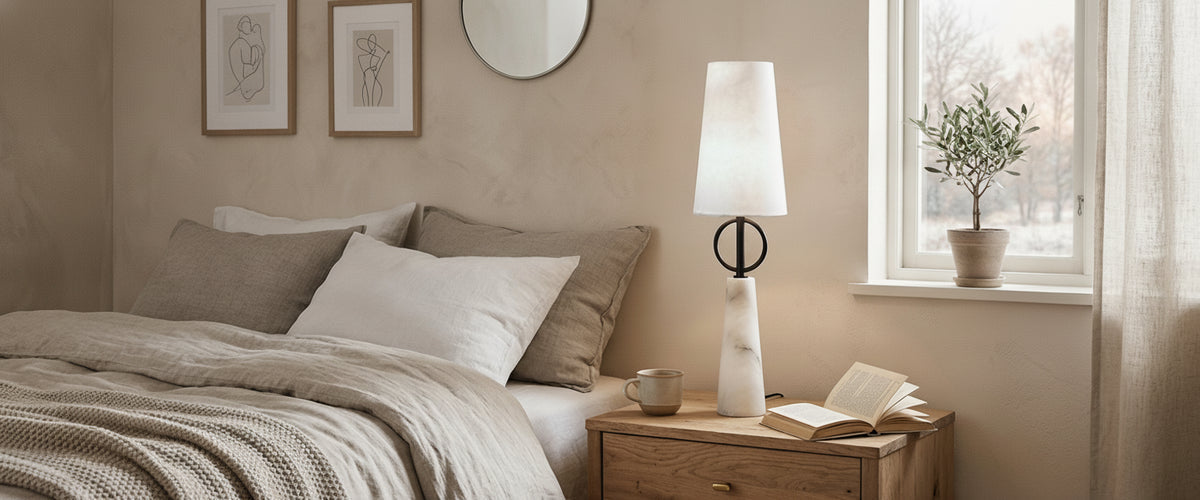

Switch off the ceiling light for a week and you soon find out which lamp in the bedroom earns its keep. The bedside table lamps handles your reading, the 2am glass of water and the first bleary minutes of a winter morning, often all in the same day. Most people choose it last, by eye, from a photograph. That is why so many end up with a lamp that dazzles them when they sit up or barely reaches the page of a book.
At Niori we make alabaster and natural-stone lighting, and the bedside lamp is the piece customers ask us about most. The questions are rarely about style. They are about height, glare and whether the light will be too dim to read by.

Quick Answer
- Height: the lower edge of the shade should sit roughly at chin height when you are propped up in bed.
- Shade: translucent stone such as alabaster gives a soft, glare-free glow. Pair it with a directional source if you read for long stretches.
- Power: plug-in suits most UK bedrooms. Hardwiring is neater but is a job for a qualified electrician.
- Bulb: a dimmable LED at 2700K, matched to a compatible dimmer.
- Pairs: match them in symmetrical rooms. Mix them when the bed sits off-centre or the two sides do different jobs.

Why the Bedside Table Lamp Does More Work Than Any Other Light
A pendant gets switched on and off. A bedside table lamp gets used. It is the light you reach for half asleep, so it has to be easy to find in the dark and comfortable at close range. It needs enough output to read by but must stay low enough not to disturb whoever is sleeping beside you.
It also sits closer to your face than any other fixture in the house, often within 60 cm (about 2 ft). At that distance an exposed bulb or a hot spot on the shade becomes something you stare into every night. This is where diffusing materials earn their reputation. A shade of alabaster or onyx turns the bulb into a broad, even surface of light, so there is no single bright point for the eye to catch on.
The One Measurement That Separates a Useful Lamp From a Frustrating One
Forget the overall height of a bedside table lamp. What matters is where the bottom of the shade sits relative to your eyes when you are sitting up in bed. Too high and the bare bulb shows underneath it. Too low and the light pools on the bedside table instead of reaching your book.
The rule we give clients is simple. Sit up against your headboard, hold a tape measure beside your head, and note the height of your chin from the floor. The lower edge of the shade should land close to that figure. For many beds and bedside tables, that puts the shade bottom roughly 40 to 50 cm (16 to 20 in) above the top of the mattress. Measure your own setup rather than trusting an average, though. A low platform bed and a tall Victorian bedstead with a deep mattress can differ by a surprising margin.
A common mistake: ordering a pair of lamps sized for an old divan, then upgrading to a much taller bed. The lamps may still be fine, but the bedside tables suddenly sit too low and the shades end up below chin height. Check the table and mattress heights together before you choose the lamp.
Shade Material and Opacity: Diffused Glow Versus Directed Reading Light
Opacity decides what kind of light you get. An opaque metal or card shade throws light down and up in two defined cones, which is good for reading and less flattering for the room. A thin linen shade spreads light sideways. Translucent stone does something different again: the whole body of the lamp glows.
Alabaster is soft and fine-grained. When it is carved thin enough, light passes through it and picks up the warmth of the stone and the drift of its veining. The result is ambient, low-glare light, which is exactly what you want by the bed for winding down. Onyx tends to show bolder banding and a slightly amber cast. Marble is denser and is often used for bases rather than glowing shades, paired with glass or fabric above.
Be honest with yourself about how you read. If it is ten minutes before sleep, a glowing alabaster bedside table lamp is plenty. If you read for an hour or work through papers in bed, add a directed source. That could be a lamp with an open top or bottom to the shade, or a swing-arm wall light on the reader's side. Our alabaster lighting collection lets you compare shapes and stone finishes and see how open and closed forms differ in practice.
Plug-In, Hardwired or Rechargeable: Which Suits a UK Bedroom
Plug-in is the default for good reason. Many UK bedrooms have a socket on each side of the bed, and a plug-in bedside table lamp can move with you when you redecorate or relocate. The downside is the visible flex. Run it behind the bedside table, and choose a white or clear flex if the lamp sits against a pale wall.
Hardwired lamps, or table lamps wired to a 5A round-pin socket on a lighting circuit, let you switch both bedside lights together, from the door and from the bed. It looks considered, and it suits renovations where the walls are open anyway. This is not DIY territory. Any new circuit, switch or socket should be designed and installed by a qualified electrician registered with a competent person scheme, who can confirm what needs certifying under Building Regulations.
Rechargeable cordless lamps solve the period-property problem of a bed placed far from any socket, and they are handy for guest rooms. Their output is usually modest and battery life varies, so treat them as a soft accent rather than your main reading light. In a guest bedroom where a trailing flex would otherwise cross the floor, a compact cordless lamp such as the Fluxy Cordless Rechargeable Outdoor Table Lamp in white sits neatly on a small table and can move out to the terrace in summer. If one side of the bed only needs a gentle glow for the 2am glass of water, a low-output 1.2W lamp like the Inita LED 1.2W Cordless Rechargeable Outdoor Table Lamp does the job without lighting up the whole room. Heavier stone lamps are almost always mains-powered.
Matching Pairs or Deliberate Asymmetry
A matched pair is right when the room is symmetrical: bed centred on the wall, identical tables, windows balanced either side. It calms the eye, and in a hotel room or a guest suite it reads as finished.
Asymmetry makes sense when the room is not balanced to begin with. A bed pushed against a chimney breast, a desk on one side, or two sleepers with different habits all argue for mixing. Keep one thing consistent so the pairing looks intentional rather than accidental. That might be the stone, the brass finish, or the shade height, which should line up even if the bases differ. A tall alabaster lamp on one side and a lower, wider one on the other works well, as long as both shade bottoms sit close to that chin-height line.
Colour Temperature and Dimming: Why 2700K Dimmable Is Not Optional
Bedroom light should warm as the evening goes on. At 2700K an LED gives the honey tone of an old incandescent bulb. At 4000K it reads clinical and wakeful. There is a physiological case too: research summarised by Harvard Health Publishing links evening exposure to bluer light with suppressed melatonin and disrupted sleep.
Stone makes the choice more obvious. When we test shades in the studio, we light the same piece at 2700K and 3000K side by side. At 2700K the alabaster turns creamy and the veining comes forward. At 3000K the same stone looks a touch cooler and flatter. That small step matters more than most people expect.
Dimming finishes the job. Choose an LED bulb marked dimmable, then match it to a compatible dimmer. Use an inline cord dimmer for plug-in lamps, or a trailing-edge wall dimmer for hardwired circuits. Mismatched bulbs and dimmers can flicker or buzz. LEDs also run far cooler than old filament bulbs, which matters inside a closed stone shade.
Bedside Table Lamp Checklist Before You Order
- Measure mattress top and bedside table height together, then confirm the shade bottom will land near chin height when you sit up.
- Check the table surface. A heavy stone base needs a stable top with room around it for a phone, glass and book.
- Decide whether the lamp is for ambience or serious reading, and add a directional light if it is the latter.
- Locate the nearest socket, or book an electrician early if you want switched or hardwired lamps.
- Specify 2700K dimmable LED bulbs and a compatible dimmer.
- For pairs, line up shade heights even if the bases differ.
- Ask about the bulb fitting and maximum wattage before ordering, and request a tailored quote for bespoke sizes or finishes.
Caring for a Stone Bedside Table Lamp
Bedside lamps get touched more than any other fixture, so care matters. Alabaster is soft and porous. Dust it with a dry, lint-free cloth, and keep water, cleaning sprays and hand cream away from it. Use a coaster rather than standing a glass directly on a marble base: water can leave rings, and acidic drinks such as juice or wine can etch the surface. Switch off and let the bulb cool before handling, and lift the lamp by its base rather than the shade.
Choose the height first, the light quality second and the style last, and a bedside table lamp will serve you well for years. If you are planning a whole room rather than a single lamp, the wider niori lighting range covers pendants, wall lights and floor lamps in the same stones, so the bedside glow can carry through the rest of the space.