
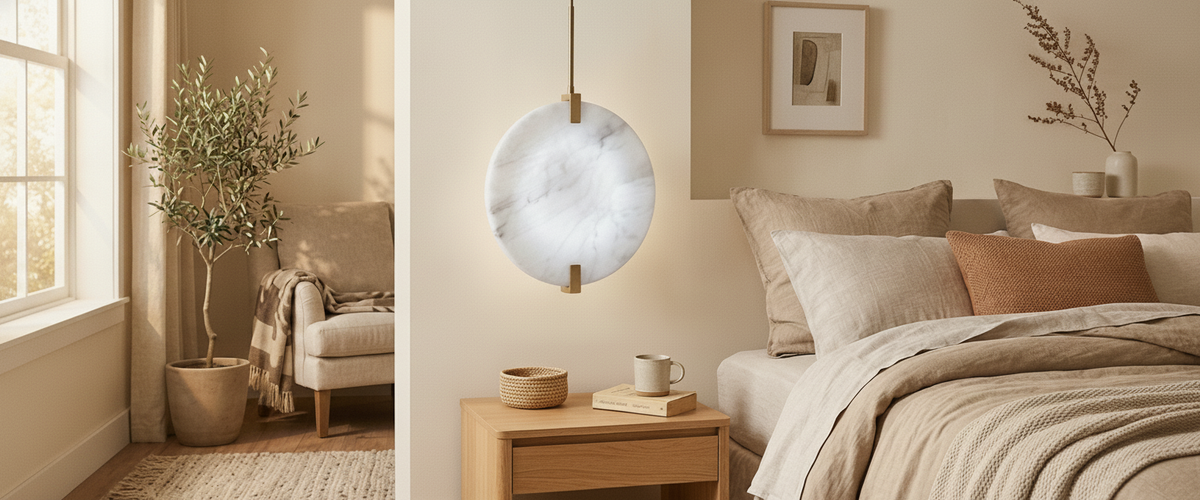

A bedside lamp has two jobs, and they pull in opposite directions. At 11pm it needs to give you enough light to read by without waking the person next to you. At 7am it needs to look like it belongs to the room. Most bedside lamps are chosen for the second job and fail badly at the first, which is why so many bedrooms end up with a lamp that glares straight into your eyes at exactly the wrong angle. Getting bedside lamps right is mostly a question of height, diffusion and honest measurement, and alabaster solves the diffusion part before you even switch it on.

Key Takeaways
- Height first: the bottom edge of the shade should sit near eye level when you are sitting up in bed, roughly 100 to 125cm (40 to 50in) from the floor.
- Work backwards from the table: a nightstand around 60cm (24in) high usually wants a lamp of about 50 to 70cm (20 to 28in) overall.
- Diffusion beats brightness. Translucent alabaster and onyx soften the source so you never see a hot filament from the pillow.
- Leave the table usable. A base wider than about a third of the surface will crowd a book, a glass and a phone.
- Dimming is not optional in a bedroom. Specify a dimmable warm bulb and a compatible control.
- Pairs need not be identical, but they should match in height and light output.

What Bedside Lamps Are Really For, and Who Should Care
Bedside lamps are the last light you touch at night and often the only one that matters. Ceiling lighting in a bedroom is functional at best; it flattens faces and kills atmosphere the moment you want to wind down. The pair either side of the bed carries the room's mood, which is why designers treat them as a scheme decision rather than an accessory bought at the end of a project.
They suit almost everyone, but the specification changes with the situation. A reader wants directional light and a switch they can find without opening their eyes. A hotel or short-let owner wants something guests cannot easily knock over, with a switch on the base rather than halfway down a cable. A designer working on a principal suite in a listed property may want a table lamp precisely because the walls cannot be chased for wiring. small bedside lamps solve the opposite problem: narrow tables, floating shelves, or a bed pushed close to a chimney breast where a full-size base simply will not fit.
Light at night also has a physiological side. Warm, low-level light is easier on the wind-down process than cool white, and Harvard Health sets out clearly why evening light exposure affects sleep. That single fact should drive your bulb choice more than any style consideration.
How to Compare Bedside Lamps Before You Buy
Photography lies about scale. A lamp shot alone on a plinth looks generous; the same piece on a 40cm (16in) wide table looks like a monument. Run every candidate through the same five checks.
1. Total Height Against Your Sitting Eye Line
Sit up in bed, get someone to measure from the floor to your eyes, and aim for the bottom of the shade to land within a few centimetres of that number. Higher and you get glare. Much lower and you light the tabletop instead of the page.
2. Shade Opening and Direction
An open-bottomed shade pushes light down onto a book. A fully enclosed alabaster form gives ambient glow rather than task light. Plenty of bedrooms want both: a stone lamp for atmosphere and a small swing-arm or wall light for reading.
3. Base Footprint Versus Table Surface
Measure the nightstand. If the base takes more than about a third of the depth, you will spend the next decade moving your water glass. On a compact table such as the Carvora 1 Drawer Small Bedside Table, that maths rules out most full-size stone columns before you have even looked at height; on a deeper two-drawer piece like the Camvenne 2 Drawer Bedside Table you can carry a wider base and still keep a book and a glass in play.
4. Switch Position and Type
Inline cord switches are the most common and the most irritating in the dark. A switch on the base or a rotary at the lampholder is worth paying attention to. If the lamps sit on a controlled circuit, check the dimming method before committing.
5. Weight and Stability
Stone and marble bases are heavy by nature, which is an advantage next to a bed. Anything light enough to tip when a cable is tugged is the wrong choice for a family home or a guest room.
Materials, Finishes and Scale Decisions
Ceramic and metal lamps bounce light off a shade. Alabaster does something different: the stone itself becomes the light source. Because gypsum alabaster is translucent in thin sections, a lit shade or column glows from within, and the mineral veining reads as soft amber and cream shadows that are barely visible when the lamp is off. No two pieces look the same. In the studio we light-test blocks before pairing them, because two slabs cut from the same quarry can throw noticeably different tones once a bulb is behind them. That is also why we pair them by eye rather than treat them as identical stock items.
Onyx is the more dramatic option, with banded veining and a stronger honey or green cast when lit. Marble tends to be denser and works better as a solid base beneath a fabric or glass shade, giving weight and a cool, quiet surface. Brass detailing suits all three; a warm unlacquered brass will patinate over time, while a satin or antique finish stays more consistent. If you want to see how the same material behaves across pendants, wall lights and table lamps before you settle on a bedside pair, browsing the alabaster lighting collection is the fastest way to compare forms side by side.
The table underneath matters as much as the lamp on top. Warm-toned timber pushes alabaster towards cream, which is why a pale oak surface like the Ashvenne 1 Drawer Bedside Table tends to flatter a honey-veined stone base more than a high-gloss dark lacquer, which reflects the light source back at you as a hard highlight.
On scale: a tall bed with an upholstered headboard can carry a lamp of real presence. A low platform bed cannot, and a heavy stone column will loom over it. Small bedside lamps, generally around 30 to 40cm (12 to 16in) tall, are the right answer for slim tables, bunk-adjacent spaces, and guest rooms where you want soft light rather than a reading station. They are also the sensible choice if you already have wall lights doing the task work.
Where to Place Bedside Lamps for the Strongest Effect
The default is a matched pair flanking the bed, and it works because symmetry calms a room. It is not the only option. An asymmetric layout, with a stone table lamp on one side and a wall-mounted alabaster disc on the other, suits bedrooms where one nightstand is squeezed against a wall or radiator. What matters is that both sides deliver similar light levels; mismatched brightness is far more noticeable than mismatched shapes.
Push the lamps slightly behind the front edge of the table rather than centring them. It reduces the chance of catching a sleeve and keeps the glow closer to the headboard, where it flatters the wall finish. In rooms with panelling or a textured plaster, a translucent alabaster base placed a few centimetres off the wall will wash that texture in a way a solid ceramic lamp cannot.
Guest bedrooms deserve more thought than they usually get. We shipped a pair of alabaster bedside lamps to a client converting a Yorkshire farmhouse into a small guest annexe, and the brief was specific: cables kept out of sight, no fiddly switches, and enough light to find a suitcase at midnight. Base-mounted switches and a warm dimmable bulb solved it. If you are still weighing pendant, wall and table options for a whole bedroom scheme, the wider lighting range is worth a slower look before you buy anything piecemeal.
Bulbs, Dimming and a Short Care Checklist
- Colour temperature: 2200K to 2700K. Anything cooler makes alabaster look grey and makes the room feel clinical.
- Output: roughly 200 to 400 lumens per lamp for ambient light; more if the lamp is your only reading source.
- Dimmable LED, with a driver or dimmer confirmed as compatible. Mismatched dimmers cause flicker at low settings, which is exactly when you will notice it.
- Colour rendering: aim for CRI 90 or above so the stone veining stays warm rather than muddy.
- Dust dry. A soft, lint-free cloth or a clean natural-bristle brush is enough for weekly care.
- Keep water off gypsum alabaster. It is soft and water-soluble, and conservation guidance from bodies such as the Getty Conservation Institute treats moisture as the main risk to stone of this type. No sprays, no damp cloths.
- Lift from the base, never by the shade or stem, and never drag a stone lamp across a timber top.
- Hardwired wall lights need a qualified electrician. Plug-in table lamps are the DIY-friendly route.
Budget, Quality and Delivery
Price on natural-stone lighting is driven by things you can actually inspect: the grade and translucency of the block, how much of it is wasted to get a clean section, the wall thickness of the carved parts, the quality of the metalwork, and the electrical components inside. Hand-finished stone with consistent wall thickness costs more than a thick, cloudy section that hides its flaws. Because every block differs, the sensible route is to request a tailored quote for the pieces and quantities you need rather than assuming a fixed figure.
Two practical points on delivery. Stone lamps are heavy and travel in protective packing, so allow space to unpack near the room rather than in a hallway. And check the socket type and cable length against your actual power points before installation day; a cable that is 20cm short is a frustrating way to end a project.
How Niori Can Help
Niori works in alabaster and natural stone across pendants, chandeliers, wall lights, table lamps and floor lamps, shipping worldwide from the UK. For bedside lamps specifically, the useful conversation is usually about proportion: send us the headboard height, the nightstand dimensions and a photo of the wall, and we will tell you honestly whether a full-size stone lamp or a smaller pair will sit better. If you are specifying for a hotel, a rental or a multi-room project, we can advise on matched pairing across rooms so the light quality stays consistent from suite to suite. Start with the main collection and narrow from there.