
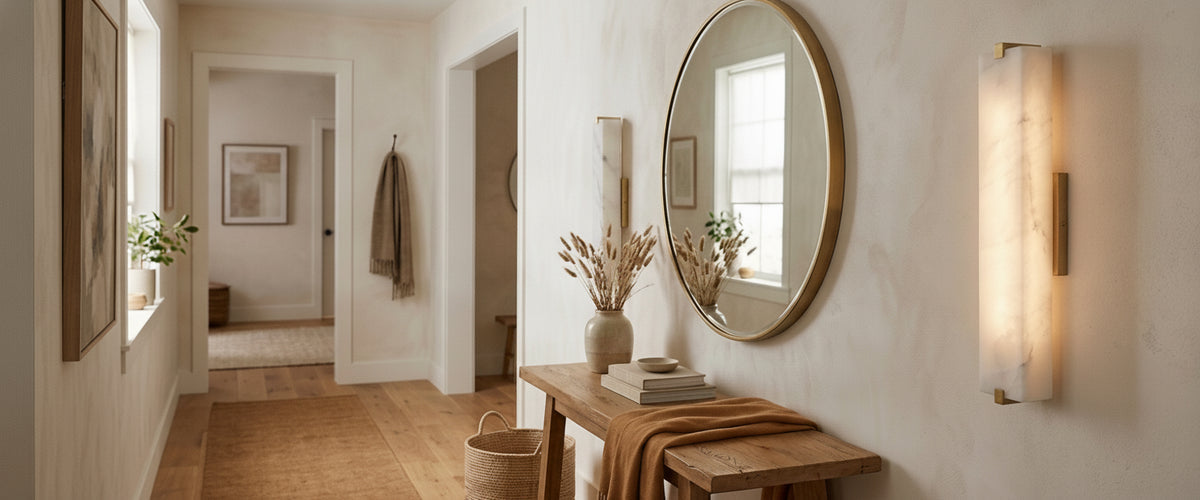

Hang alabaster from a ceiling and the room forgives most decisions. Put it on a wall at eye level and every choice shows: the veining, the bulb, the height, the gap between one fixture and the next. An alabaster wall sconce sits in your sightline all evening, which makes it the most revealing stone light you can buy. It is also the easiest one to get slightly wrong.

Quick Answer
- Stone or glass: carved alabaster shows irregular clouds and veins when lit; faux alabaster glass glows evenly. Decide which effect you want before you shop.
- Pairs over singles: two sconces framing a bed, mirror or doorway read as intentional. A lone sconce needs something to anchor it.
- Height: roughly 1.5 to 1.7m (5ft to 5ft 7in) to the centre of the shade in hallways and living rooms; lower beside a bed.
- Bulb: 2700K suits pale white stone. Honey-toned alabaster often looks better at 3000K.
- Before drilling: confirm projection, fixing offset and IP rating.

Why Stone at the Wall Behaves Unlike Stone Overhead
A pendant is mostly seen from below and at an angle. You glance at it, then past it. An alabaster wall sconce is seen face on, at the height of your eyes, from every sofa and doorway in the room. The whole front face of the shade is lit edge to edge, so any blotch, hotspot or uneven cut is on display in a way it never is overhead.
Alabaster is a fine-grained form of gypsum, a soft mineral that turns translucent when it is cut thin; the British Geological Survey covers gypsum in its mineral resources material. That translucency is the whole point. In a well-made alabaster wall sconce the shade is pared down until the lamp behind it turns the stone itself into the light source, so you see a glowing slab rather than a bulb behind a cover.
The second difference is the wall itself. A sconce lights the surface it is fixed to, so it doubles as a wall wash. Against limewash or a textured plaster it brings out every trowel mark; against a flat, eggshell paint it can look clinical if the stone is too bright. The finish behind the fixture often changes the effect as much as the shade does. Think about the wall before you think about the shade.
Carved Alabaster Versus Faux Alabaster Glass: What the Lit Shade Gives Away
Switched off, a good faux alabaster wall sconce in opal or acid-etched glass can pass for stone across a room. Switch it on and the difference is immediate. Real alabaster has variable density, so the light breaks into soft clouds, with darker veins reading as gentle shadows inside the glow. Glass diffuses evenly, and cheaper versions show a brighter spot where the lamp sits.
Neither is the wrong answer. Glass makes sense in a steamy family bathroom, or in a hotel corridor where twelve fixtures must look identical from end to end. Carved stone earns its place in a drawing room, bedroom or restaurant where you want the light to have character, and where no two shades matching exactly is a feature rather than a fault.
The most common mistake is ordering a pair of carved alabaster wall sconces and expecting them to be twins. They will be cut to the same profile, but the veining will differ, sometimes noticeably. If perfect uniformity matters to you, that is a strong argument for glass. If you want to see how much variation natural stone carries across different fixture shapes, browsing the alabaster lighting collection side by side is the quickest way to calibrate your eye.
The Symmetry Question: Why Pairing Amplifies and a Single Sconce Often Floats
Picture a single alabaster wall sconce centred on a long landing wall. Nothing is wrong with the fixture. It simply looks like it is waiting for something. Move it to one side of a large framed print, add a second on the other side, and the landing goes from awkward to composed with no other change.
Pairs work because the eye reads symmetry as decision. Two sconces either side of a bed, a mirror, a fireplace breast or a pair of doors create a frame, and the stone glow on both sides doubles the sense of warmth without either light being bright. Where a narrow chimney breast or a short stretch of wall between two doors leaves no room for separate fixtures, a twin-shade design such as the Velaris 2 Light Double Alabaster Wall Light in brushed brass gives you that symmetry from a single fixing point.
A single alabaster wall sconce can still work, but it needs an anchor: a reading chair beneath it, the end of a corridor where it becomes a focal point, or an alcove that holds it. On a long corridor, a run of alabaster sconces at a steady rhythm does a job no ceiling light can. Spacing of around 2 to 3m (6ft 6in to 10ft) usually keeps pools of light overlapping without the passage feeling like an airport.
Alabaster Wall Sconce Height and Sightlines, Room by Room
Height guidance starts with one rule: from a standing or seated position, you should see the glowing stone and never the lamp. Adjust the numbers below to your ceiling height and furniture.
Hallways and Landings
Centre the shade at roughly 1.5 to 1.7m (5ft to 5ft 7in) from the floor. On stairs, follow the pitch so each fixture sits the same height above the tread line, not the same height above the ground floor, and check that people looking down from above cannot see into an open-topped shade.
Living Rooms
The same band works, but check sightlines from the sofa. If seated guests can see up into an open-bottomed shade, choose a profile with a closed or diffused base.
Bedrooms
For bedside sconces, aim for the shade centre roughly 60 to 75cm (24 to 30in) above the top of the mattress, so the light clears your head when you sit up to read. Set the fixtures slightly outboard of the headboard so the glow falls beside you rather than behind you. A switch on the fixture or a bedside dimmer is worth more here than anywhere else.
Bathrooms
Either side of a mirror at around eye height gives the most flattering face light. Gypsum dislikes sustained moisture, so real stone belongs outside the wettest zones and only in fixtures rated for the location. Much bathroom electrical work is notifiable under Part P of the Building Regulations; the Planning Portal explains the requirements. Always use a qualified electrician for wiring and fitting.
Dining Rooms and Hospitality
Sconces here are mood rather than task lighting. Set them a little lower than in a hallway so the glow sits in seated eyelines, and put them on a separate dimmable circuit from the pendant over the table.
2700K Behind Alabaster: Why the Warmest Bulb Isn't Always the Right One
Stone is a filter. Light passing through alabaster comes out warmer than it went in, and how much warmer depends on the stone. Pale white alabaster shifts colour only slightly, so 2700K gives that familiar candlelit cream.
Honey and amber varieties are another story. Put the same 2700K lamp behind a white shade and a honey-veined one and the white looks right, while the honey shade drifts close to orange and the veining, the reason you paid for stone, flattens into one warm blur. Moving to 3000K brings the cream back and lets the darker veins read again.
A few more points that matter more on a wall than on a ceiling:
- Colour rendering: choose a CRI of 90 or above so the stone's natural tones, and the skin of anyone standing near it, look true.
- Output: a sconce is accent lighting. Too many lumens and the stone glares rather than glows, which defeats the material.
- Dimming: confirm the lamp or integrated LED is dimmable and that your dimmer suits LED loads; mismatches cause flicker that stone makes painfully visible.
Three Spec-Sheet Details to Confirm Before You Mark the Wall
- Projection. How far the fixture stands off the wall decides whether it suits a narrow hallway or catches every passing shoulder. Deep stone bowls need room; slim plates suit tight corridors.
- Fixing point versus light centre. On many designs the backplate does not sit at the centre of the shade. A long horizontal piece, such as the 800mm Albatre Alabaster LED Wall Light in brass, or a double-arm fixture with two shades, may have its fixing well off centre. Tell your electrician where the glow should land, not just where the cable comes out.
- Light source and rating. Integrated LED or a replaceable lamp? Colour temperature, dimmability and IP rating should all be on the sheet. If any are missing, ask before you order.
Choosing a Modern Alabaster Wall Sconce: Buyer Checklist
A modern alabaster wall sconce tends to lean on clean geometry (flat slabs, half-cylinders, slim bars) with brass or bronze framing kept minimal so the stone does the work. Run through these before you commit:
- Have you decided between visible veining and uniform glass glow?
- Will the sconce be paired, or is there a clear anchor for a single?
- Have you checked sightlines from seated as well as standing positions?
- Does the stone tone suit 2700K, or does it need 3000K?
- Is the projection right for the width of the space?
- Is the fitting rated for its location, especially near water?
- Is a qualified electrician booked, with the light centre marked on the wall?
Care is simple but specific. Dust an alabaster wall sconce with a dry, soft cloth or a soft brush, keep water and spray cleaners off it, and handle shades with clean, dry hands, since gypsum marks and absorbs oils more readily than marble. Treated this way, alabaster mellows rather than wears.
Budget depends on stone thickness, scale, the complexity of the carving and metalwork, and whether you need a matched pair or a long corridor run. For hospitality or multi-room projects, request a tailored quote. If you are still weighing wall lights against pendants or lamps for a scheme, the full lighting collection shows how Niori's alabaster and natural-stone pieces work together across a room.