
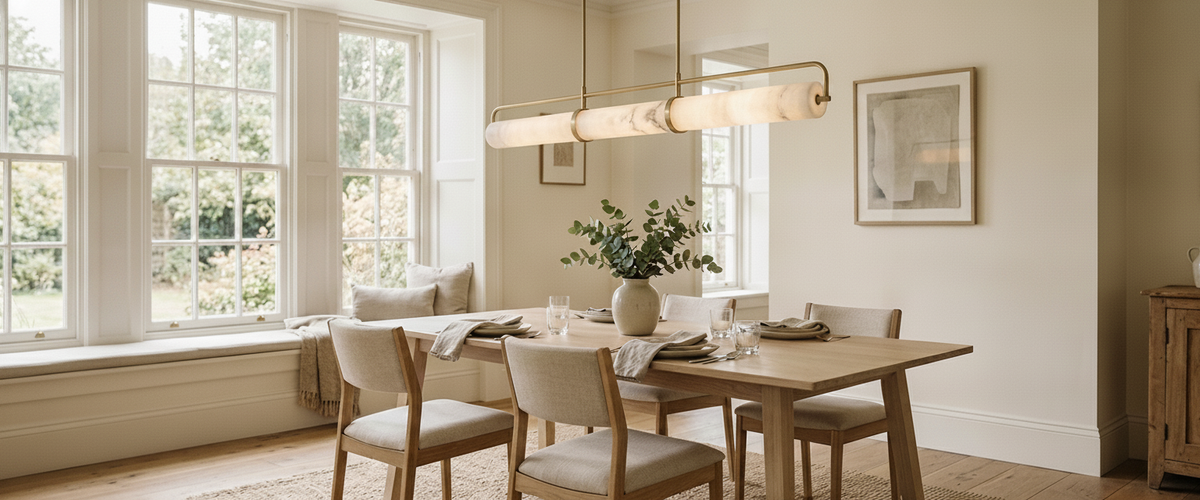

Hang a crystal chandelier and it scatters light in hard little pinpricks; every facet fires a separate spark across the ceiling. A stone chandeliers does the opposite. It holds light inside the material, softens it, and pushes it back into the room as a warm wash. That single difference changes where the fixture belongs, how bright it reads, and how you shop for one. If you have only ever chosen lighting by lumens and shape, stone asks you to think about the material first and the fitting second.
We ship alabaster and natural-stone pieces to homes and hospitality projects that want that glow rather than the glitter, and the questions that come up before purchase are almost always the same. So here is the honest version, minus the showroom polish.

Key Takeaways Before You Buy
- Stone diffuses, crystal refracts. Expect a soft ambient glow, not sparkle.
- Alabaster is the warmest and most even diffuser; onyx is bolder and more dramatic; agate reads jewel-like and directional.
- Every stone panel is unique. Veining and translucency vary piece to piece, so ask what you are actually getting.
- Size to the room, not the table. Drop and diameter both matter under high ceilings.
- Warm, dimmable bulbs keep stone glowing. Cool light turns it flat and grey.

Why a Stone Chandelier Behaves Nothing Like Crystal or Glass
Crystal and cut glass are built to bounce light off their surfaces. That is the entire point of a drop stones chandeliers or a classic crystal stone chandelier: the facets catch a bright source and throw it around as reflected sparkle. Turn the lamps up and the whole thing glitters harder.
Stone works from the inside. Thin-cut alabaster and onyx are translucent enough to let light pass through the material itself, so the panels glow rather than shine. You are lighting the stone, not lighting the room and letting the stone reflect it. The result is a soft, enveloping light with visible depth in the material. It is quieter overhead, and far more forgiving on faces and finishes below.
That behaviour is why the fixture reads as calm even at full output, while crystal can feel busy. If your brief is atmosphere rather than statement sparkle, stone is usually the right call. You can compare both approaches across our full lighting range to see how differently each material carries the same wattage.
Alabaster, Onyx and Agate: The Glow Each Stone Actually Throws
Alabaster is the most even diffuser of the three. It is a fine-grained gypsum stone, prized for centuries precisely because light passes through it so gently; medieval churches used thin alabaster panes as glowing windows long before frosted glass was common, a use the V&A documents in its stone and sculpture collections. Cut thin, it gives a creamy, honeyed light with soft cloud-like veining. An alabaster stone chandelier is the safe, warm, timeless choice, and the one most of our clients come back to.
Onyx is bolder. The banding is stronger, the colour range wider (amber, green, deep caramel), and the light it throws carries more drama. Where alabaster whispers, onyx has presence. It suits rooms that can take a strong centrepiece.
Agate behaves differently again. It tends to appear as thinner slices with high translucency and vivid edges, closer to backlit stained glass than a soft panel. An agate stone chandelier reads jewel-like and a little theatrical. It is the material people picture when they search for a blue stone chandelier or a pink chandelier accent; those saturated tones come from agate and similar banded stones rather than from alabaster.
Worth flagging: searches for blue stone chandelier earrings, multi stone chandelier earrings and pink stone chandelier earrings pull in jewellery, not lighting. If you landed here from those, the colour cue is the same, but a ceiling fixture is a very different object. For overhead lighting, focus on how the stone diffuses rather than how it looks in a shop window.
Reading Veining and Translucency Before the Stone Reaches Your Ceiling
No two stone panels are identical, and that is the point. It also means you should never buy blind. Natural veining changes how light moves across the surface, so a piece can look dense and dramatic in one panel and softly cloudy in the next.
Before you commit, ask three things:
- How translucent is the cut? Thinner stone glows more; thicker stone reads solid and lights up less evenly. Good makers balance the two so the panel is strong enough to survive but thin enough to transmit light.
- Where does the veining sit? Heavy banding across a lit panel creates visible dark and bright zones. Some buyers love that movement; others want a calmer wash. Neither is wrong, but you should choose on purpose.
- Are the panels matched? On a multi-panel fixture, ask whether the stone is selected to sit together tonally, or whether you might get one amber panel next to a grey one.
The Natural Stone Institute is a useful reference for understanding how gypsum and calcite stones vary in density and finish, which feeds directly into how they light. When you enquire, request photography of the actual stone where possible, not a stock render.
Drop and Diameter: Sizing a Stone Chandelier to the Room Beneath It
Stone is heavier and more sculptural than crystal, so scale mistakes show up fast. A fixture that looks generous online can feel mean over a large dining table, or overbearing in a modest hallway.
Two measurements matter: diameter (how wide it reads in plan) and drop (how far it hangs). As a working starting point:
- Over a dining table: aim for a fixture roughly half to two-thirds the width of the table, hung so the base sits around 30 to 36 inches (76 to 91 cm) above the tabletop.
- In a room, centred: a rough guide is to add the room's length and width in feet, then treat that number in inches as a sensible diameter. A 14 by 16 foot room points toward a piece around 30 inches (76 cm) wide.
- Ceiling height: allow about 2.5 to 3 inches of drop per foot of ceiling height (roughly 6 to 8 cm per 30 cm), then confirm at least 7 feet (2.1 m) of clear headroom in circulation spaces.
Under a double-height stairwell or a tall entrance, a longer cascading drop stones chandelier earns its keep because the eye reads it from several floors. Where a long dining table calls for even coverage rather than a single central mass, a horizontal fixture such as the Essence Linear Pendant Light in Brass distributes light along the length instead of concentrating it in one spot. Under a standard 8 to 9 foot ceiling, a compact flush or semi-flush stone fitting usually behaves better. Weight also matters with stone; always have a qualified electrician confirm the ceiling fixing can carry the load before installation.
Warm Bulbs and Dimming That Keep Stone Glowing Instead of Going Grey
This is where most of these fixtures are won or lost. The stone can be beautiful, and the wrong bulb will kill it.
Cool white light (anything up toward 4000K and above) drains the warmth from alabaster and onyx and leaves the veining looking chalky and grey. Stone wants warm light. We recommend LED lamps in the 2400K to 2700K range, which reads as candle-warm to soft-white and lets the amber and honey tones in the stone come forward. A high colour rendering index (CRI 90 or above) keeps the veining reading as natural rather than muddy.
Dimming is not optional if you want the fixture to work morning to night. A dimmable circuit lets you run it bright for a working dinner and drop it to a low glow for the end of the evening, when stone is at its best. Match dimmable LED lamps to a compatible trailing-edge dimmer to avoid flicker; the UK guidance from CIBSE on lighting quality is a sound reference for getting output and control right. Get an electrician to confirm compatibility rather than guessing at the switch.
The Rooms That Carry a Stone Chandelier, and the Ones It Swallows
Not every room deserves one, and a few actively fight it.
Dining rooms are the natural home. Stone's warm downward glow flatters food, table settings and faces, and the fixture becomes the anchor of the room. Entrance halls and stairwells are the other strong candidate, especially with a longer drop that greets people as they arrive. Principal bedrooms take a smaller fitting well; the soft light suits winding down, and paired with dimming it doubles as gentle ambient lighting.
Where a room leans architectural rather than ornate and you want warmth without a busy silhouette, a spare multi-arm form such as the Dynamite 6 Light Chandelier in Brass holds the centre of a dining room without fighting the stone glow you are after elsewhere. Where stone struggles: very bright, cool, task-heavy spaces such as a working kitchen or a home office lit for screens. Flood those rooms with cool light and the glow disappears into the background; the stone reads flat and you have paid for a feature you cannot see. Rooms with a lot of competing sparkle (mirrored walls, polished chrome everywhere) also tend to swallow the quieter stone glow. In those cases, use stone as a table lamp or wall light instead, where it is closer to the eye.
If you want to see how alabaster in particular carries a room, our alabaster lighting collection is the clearest place to compare fixture types side by side. And if you are weighing a bespoke or larger project, budget depends on the stone, the scale, the engineering and the installation, so it is worth requesting a tailored quote rather than working from a headline figure.
A Quick Buyer's Checklist
- Decide glow versus sparkle first; that alone rules stone in or out against crystal.
- Choose the stone by behaviour: alabaster for even warmth, onyx for drama, agate for jewel-like colour.
- Ask for photos of the actual panels and confirm tonal matching.
- Size by room, not by table, and check headroom and ceiling load.
- Specify 2400K to 2700K, CRI 90+, dimmable LEDs on a compatible dimmer.
- Have a qualified electrician handle fixing and wiring.