
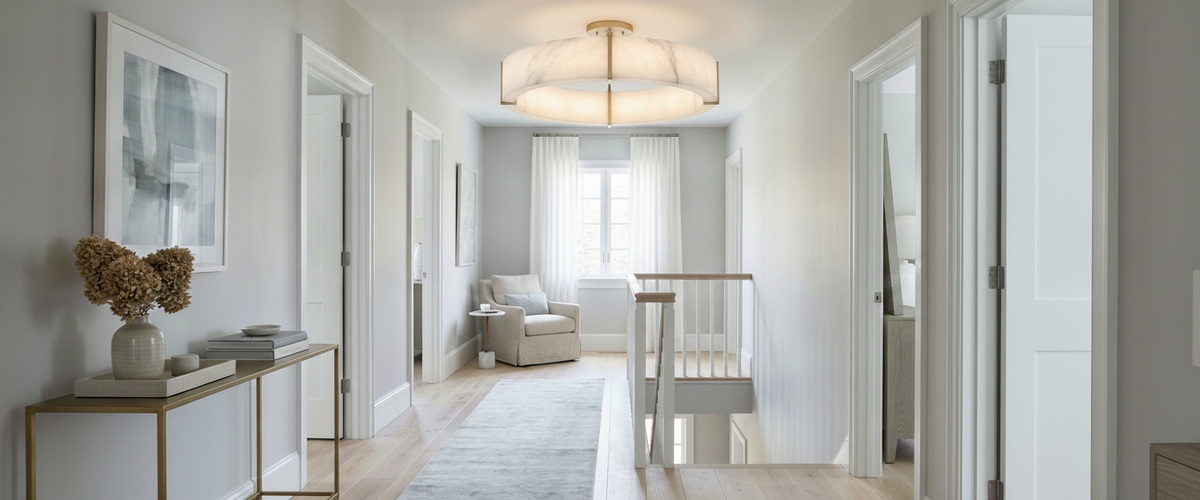

A pendant hanging on half a metre of rod in a room with a 2.4 metre ceiling looks like a mistake, because it is one. Heads clip it, doors swing near it, and the whole room feels lower than it already is. Semi flush ceiling lights solve that problem without falling back on a flat, featureless disc: they sit close to the plaster, keep a little air above the shade, and let light wash upward as well as down. For most British homes built since the 1960s, semi flush ceiling lights are simply the more sensible choice.

At a Glance
- Semi flush means a short stem or gallery between ceiling and shade, usually a few centimetres, so the fitting reads as a proper light rather than a bulkhead.
- Semi flush ceiling lights suit ceilings under roughly 2.6 metres, plus hallways, landings, en suites, dressing rooms and any spot where a drop would be knocked.
- Alabaster and natural stone shades diffuse light beautifully at close range, which matters more when the fitting is near eye level.
- Sizing rule of thumb: add the room's length and width in metres, then multiply by eight to ten for a fixture diameter in centimetres.
- Specify warm, high-CRI, dimmable LED. Cool white behind stone drains the warmth out of the veining.
- Budget varies with material, scale, metalwork and installation complexity, so ask for a tailored quote rather than assuming a flat figure.

What Semi Flush Ceiling Lights Suit, and Who They Are For
The category sits between two extremes. A fully flush fitting is pressed straight against the plaster and throws almost everything downward, which is efficient but can feel institutional. A pendant drops into the room and becomes a sculptural object, which is lovely until the ceiling cannot carry it. Semi flush ceiling lights borrow the best of both: enough separation from the ceiling to cast a halo of reflected light across the plaster, without stealing head height.
Semi flush ceiling lights earn their keep in circulation spaces above all. Hallways, landings, stairwell half-landings and boot rooms all need even light at a height nobody will collide with. Bedrooms are the next obvious home, particularly where a ceiling rose sits directly over the bed and a long drop would feel oppressive when you are lying under it. Kitchens with lower soffits, home offices, walk-in wardrobes and generous bathrooms (with the correct IP rating for the zone) all work too.
Designers and hospitality buyers reach for semi flush ceiling lights for a different reason: repeatability. A run of matching fittings down a corridor gives rhythm without the alignment nightmare of pendants at varying drops. We supplied a small Edinburgh townhouse hotel where the top-floor corridor had a sloping coombed ceiling on one side. Pendants were out. A sequence of alabaster close-to-ceiling fittings gave the corridor a soft, low-glare glow that photographed well and stopped guests squinting on the way to their rooms at midnight.
Sizing and Placing Semi Flush Ceiling Lights
Start with clearance. Keep the lowest point of any ceiling fitting comfortably above head height in walkways; around 2.1 metres of clear space below is a sensible working target, and more if tall guests or a doorway swing are involved. In a bedroom over the bed, you have more latitude, because nobody stands under it, but do check the fitting will not sit awkwardly in your eyeline when sitting up against the headboard.
For diameter, the metric rule of thumb is easy: add the room's length and width in metres, then multiply that figure by eight to ten for a target diameter in centimetres. A 4 metre by 3 metre bedroom points at 55 to 70 cm, which is bigger than most people instinctively choose. Undersizing is the single most common error we see. A small fitting in the middle of a large ceiling looks apologetic, and it also fails to spread light far enough to reach the room's corners.
Placement deserves the same care as sizing. Centring a fitting on the room is the default, but it is often the wrong default. Centre on the visual anchor instead: the bed, the island, the run of the hallway, the seating arrangement. In older properties, the existing ceiling rose is frequently off-centre relative to the furniture, and moving the point before the ceiling is redecorated costs far less than living with a light that sits 30 cm off from where the eye expects it.
In corridors, space fittings evenly and resist the urge to squeeze in one more. Two well-sized semi flush ceiling lights with generous spacing read as considered; five small ones read as an airport gate. Where the same fitting has to repeat down a hallway without dominating it, a single-shade design such as the Kieran Semi-Flush Ceiling Light in Lacquered Brass repeats more calmly than a multi-arm fitting, which starts to crowd the ceiling once you install three or four of them. Where a stairwell turns, one fitting on each level usually beats a single fitting struggling to serve both.
Materials, Finishes and Light Quality
Because semi flush ceiling lights sit close to the eye, material quality shows. Every seam, every casting mark, every slightly-off finish is visible from below in a way it never is on a high pendant. That is precisely why natural stone performs so well here. Alabaster is a gypsum-based stone that transmits light through its thickness, so an alabaster shade does not just block glare, it glows from within and shows its own mineral banding. No printed acrylic imitates that convincingly at close range.
Alabaster has been carved into lamps and translucent window panels for centuries, and it is far softer and more moisture-sensitive than marble; the carved alabaster held by the Victoria and Albert Museum shows both the workability of the stone and how easily it wears. Marble reads denser and cooler and reflects rather than transmits, which suits a shallow dish or a base detail. Onyx brings dramatic amber and green banding, and it is the one material where you should ask to see the actual slab or a photograph of the exact piece, because variation is enormous.
Metalwork is the other half of the story. Antique or lacquered brass warms the light slightly at the edges and flatters stone veining. Blackened or bronzed finishes give more graphic definition, so in a hallway or landing a two-tone frame like the Kieran Semi-Flush Ceiling Light in Black & Brass holds its outline against white plaster in a way an all-brass fitting will not, which matters when the fitting is the only object on the plane. Polished chrome is crisp and modern but unforgiving of fingerprints on a fitting people may occasionally touch. If you are browsing the wider range, the alabaster lighting collection is the quickest way to see how different stone thicknesses change the character of the glow.
Bulbs and Dimming
- Colour temperature: 2700K for living spaces and bedrooms. 3000K is the maximum before alabaster starts to look chalky rather than honeyed.
- Colour rendering: CRI 90 or above. Stone veining and skin tones both suffer badly under cheap LEDs.
- Dimming: specify dimmable lamps and match them to a compatible trailing-edge dimmer. Mismatched dimmers cause flicker and buzzing, and it is nearly always the dimmer at fault, not the fitting.
- Output: think in lumens, not watts. In a hallway, less is usually more once the stone is doing the diffusing.
- Lamp shape: where the bulb sits close to the stone, a frosted or opal lamp avoids a hot spot printing through the shade.
- Heat: keep to the stated maximum wattage. Stone is not a heat sink, and prolonged overheating stresses adhesives and fixings.
Common Mistakes and How to Avoid Them
The first is treating one ceiling fitting as the whole lighting scheme. Even well-chosen semi flush ceiling lights are ambient light. Without a table lamp, a wall light or a floor lamp to layer against them, the room stays flat after dark. Plan the ceiling light and the secondary sources as one decision.
Second, ignoring the ceiling itself. A dark or heavily textured ceiling absorbs the upward light that makes a semi flush fitting worth choosing. If your ceiling is painted a deep colour, expect less bounce and compensate elsewhere.
Third, buying on picture rather than on scale. Product photography flattens size cues. Cut a paper disc to the stated diameter and tape it to the ceiling for a day. It takes five minutes and prevents the most expensive kind of regret.
Fourth, DIY wiring. Swapping a like-for-like fitting is one thing; new points, altered circuits or bathroom zones are another. Use a qualified electrician registered with a competent person scheme, and check the ceiling fixing is sound, especially in lath and plaster where a heavier stone fitting needs a joist or a proper noggin. Guidance from NICEIC is a sensible starting point for finding a registered contractor.
Fifth, cleaning stone like glass. Alabaster is porous and softer than marble. Dust with a soft dry brush or microfibre cloth, and if you must go further, use a barely damp cloth and dry immediately. Avoid ammonia, vinegar, bathroom sprays and anything abrasive. Isolate the power first, let the lamps cool, and never soak a shade.
Choosing Between Semi Flush Ceiling Lights and the Alternatives
Ask four questions before you commit. What is the finished ceiling height, measured after any new flooring goes down? Will anyone walk directly beneath the fitting? Does the room need light thrown outward to the walls, or concentrated onto a surface? And is there an existing decorative feature, such as a cornice or a beam, that a drop would fight with?
If the answers point to low ceiling, foot traffic and a need for wide, even light, semi flush wins. If the ceiling is generous and you want a focal point over a table or an island, a pendant or chandelier will do more for the room. Where a ceiling is genuinely tight, under roughly 2.3 metres, go fully flush and add wall lights to give the space depth; a low-profile fitting such as the Otis 1 Light Flush Ceiling Light in Matt Black gives you the clearance semi flush ceiling lights simply cannot at that height. Browsing the full lighting range side by side helps here, because the same design language often runs across pendants, wall lights and ceiling fittings, which makes a coherent scheme far easier to build.
How Niori Can Help with Your Lighting Project
Niori works in alabaster and natural stone: pendants, chandeliers, wall lights, table lamps, floor lamps and close-to-ceiling fittings, usually with brass or blackened metal detailing. We ship worldwide and regularly work with interior designers, architects and venue owners who need consistency across multiple rooms rather than a single one-off purchase.
If you are specifying semi flush ceiling lights for a project, tell us the ceiling heights, the room dimensions, the control system and the mood you are after, and we will advise on scale, lamp choice and finish combinations. Costs depend on material, size, metalwork complexity, engineering and installation, so we quote per project rather than publishing a single figure. Start at the Niori homepage to get a feel for the range, then send through your plans and we will work from there.