
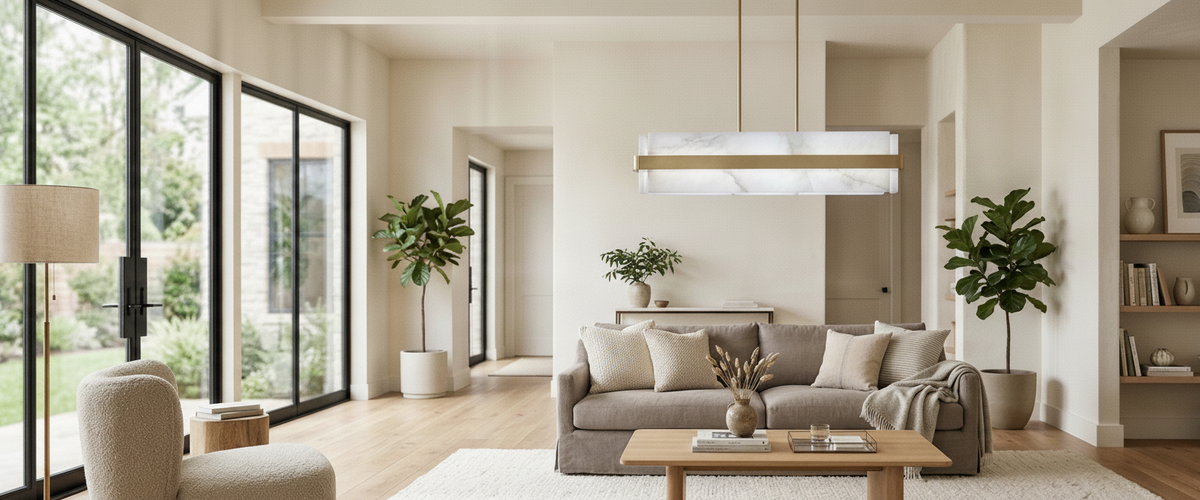

The wrong living room chandeliers are almost never the wrong style. It's the wrong size, hung at the wrong height, over a spot no one actually sits. People fall for a fixture in a photograph, order it, and only when the box arrives do they realise it swallows the ceiling or floats there looking apologetic. Getting the proportions of a living room chandelier right is the boring part that decides everything, and it happens well before you argue about crystal versus stone.
So let's fix the sizing first, then talk about material and mood. The finish is the easy decision once the maths is honest.

Key Takeaways
Size before style. Measure the room and ceiling height before you shortlist a single living room chandelier.
Diameter rule of thumb. Add the room's length and width in feet, and that number in inches is a sensible fixture diameter.
Height rule. Hang the bottom roughly 7 feet (about 2.1 m) off the floor in a walk-through space; higher ceilings let you drop it lower over a seating group.
Stone calms, crystal sparkles. Alabaster gives soft, even light; crystal throws sharp highlights that can compete with a busy room.
Dimming is non-negotiable. Warm, dimmable light is what holds the room together after dark.

The Size Question Everyone Gets Wrong First
Ask most buyers what size living room chandelier suits their space and they guess from a photo. The photo lies, because you never see the ceiling height or the width of the walls beside it. A fixture that reads as a jewel in a 20-foot room looks like a hat in a 12-foot one.
Start with a simple method. Add the length and width of the room in feet, then read that total as inches. A room that measures 16 by 14 feet (about 4.9 by 4.3 m) gives you 30, so a living room chandelier around 30 inches (76 cm) in diameter sits comfortably. Treat it as a centre point, not a rule. A very open-plan space can carry a little more presence; a snug reading corner wants less.
This is where a lot of people trip up on how big a hanging light should be in a room this size. They scale it to the sofa or the coffee table and forget the room around it. The fixture answers to the volume of the space first, then to the furniture beneath it.
Reading Ceiling Height and Seating Layout to Size the Drop
Diameter is only half the job. The drop, meaning how far the fixture hangs down, is what people misjudge most. The standard guidance is to leave the bottom of a living room chandelier roughly 7 feet (about 2.1 m) above the floor where people walk beneath it. Over a low coffee table or a seating group no one strolls through, you can bring it lower for intimacy, closer to 6 feet 6 inches (about 2 m).
Ceiling height changes the character entirely. For a standard 8-foot (2.4 m) ceiling, a low-profile or semi-flush piece often beats a long-dropping one; a tall drop just crowds the head height. Push up to 10 or 12 feet (roughly 3 to 3.7 m), common in loft conversions and new-build great rooms, and a longer drop earns its keep by filling the vertical gap rather than leaving a lonely fixture stranded near the ceiling. Over a long dining-adjacent zone or a wide coffee table, a linear form such as the Essence Linear Pendant Light in brass distributes that vertical presence along the furniture rather than concentrating it in one round mass.
A rough working figure many designers use for a living room with a chandelier: add around 2.5 to 3 inches of drop for every extra foot of ceiling above 8 feet. It keeps the fixture in proportion with the volume instead of clinging to the plaster.
When Stone Settles the Room and When Crystal Starts a Fight
Here's where material stops being decoration and starts doing a job. Crystal scatters light into sharp, glittering points. In a formal, restrained room that's the intended drama. In a lived-in family space full of pattern, books and texture, all those highlights can start a visual argument the room doesn't need.
Alabaster does the opposite. The stone is faintly translucent, so light passes through it and comes back softened and warm rather than pinned into bright spots. It settles a room instead of energising it. That quality is why Niori builds every alabaster living room chandelier around natural stone; the material behaves like a diffuser you can't buy off a shelf, and the veining means no two pieces read exactly the same. The Natural Stone Institute has good background on how the translucency and mineral structure of stones like alabaster vary from block to block, which is worth reading if you want to understand why the glow differs piece to piece (naturalstoneinstitute.org).
For a chandelier in the living room that needs to work morning and night, in front of a television, near a fireplace, stone usually wins. It flatters faces, hides fingerprints better than polished crystal, and reads as calm. Where you still want a defined silhouette without the glitter of cut crystal, a six-arm piece like the Dynamite 6 Light Chandelier in brass gives structure and warmth in the same fixture. If you want the fixture to be the sparkling centrepiece of a formal reception space, crystal has its place. Just know what you're choosing. When you compare living room contemporary chandeliers side by side, browse both approaches across our lighting collection to see how the light quality shifts between materials.
Diameter and Clearance for Lounges People Actually Sit Beneath
A living room chandelier over a seating group has a second measurement to respect: the furniture footprint. If it sits over a coffee table, aim for it to span somewhere between half and two-thirds the width of that table, so it relates to the object below without overhanging the edges where someone could knock their head standing up.
Clearance to walls matters too. Give the widest point at least 2 feet (about 60 cm) of breathing room from anything vertical, more in a generous room. A fixture crammed near a wall or a beam looks like an afterthought, however good the piece itself is.
We once shipped a pair of alabaster pieces to a client remodelling a double-height lounge. The original plan was one large living room chandelier dead centre. Once we mapped the seating, it was clear the room had two conversation zones, not one. Two smaller fixtures, each sized to its own group, held the space far better than a single giant one hovering over the gap between the sofas. The lesson stuck: size to how people sit, not to the geometric middle of the floor plan.
Dimming and Warm Light So It Holds the Room After Dark
A living room chandelier like this lives two lives. Bright and practical in daylight, low and warm at night. If it can only do one of those, it fails half the time.
Specify dimmable LEDs and choose a warm colour temperature, ideally in the 2400K to 2700K range for evenings. Alabaster leans into that warmth beautifully; the stone takes a warm bulb and turns it into something that feels like candlelight rather than a lightbulb. Cool white behind stone looks clinical and wastes the material.
Match the dimmer to the driver. Not every LED plays nicely with every dimmer, and a mismatch shows up as flicker or a buzz you'll notice on a quiet evening. Have a qualified electrician confirm compatibility and handle the wiring; the piece is heavier and more permanent than a table lamp, and the fixing into the ceiling has to be sound. Guidance on safe installation and using competent electricians is set out by Electrical Safety First.
The Stranded Fixture: Hung Over Nothing, Centred on the Wrong Thing
The most common mistake isn't size at all. It's centring. Builders often place the ceiling rose in the geometric middle of the room, which frequently lands over empty floor or a walkway rather than over the seating. A gorgeous living room chandelier hung there looks stranded, no matter how well it's sized.
Decide where people gather first, then centre the fixture on that, even if it means moving the electrical point. In open-plan spaces, the light should anchor the lounge zone, not the through-route to the kitchen. If moving the fixing is impractical, a piece on an adjustable canopy or a plaster ceiling medallion can help visually reset where the eye reads the centre.
Quick Buyer's Checklist
Measure room length plus width in feet; read as inches for a starting diameter.
Confirm ceiling height and set the bottom of the living room chandelier around 7 feet off the floor in walk-through zones.
Centre on the seating group, not the plaster rose.
Choose stone for a calm, lived-in room; crystal for formal sparkle.
Specify dimmable, warm-white LEDs and check dimmer compatibility.
Leave at least 2 feet of clearance to walls and beams.
Book a qualified electrician for installation and fixing.
Get the numbers right and the style choice becomes a pleasure instead of a gamble. If you want to see how alabaster handles all of this in a living room chandelier, our alabaster lighting collection is the place to start, and the Niori homepage gives a wider sense of how stone shapes light across a whole room.