
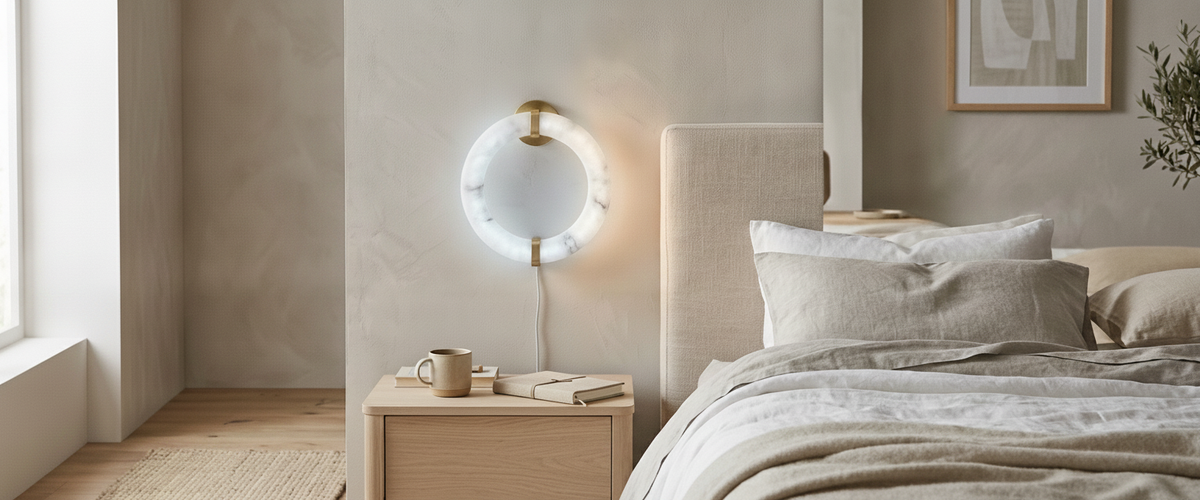

The short answer on LED wall lights bedroom schemes: run them warm at around 2700K, put them on a dimmer that each side of the bed can control on its own, mount the center of the light source at seated eye level (roughly 24 to 30 inches, or 60 to 76 cm, above the mattress top), and keep the bright element out of your sightline. Most bedrooms get lit like kitchens instead: cool, bright, and aimed straight down at the pillow. Your body reads that as morning, and the wind-down you were counting on quietly cancels itself. The fix usually starts on the wall.
This is a buyer's guide to LED wall lights for the bedroom that actually help you sleep, covering color temperature and dimming, the difference between a reading beam and an ambient wash, mounting height and spacing beside the headboard, integrated LED versus a fitting you can rebulb, and how to keep stone shades looking right. Get it wrong and you live with a cool, bright fitting stuck at full output: fine over a chopping board, miserable at the end of a long day. Most LED wall lights bedroom projects fail because someone specified the fittings as task lights and hoped the room would forgive it. Stone is the honest answer here. Alabaster scatters light through its own body rather than firing it out of a thin plastic lens, so the glow lands soft and even instead of turning the wall into an interrogation scene. Comfort comes from diffusion rather than raw output.

Key Takeaways for an LED Wall Lights Bedroom Scheme
Warm over cool. Aim for around 2700K, and lower if the fitting supports warm dimming.
Dimming is non-negotiable. Bedroom wall lights that cannot be dimmed are lights you will stop using.
Reading and ambience are different jobs. One washes the wall, the other throws a controlled beam onto a page.
Height matters more than style. Set the center at seated eye level beside the bed and the glare problem disappears.
Decide early: integrated LED or a fitting you can rebulb. It changes what happens in five years.
Quick Specification Checklist
Color temperature: 2700K baseline, 2200K on warm-dimming fittings at their lowest setting.
Color rendering: CRI 90 or above so skin tones and timber do not look flat.
Output: roughly 300 to 500 lumens per fitting for an ambient wash, 200 to 400 lumens landing on the page for reading.
Dimming: trailing-edge dimmer for most integrated LED drivers, switched independently left and right.
Mounting height: center of the light source 24 to 30 inches (60 to 76 cm) above the mattress top.

Why LED Wall Lights Bedroom Schemes Fail When You Treat Them Like Task Lights
A task light is built to put maximum output on a surface with minimum spill. That is the enemy of rest. The moment a bedside fitting delivers crisp, directional, daylight-white light, your body reads it as morning and the wind-down stops before it starts. We have shipped alabaster fittings to plenty of clients who first tried bright architectural downlights beside the bed, lived with the glare for a year, then swapped them for softer wall fittings that behave after dark.
The fix is to choose for atmosphere first and reading second, not the other way round. Stone and alabaster designs handle the atmosphere part naturally because the light leaves the fitting already softened. You are lighting the wall and the person, not blasting a beam across the duvet. Browse the alabaster lighting collection and you will notice how many pieces glow as objects in their own right; that ambient glow does half the work before you add any reading beam, and it is what separates good bedroom wall lighting from repurposed task fittings.
Color Temperature and Dimming: The Difference Between Rest and Interrogation
Color temperature sets the mood before brightness ever does. For a bedroom, 2700K is the sensible baseline, and warm-dimming fittings that drop towards 2200K as you lower them feel closer to candlelight. Go cooler than 3000K and the room starts to read clinical after dark. The Chartered Institution of Building Services Engineers argues that lighting should suit the task and the time of day rather than defaulting to one bright setting, and a bedroom is the clearest case for that thinking (see CIBSE guidance on lighting for wellbeing).
Dimming is where most LED wall lights bedroom plans are won or lost. A single fixed output forces you to choose between too bright to relax and too dim to read, so you use it once and stop. Match the dimming method to the driver: many integrated fittings need a trailing-edge dimmer to run smoothly, and a mismatched dimmer causes the flicker and buzz people blame on the light itself. If you are running dimmable fittings either side of the bed, wire them so each side can be controlled on its own. One person reading while the other sleeps is the most common bedroom scenario there is, and independent switching is the detail that gets the lights used every night.
Reading Over the Bed Versus Washing the Wall: Two Different Fittings
These are two jobs, and one fitting rarely does both well. A wall-wash light throws its glow up and out across the plaster, giving you that low ambient layer for undressing, watching something, or just moving around at night. A reading light needs a tighter, aimable beam that lands on the page and nowhere near your partner's face.
Alabaster and onyx shades excel at the wash: the stone spreads the light and takes any hardness out of it. Where you want a controlled, directable beam for the book rather than a diffuse glow, an armed fitting such as the Arden 1 Light Wall Light in Brushed Gold is closer to the right design language than a solid glowing shade. Otherwise, run a soft alabaster piece for ambience and add a small clip or picture-light style beam purely for reading. Forcing a single glowing stone shade to double as a sharp reading spot usually leaves you with neither, so plan your LED wall lights bedroom layout as two layers from the start.
Height and Spacing Beside the Headboard That Keep Light Off Your Eyes
Get the geometry right and the glare problem solves itself. Most complaints about LED wall lights bedroom installations come down to mounting height rather than the fitting itself. As a rough starting point, mount bedside fittings so the center of the light source sits at roughly seated eye level when you are propped up against the headboard, often somewhere around 24 to 30 inches (60 to 76 cm) above the mattress top, adjusted for your headboard height and how you actually sit.
Keep the source above your sightline or shielded. If you can see the bright element straight on while sitting up, it is mounted too low or aimed wrong.
Space them to the bed, not the room. Center each fitting over its own nightstand so the pair frames the bed symmetrically.
Leave clearance from the headboard. A few inches of breathing room stops the shade from feeling crammed against the frame.
Mind the switch. A pull-cord, integrated switch, or bedside wall switch beats reaching across to a distant wall plate at midnight.
These are guides, not laws. On a narrow nightstand where a wide fitting would crowd the frame, a compact piece such as the Georgette Small Wall Light in Lacquered Brass holds the symmetry without dominating the wall, whereas a taller room can carry the medium version comfortably. A tall padded headboard or a very low platform bed will shift the ideal height, so hold the fitting in place and check the sightline from the pillow before anyone drills.
Integrated LED Versus a Fitting You Can Rebulb
This choice quietly decides what your LED wall lights bedroom scheme costs you later. Integrated LED fittings build the light source into the body, which allows slimmer forms and tightly tuned optics; the trade-off is that when the LED eventually fails, you may be replacing or repairing the whole fitting rather than swapping a bulb. A fitting that takes a standard replaceable lamp is easy to refresh, easy to change color temperature on later, and simple to keep going for years.
For a stone or alabaster piece you have chosen partly as an object, a replaceable lamp is often the more sensible long-term route. You keep the fitting you love and change the light source as LED technology moves on. If you do go integrated, ask about the rated lifespan in hours and whether the driver and module can be serviced. It is worth reading around the wider lighting range with that question in mind before you commit, because the answer shapes how long the fittings stay in the room.
Matching the Glow to a North-Facing or a Warm-Toned Bedroom
Light behaves differently depending on the room it lands in, so the same fitting can feel cool in one space and just right in another. North-facing rooms get flat, bluish daylight, and by evening they can read cold. Warm-toned alabaster and honeyed onyx work hard here, which is why stone shades suit these rooms so well; they add the amber the daylight lacks. Tone should answer the daylight, so a pale, almost white alabaster keeps things crisp if the room already leans warm.
Decorating a Bedroom With Light Blue Walls
Light blue is a cool color, and cool colors can look gray and lifeless under cool light. LED wall lights bedroom schemes running around 2700K are the counterweight; they keep the blue looking calm and coastal rather than chilly. Brass or lacquered-brass detailing adds a warm metal note that flatters pale blue beautifully. Let the lights sit as pools of warmth against the cool wall rather than trying to flood the whole room evenly.
Fairy Lights, String Lights and Christmas Lights on a Bedroom Wall
Decorative lights work as an extra layer, and they cannot stand in for proper fittings. To hang fairy lights or string lights on a bedroom wall without damage, use removable adhesive hooks or clips rather than nails, run the strand along a picture rail or headboard edge, and keep it clear of soft furnishings. The same approach works for hanging Christmas lights seasonally: low-heat LED strings on adhesive fixings, with a socket nearby so you are not trailing cable across the floor. Keep decorative strings on their own switch or timer so they never compete with your main wall lights.
How to Install LED Wall Lights in a Bedroom
Fixed LED wall lights bedroom installations need a mains connection, and that is a job for a qualified electrician working to the current wiring regulations; treat the steps below as planning, not a wiring tutorial.
Confirm the fixing surface. Solid masonry, stud, or dot-and-dab plasterboard all need different anchors, and a heavier stone fitting needs a secure fixing into something solid.
Plan the switching before first fix. Decide on independent left and right control, dimmers, and whether you want a bedside switch while the wall is still open or accessible.
Check dimmer compatibility. Confirm the driver and dimmer work together to avoid flicker and buzz.
Position with the bed in place. Mark heights against the real headboard, not a tape measure and a guess.
Have the connection made safely. Isolate the circuit and let your electrician handle the mains side. Electrical Safety First publishes clear guidance on why this work should be left to a competent professional (electricalsafetyfirst.org.uk).
Caring for Alabaster and Stone Wall Lights
Stone lighting rewards a little care. Dust the shade with a soft, dry cloth; alabaster is porous, so avoid soaking it or using harsh cleaners, and wipe away any marks promptly rather than scrubbing. Let a fitting cool before you handle it, and check fixings occasionally on a piece that carries real weight. Treated gently, alabaster bedroom wall lights stay a quiet, glowing presence for a very long time.