
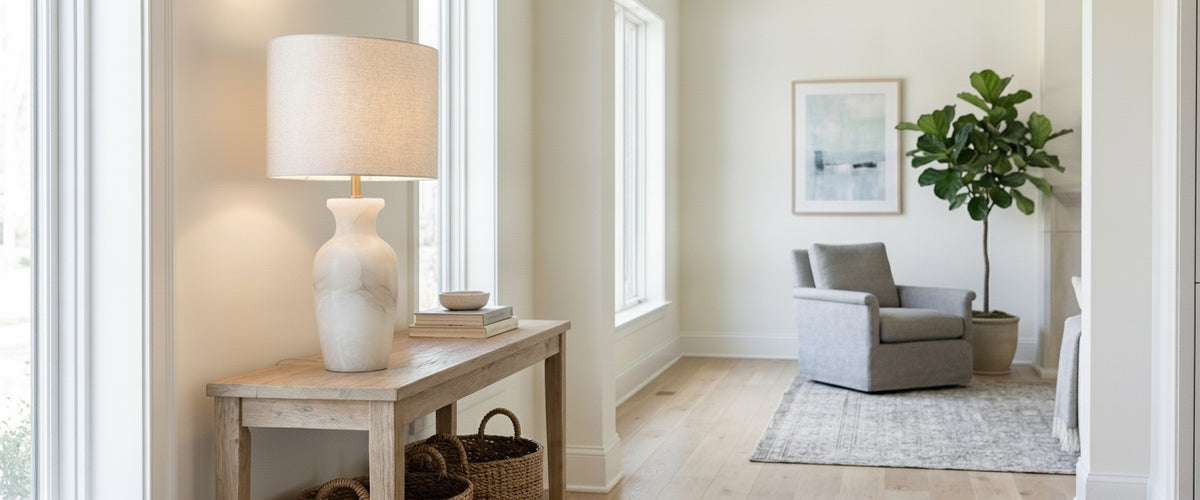

Most table lamps that look wrong in a room have a perfectly good base. The shade is the problem. It is too small, too opaque or lined in the wrong color, or it sits at a height that throws a bare bulb straight into the eyes of anyone on the sofa. Choosing lampshades for table lamps is where the lamp's real job gets decided, and it deserves more thought than a quick match to the base finish.

At a Glance
Size: on most table lamp shades, the diameter should roughly equal the height of the base. Shade height should be about two-thirds of the base height.
Shape: drums spread light wide, empires push it down onto the table, and ovals suit narrow consoles and bedside tables.
Material: linen and cotton glow, card directs light, and glass and stone shades become light sources in their own right.
Lining: white maximizes output, cream softens it, and gold warms and dims it noticeably.
Bulb: a dimmable LED at around 2700K suits most fabric shades. Always stay under the fitting's maximum wattage.

Why the Shade Decides What a Table Lamp Actually Does
A lamp base holds the bulb up. The shade decides where the light goes. An open-bottomed drum on a side table makes a pool of reading light and a soft halo on the ceiling. Put a narrow, closed-in shade on the same base and you get a bright disc on the tabletop with very little ambient glow. The base is identical in both cases, but the two lamps behave completely differently, which is why lampshades for table lamps deserve the same care as the base itself.
This matters more with stone. An alabaster or onyx base glows faintly when light catches it from above, and the shade on a stone table lamp controls how much of that light reaches the stone. A shade that is too deep or too dense hides the veining you paid for. One that is too shallow exposes the lampholder and the top of the bulb, which spoils the piece on a sightline you see every day.
Empire, Drum or Oval: Choosing a Shape by Purpose
Drum
Straight sides and a wide, open base. Of all the table lamp shades you can buy, drums throw the most light outward and downward, which makes them the default choice for living rooms where the lamp is doing ambient work. They suit cylindrical and squared-off bases, including the cleaner contemporary alabaster forms.
Empire
Narrow at the top, flared at the bottom. The taper concentrates light downward and keeps the ceiling darker, so an empire shade feels more intimate and more traditional. It pairs naturally with baluster and urn-shaped bases, and it works well on bedside tables because less light spills toward a sleeping partner.
Oval and Rectangular
These are the problem-solvers among lampshades for table lamps. Against a wall on a slim console, or on a bedside table that is only about 16 in (40 cm) deep, a round shade of the right width would overhang the back edge or hit the wall. An oval gives you the visual width from the front without the depth.
Linen, Cotton, Card and Glass: How Each Filters a Warm Bulb
Linen has a slubbed weave, and when the lamp is lit you can see that texture. It softens a warm bulb into something slightly uneven and organic, which flatters stone bases. Natural, oatmeal and ivory linen all pass a good amount of light.
Cotton is smoother and more even. Cotton table lamp shades read crisper, glow more uniformly and suit a tailored room. In darker colors, cotton blocks far more light than you would expect from the swatch, so check how it looks lit before committing.
Card and parchment pass little light: card is close to opaque, and most parchment only slightly less so. Nearly all the light exits top and bottom, so the shade itself stays dark and graphic. This is useful for a strong silhouette on a sideboard, but a poor choice if the lamp is your main source of ambient light.
Glass changes the brief. Opal glass diffuses evenly and the whole shade glows. Clear or ribbed glass shows the bulb, so the filament style becomes part of the design. A glass shade for a table lamp also handles heat and cleaning better than fabric.
Then there are shades carved from stone itself. Alabaster is a fine-grained form of gypsum, and it is soft and slightly water-soluble. Its fine grain lets thin sections glow warmly when lit, and its softness and solubility are why you dust it rather than wipe it with water. For buyers comparing lampshades for table lamps, a stone shade is the one option where the shade, not the bulb, sets the color of the light. The alabaster lighting collection is a useful place to see how veining changes from piece to piece once a lamp is lit.
Lining Color: White, Cream and Gold Give Different Glows
Shoppers choosing lampshades for table lamps often treat the lining as an afterthought. It is the part the bulb actually hits, so it shapes the light more than the outer fabric does.
White lining reflects the most light and keeps color rendering neutral. Choose it for reading lamps, kitchens and any room where you need to see true color.
Cream or ivory lining takes the edge off without dulling the light much. It is the safe all-rounder for living rooms and bedrooms.
Gold or metallic lining warms the light dramatically and cuts output. It is beautiful in a dining room or bar at night, but tiring as a main light.
Warmth stacks up quickly. Put gold-lined table lamp shades over honey onyx bases, add 2700K bulbs, and a whole room can turn orange, as if lit by a sodium streetlamp. Swapping to cream linings and letting the stone carry the warmth fixes it straight away. The lesson: if the base or the room is already warm, let the lining stay neutral.
Getting the Proportions Right on Lampshades for Table Lamps
Proportion is where most shades go wrong, and the usual mistake is buying too small. Use these ratios as a starting point:
Diameter: the bottom diameter of the shade should be about equal to the height of the base, measured from the table to the lampholder. It should also be at least 1 in (2.5 cm) wider than the widest point of the base on each side.
Height: the shade should be roughly two-thirds the height of the base. Taller looks top-heavy; shorter looks like a hat.
Coverage: the bottom edge of the shade should hide the lampholder and fitting when you stand beside the lamp.
Eye level: for a lamp beside a sofa or bed, the lower rim should sit roughly at eye level when you are seated, so you never look up into the bulb.
Heavy stone bases need the generous end of these ranges. A substantial alabaster column with a timid table lamp shade looks unfinished, because visual weight matters as much as the measurements.
How to Measure for a Replacement Shade
Measure the base height from the table surface to the top of the lampholder.
Measure the widest point of the base.
On an existing shade you like, record the top diameter, the bottom diameter and the slant height (measured along the side, not straight down). These are the three figures retailers use to list lampshades for table lamps.
Check the fitting. UK lamps typically use a shade ring that sits on the lampholder, a harp and finial, or a clip-on fitting, and bayonet (B22) and Edison screw (E27, E14) holders need different rings or reducers.
If the lamp needs rewiring or a new lampholder to take the shade you want, use a qualified electrician. It is a small job, but not one to improvise.
When the Shade Should Disappear and When It Should Be the Point
There are two schools of thought on lampshades for table lamps, and both are right in the right room. If the base is the statement, such as a carved alabaster urn or a striking onyx block, choose a quiet shade: natural linen, cream lining, a simple drum. Its job is to frame the stone and deliver good light, then step back.
When the base is simple, the shade can carry the design. That might be a pleated silk, a deep colored cotton or a carved stone or opal glass shade that becomes the glowing object in the room. Choose one hero per lamp. Pairing a heavily veined base with a patterned shade almost always looks crowded. Browsing the wider lighting range with this question in mind helps: decide which part of the lamp is meant to hold the eye before you look at anything else.
A Buyer's Checklist Before You Order
Run through these before buying lampshades for table lamps, especially if you are ordering online:
Is the lamp ambient, task or decorative? That settles shape and material first.
Does the bottom diameter roughly match the base height?
Will the shade clear the wall and the back edge of the table?
Does the lining suit the bulb and the room's existing warmth?
Is the fitting type (shade ring, harp or clip) correct for your lampholder?
Is the bulb dimmable, around 2700K, and within the fitting's maximum wattage?
For stone shades: is there a dry, soft cloth on hand and a plan to keep it away from damp bathrooms and wet cleaning?
Get the table lamp shade right and a good base finally does what it was made to do. Get it wrong and no amount of craftsmanship in the stone will save it.