
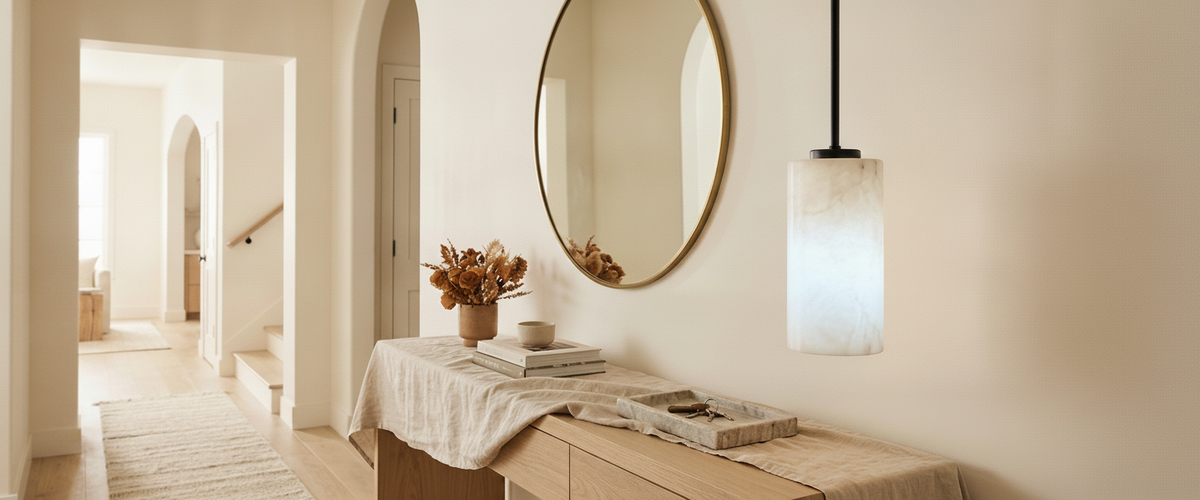

Search for something like justice design alabaster and you land in a crowded room of fittings that all promise the same thing: that soft, honeyed, stone-lit glow. Some of them deliver it. Many are molded resin with a printed vein pattern, and the difference only becomes obvious once the bulb is on and you are standing in your own hallway wondering why the light looks flat. This guide is about telling the two apart before you commit, and about what a genuine alabaster fitting actually does that an imitation cannot.
At Niori we work only in alabaster and natural stone, so we spend a lot of time explaining why one glowing shade costs what it does and another looks similar in a photo but reads as plastic in the flesh. Most people who reach us after comparing Justice Design alabaster options are really asking one question: is this stone or is it not? The short version is that real stone scatters light through its whole body, while a resin lookalike mostly bounces it off a surface. Once you have seen both lit in the same room, you stop confusing them.

Key Takeaways
Genuine alabaster is translucent stone. Light travels into it and scatters, giving depth and a warm inner glow. That is the benchmark any Justice Design alabaster fitting has to meet.
Faux alabaster is usually resin or acrylic with a molded or printed vein. It tends to glow flat and evenly, without the layered look of real stone.
Veining, thickness, weight and edge detail are the giveaways. Ask about all four before buying.
Budget depends on material, scale, engineering and finishing, not on brand name alone. Whether a piece is sold as Justice Design alabaster or under any other label, request a tailored quote rather than trusting a single headline figure.
The alabaster look suits calm, layered rooms: hallways, dining spaces, bedrooms and quiet corners of hospitality interiors.

What the Faux Alabaster Look Promises, and Where Resin Quietly Fails
The pitch for faux alabaster is understandable. You get the pale, veined, glowing shade at a fraction of the weight, with none of the sourcing headaches that come with a natural material. For a molded fitting, every unit looks identical, which suits a spec sheet nicely, and it is why so many Justice Design alabaster-style listings read as easy value at first glance.
The failure shows up in light. Resin and acrylic are engineered to be uniform, so when you put a bulb behind them they light up like a lampshade: uniformly bright and faintly lifeless. There is no sense that the light is coming from within the material, because it is not. It is passing through a thin, consistent skin. Real alabaster, by contrast, has density that varies across the piece, so the glow pools and softens in a way your eye reads as natural before your brain works out why.
If you are weighing a Justice Design alabaster fitting against a carved stone one, longevity is the second question after light. Alabaster is a form of gypsum stone that has been carved and polished for lighting and sculpture for centuries; the British Museum holds Mesopotamian alabaster pieces that have survived thousands of years (britishmuseum.org). Resin does not age with the same grace. Under a warm bulb over years, some resins yellow, cloud or develop a faint plastic sheen. A stone shade simply stays stone.
How Genuine Stone Scatters a Bulb While a Molded Lookalike Just Glows Flat
Hold a slab of real alabaster up to a light and you can watch the beam disappear into it and re-emerge softer, warmer and unevenly spread. That is subsurface scattering, the same optical behavior that makes skin and marble look alive rather than painted. The stone's crystalline structure bends and diffuses light through its thickness, so a single bulb becomes a gentle field of glow rather than a hotspot.
A molded lookalike cannot do this convincingly because its material is too thin and too even. You often see the bulb as a bright core with a halo around it, and the veins stay stubbornly flat, like a print rather than something the light is traveling through. If you ever spot a hard bright ring where the shade meets the fitting, you are usually looking at a thin synthetic shell, which is exactly what a Justice Design alabaster listing with only unlit photography can hide.
This is also why bulb choice matters more with stone. Whether the fitting is sold as Justice Design alabaster or carved to order for you, we recommend warm-white LED, roughly 2700K, with a high color-rendering index so the veining reads true. Put a harsh cool bulb behind good alabaster and you fight the very quality you paid for. If you want the fixture to sit at the center of a room, a dimmable circuit lets you take that glow from a soft evening wash up to a working level without ever making the stone look clinical. You can see how that plays out across pendants, chandeliers and wall lights in our alabaster lighting collection.
Veining, Thickness and Edge Detail That Separate Stone From Imitation
Three physical tells separate genuine alabaster from a good imitation, and they are worth learning before you put money down on any Justice Design alabaster fitting.
Veining that runs through, not across. On real stone, the veining is three-dimensional. Tilt the piece and the pattern shifts slightly because it exists inside the material. A printed or molded vein sits on the surface and looks the same from every angle. Genuine veining is also irregular in a way that is hard to fake: no two panels match, and a matched pair of fittings will be close cousins rather than identical twins. The same rule applies beyond lighting: on a solid surface such as the Circulael 45cm Marble Coffee Table, that through-body veining is exactly what you run your eye across in daylight, and it never quite repeats.
Thickness and how the edge catches light. Natural alabaster is carved with real wall thickness, so a cut edge shows depth and a faint internal glow. A synthetic shell is usually thin and uniform, and the edge can look like a molded lip. Run a finger along a carved stone edge and you feel a slight variation; a molded one feels mechanically smooth.
Weight. This is the honest test. Alabaster and marble are dense. A stone pendant shade or table lamp body has real heft, often several pounds (a couple of kilos) even at modest sizes. Pick up a resin equivalent and it feels suspiciously light for its size. If a supplier is vague about weight, that is a signal in itself, and weight is the fastest way to sort a Justice Design alabaster claim from carved stone in a showroom.
Where This Alabaster Look Actually Settles in UK Interiors
Buyers who come to us after browsing Justice Design alabaster fittings usually have one specific room in mind, and the glow does its best work where you want calm rather than sparkle. In a Victorian hallway, a single alabaster pendant hung over the stairwell turns a transitional space into somewhere you actually pause. We shipped a pair of matched alabaster wall lights to a Georgian townhouse in Bath last year, flanking a chimney breast; the client's brief was simply "stop it feeling like a corridor," and the low, warm wash off the stone did exactly that.
Over a dining table, a long alabaster pendant or a stone chandelier gives you flattering light that makes food and faces look their best, which is the whole point of eating by lamplight. In bedrooms, a stone table lamp on each side of the bed reads as quiet luxury and throws a soft pool that is kind at the end of the day. Bathrooms and dressing rooms suit alabaster wall lights, provided the fitting carries the correct rating for the zone and is installed by a qualified electrician.
The stone reads just as well as a horizontal surface. Where a living room needs the same honeyed material at low level rather than overhead, a piece such as the Circulael 45cm Marble Coffee Table in Brushed Brass lets the veining sit in daylight and picks up the warmth of nearby lamps at night, tying the scheme together without adding another light source.
Hospitality interiors lean on the same qualities. Restaurants and hotels want light that is warm and forgiving, layered rather than glaring, and natural stone delivers that without the hard edge of bare bulbs. If you are speccing across several rooms and want to weigh Justice Design alabaster options against carved pendants, chandeliers, floor and table pieces in one place, the full lighting collection is the easiest way to see the range side by side.
The Questions That Expose a Faux Fitting Before You Commit
Before you buy anything sold as Justice Design alabaster, ask these directly. A confident stone supplier answers them without flinching.
Is this natural alabaster, marble or onyx, or is it resin, acrylic or "faux alabaster"? The wording matters. "Alabaster-effect" and "faux" are honest admissions that it is not stone.
What does the shade weigh? If they cannot tell you, be cautious.
How thick is the carved wall, and is each piece unique? Genuine stone varies piece to piece; identical units across a whole product line suggest molding.
What bulb and color temperature is recommended, and is it dimmable? A stone specialist will steer you to warm, high-CRI LED and explain why.
How should it be cleaned? Real alabaster is porous and needs dry or barely-damp dusting, not sprays. A supplier who recommends kitchen cleaner is not thinking about stone.
What is included in the quote? Material, scale, engineering, finishing and any brass detailing all move the figure. Two fittings both described as Justice Design alabaster can sit far apart on price for exactly those reasons, so ask for a tailored quote rather than assuming a headline price covers the piece you actually want.
A Quick Buyer's Checklist
Confirm the material in writing: natural alabaster or stone, not resin.
Check weight and wall thickness against the size.
Look at lit photos, not just unlit product shots, because that is where a Justice Design alabaster lookalike gives itself away.
Match the bulb to the stone: warm-white, high-CRI, dimmable.
Plan installation with a qualified electrician, especially in bathrooms.
Ask about care and long-term ageing before you buy.
The alabaster look is worth having. Whether you got here through a Justice Design alabaster search or a showroom visit, make sure the thing arriving at your door is stone that scatters light, not a shell that only borrows the picture. Once you have lived with the real material, the difference stops being a spec argument and becomes something you simply see every evening.