
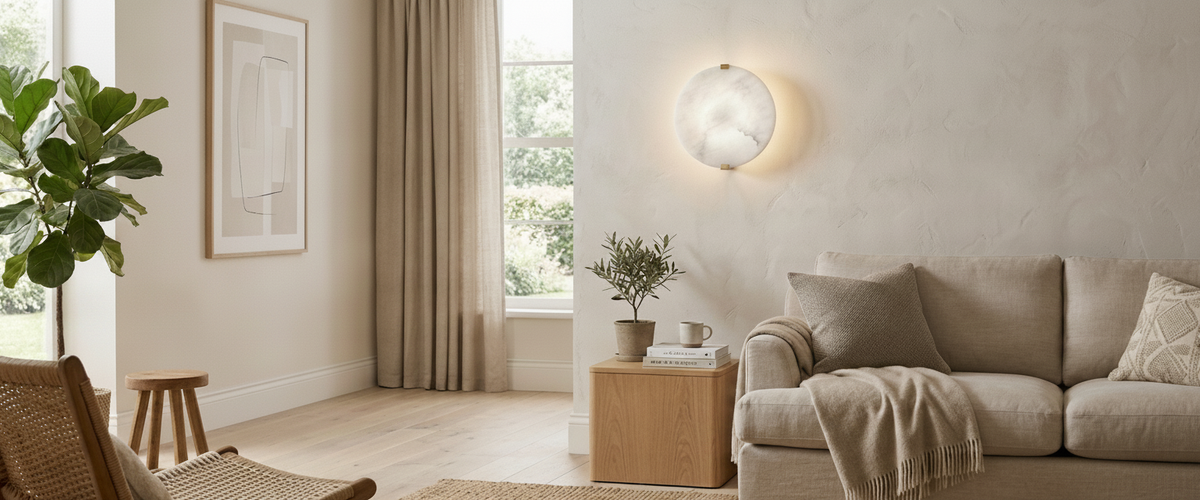

A well-placed sconce can do something a table lamp never quite manages: it lights the wall itself, so the room reads as calm and considered rather than dotted with pools of light. That is the real argument for indoor wall lights sconces. They give you glow at eye level, they clear your surfaces, and in an alabaster or natural-stone fitting they turn the wall behind them into a soft, warm panel instead of a bright spot you squint at. Indoor wall light sconces are the quiet workhorse of a good scheme.
Get the height, the spacing, and the bulb wrong, though, and you end up with two harsh dots on the plaster and a client asking why the room feels like a corridor. Below is how we think about indoor wall light sconces at Niori, where almost everything we ship is cut from stone that filters light rather than firing it straight at you.

Key Takeaways
Indoor wall sconce lighting works best at eye level or just above, roughly 60 to 66 inches (152 to 168 cm) to the centre of the fitting in most rooms.
Alabaster and marble diffuse the source, so you avoid the glare that makes cheaper indoor wall lights unpleasant to sit near.
Uplight, downlight, and diffused throws each suit a different wall job; match the fitting to what the wall needs to do.
Warm bulbs around 2700K on a dimmer are the difference between indoor wall light sconces you switch on and ones you ignore.
Indoor fittings must stay indoors, and while an exterior fitting can technically go inside, it rarely looks right there.

What Sets an Indoor Sconce Apart From a Bedside Arm or an Exterior Fitting
Not every wall light is a sconce, and not every sconce belongs indoors. A bedside reading arm is a task light: adjustable, directional, meant to throw a tight beam onto a page. Indoor wall light sconces are closer to architecture. They sit flat or shallow against the wall, spread a broad wash, and are designed to be looked at as much as read by.
Exterior fittings are a different animal again. They are sealed against rain, sized for a bigger throw, and often finished in coatings built to survive frost and UV. That engineering makes them overbuilt and visually heavy for a hallway. So while you can bring an outdoor fitting inside, you rarely want to; the detailing that reads as handsome on a stone porch tends to look clumsy next to a sofa.
Stone changes the equation. An alabaster face has natural veining that lights up from within, giving each fitting a slightly different pattern of grain. You are lighting the material, not just the wall, and that is the quality you cannot get from a flat metal plate or a frosted-glass disc. It is also why stone indoor wall light sconces reward a closer look than a plain plaster-mounted disc.
Mounting Height and Spacing That Flatter a Wall Rather Than Spotlight It
The most common mistake we see is indoor wall light sconces hung too high, so the light skims the ceiling and leaves faces in shadow. As a general rule, aim for the centre of the fitting at around 60 to 66 inches (152 to 168 cm) from the floor in living spaces. In a hallway with high ceilings you can nudge that up; flanking a bathroom mirror you drop it to sit level with the eyes of the person using it.
Spacing depends on the throw. For a pair flanking a bed, headboard, or fireplace, 30 to 40 inches (76 to 102 cm) apart usually looks balanced. Along a corridor, space fittings so their pools of light just overlap at the floor rather than leaving dark gaps between them. Walk the corridor before you drill; the eye tells you more than a tape measure here.
One studio lesson worth passing on: on a textured or plastered wall, a downlight-heavy sconce will rake across the surface and expose every ripple. If the plaster is not perfect, choose a diffused or uplight fitting that floods the wall evenly instead of grazing it. We learned that on a Cotswold-style project where the client had specced beautiful lime plaster and a batch of grazing downlights; the two did not get along.
Rooms Where a Stone Sconce Replaces the Table Lamp Entirely
The strongest case for indoor wall sconce lighting is the room where a table lamp is in the way. Beside a bed with slim floating nightstands, a pair of indoor wall light sconces frees the top surface for a book and a glass of water while giving each sleeper their own soft glow. In a tighter hallway or either side of a mirror, a more compact fitting such as the Essence Round Wall Light 75cm, Brass holds the scale without crowding the wall. In a narrow entrance hall there may be no surface at all; a sconce is the only lamp that fits.
Living rooms benefit too, especially either side of a chimney breast or artwork. A stone sconce there works as a low ambient layer you leave on all evening, so the overhead light can stay off. Dining rooms, powder rooms, and stair landings are the other obvious homes. In each, indoor wall light sconces earn their place by lighting the vertical plane, which is where our eyes actually rest when we sit down.
If you are building a scheme from scratch, it helps to see the fittings as a family. Browsing the alabaster lighting range alongside pendants and table lamps in the same stone lets you keep veining and tone consistent from room to room, which is where a project starts to feel intentional rather than assembled.
Uplight, Downlight, or Diffused: Matching the Throw to the Wall's Job
Every sconce throws light in one of three broad ways, and the right one depends entirely on what you want the wall to do. Choosing well is what separates indoor wall light sconces that work from ones that fight the room.
Uplight sends the beam toward the ceiling, bouncing soft indirect light back down. It makes ceilings feel higher and rooms feel calm. Good for living rooms, bedrooms, and anywhere you want atmosphere over task light.
Downlight pushes light toward the floor, useful for marking a route along a hallway or grazing a textured stone wall on purpose. Keep it away from imperfect plaster.
Diffused, or up-and-down, glows in both directions and is the most forgiving. An alabaster disc or a round stone fitting reads as a lit object in its own right, which is why so many of our round and square wall lights sit in this category.
Round or square is partly a styling call. Round fittings soften a room and suit period or organic interiors, while a square form such as the Essence Square Wall Light 115cm, Brass suits clean, architectural spaces where you want the geometry to line up with joinery and door frames. The larger diameters make a statement flanking a fireplace, while the smaller sizes suit a tighter hallway or a pair either side of a mirror. If you want to compare forms across the whole range, the full lighting collection shows how the same stone reads in pendants, sconces, and lamps side by side.
Warm Bulbs and Dimming for a Sconce You Actually Leave Switched On
A sconce lives or dies by its bulb. Stone rewards a warm colour temperature; around 2700K gives the honeyed tone that shows off the veining and flatters skin. Push past 3500K and alabaster indoor wall light sconces start to look cold and clinical, which defeats the point of buying stone in the first place.
Put every sconce on a dimmer. The value of a wall light is the low, ambient layer it provides late in the evening, and you want to be able to drop it to a glow rather than run it at full output. Use a trailing-edge LED dimmer matched to your bulbs to avoid flicker and buzz; the Chartered Institution of Building Services Engineers publishes useful guidance on lighting quality and glare control if you want to go deeper on the technical side (cibse.org).
Choose bulbs with a high colour rendering index, ideally 90 or above, so the stone's warm greys and creams read true rather than muddy. And check the fitting's maximum wattage before you reach for a bright lamp; more output through alabaster does not mean better, it means glare bleeding through the thinnest part of the stone.
A Quick Buyer's Checklist
Confirm the fitting is rated for indoor use, not an exterior model brought inside.
Decide the throw first (uplight, downlight, or diffused), then the shape.
Set mounting height to the centre of the fitting, around eye level for most rooms.
Space pairs 30 to 40 inches (76 to 102 cm) apart; overlap the pools along corridors.
Specify 2700K, high-CRI bulbs on a compatible dimmer.
Use a qualified electrician for any hard-wired installation.
On budget, resist any fixed figure. What you pay for indoor wall light sconces depends on the stone, the size, the metalwork and finishing, and whether the piece is hard-wired or plug-in. Solid alabaster and hand-finished brass sit at a different level from a pressed-metal fitting, so it is worth requesting a tailored quote for the exact sizes and finishes your project needs rather than working to a guessed price. Treat indoor wall light sconces as architecture you can price properly, not an afterthought.