
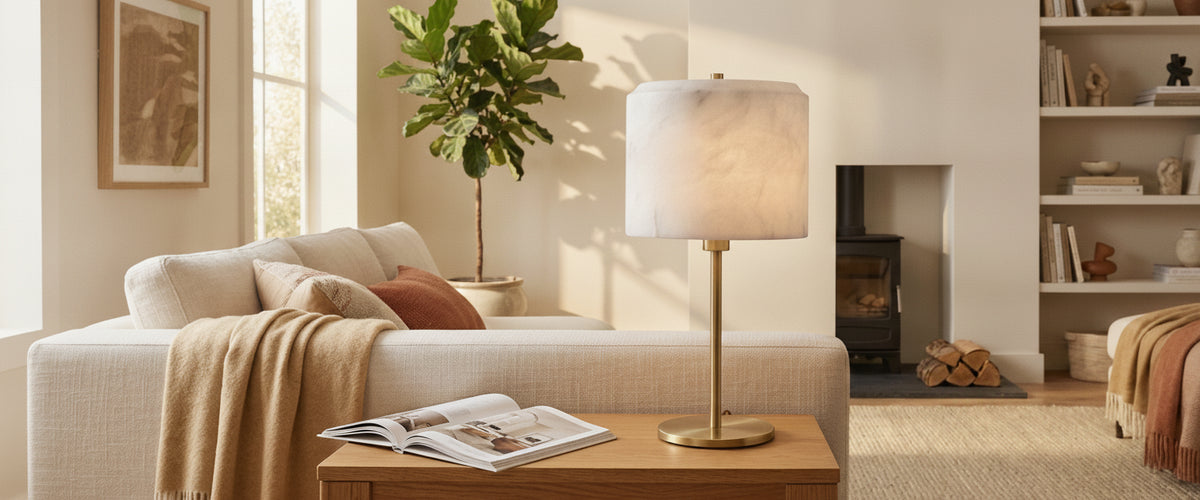

A lamp base gets all the compliments. The shade does all the work. It decides how much light reaches the floor, how much washes the wall behind it, whether the bulb glares at you across a sofa, and what colour the light lands as once it has passed through fabric, paper or stone. Get the shade wrong and even a beautifully made base looks awkward and lights badly. Get it right and one lamp can carry a whole corner of a room. That is why lamp shades deserve more thought than they usually get.

At a Glance: Choosing Lamp Shades in Six Lines
- Width: aim for a shade roughly twice the width of the widest part of the base body, then adjust by eye.
- Height: around one third of the total lamp height is a safe starting point for table lamps.
- Coverage: the bottom edge should hide the lampholder and the bulb from normal seated eye level.
- Material: lined fabric throws light up and down; raffia and open weaves leak sideways; alabaster and stone glow as one solid piece.
- Fitting: check whether you need a ring (washer) fitting, a spider and harp, or a gimbal before you buy anything.
- Bulb: warm, dimmable, and low enough in output that the shade diffuses rather than blazes.

What Lamp Shades Suit Which Rooms, and Who They Are For
Start with the job the lamp is doing. A hallway console lamp is mostly decorative and wants a shade that glows; a reading lamp beside an armchair needs a shade that pushes usable light downward onto a page. Those two briefs pull in opposite directions, and no single profile satisfies both.
Most lamp shades fall into four familiar shapes. Tapered (empire) shades angle light down and forward, which suits reading positions and low ceilings. Drum shades split light more evenly up and down, so they suit dressing tables, sideboards and rooms with generous ceiling height. Pleated shades, whether knife pleat or a gathered leaf pattern, break the surface into ridges that catch light unevenly and read as softer and more decorative; they have become the default in period homes and in schemes that need warmth rather than punch. Coolie shades, wide and shallow, throw a broad pool downward and work over side tables in a snug.
Designers and hospitality buyers tend to ask a different question again: how will the shade look when every table in the room has one? Fabric lamp shades in a restaurant need washable or replaceable covers. Alabaster and stone diffusers need no covers at all, which is one reason we see them specified for bar tops, private dining rooms and hotel corridors where nobody wants to be re-shading forty lamps in two years.
Sizing, Height and Placement That Actually Works
The two-thirds and one-third relationship is the quickest sanity check. If the base is 20in (50cm) to the top of the lampholder, a shade around 10in (25cm) tall usually sits right, and its bottom diameter should be a little wider than the widest point of the base. A shade narrower than the base always looks starved. A shade that drops so low it swallows the neck of the lamp looks like a hat two sizes too big.
Height in the room matters more than most people expect. For a table lamp beside a sofa, the bottom edge of the shade wants to land near eye level when you are seated, roughly 40in to 42in (100cm to 107cm) from the floor. Any higher and you see the bulb every time you look across the room. Beside a bed, drop it lower, so the light falls on the book rather than in your partner's eyes, and check the shade does not overhang the mattress edge.
Then there is the fitting, which is where online orders go wrong. Most UK table lamps use a ring or washer fitting that sits directly on the lampholder; others need a spider fitting supported by a harp, and wall lights often take a small gimbal shade. Candle clips are a fourth category again. Measure and confirm before you buy, because a beautiful shade with the wrong aperture is a returned parcel.
One more placement rule that saves regret: look at the lamp from the doorway, not from the chair. A client refitting a first-floor drawing room in Marylebone had chosen wide drum lamp shades that measured perfectly on paper. From the door, with a low picture rail behind them, they read as two blocks. Swapping to a tapered profile of the same height opened the wall back up and improved the reading light at the same time.
Materials, Finishes and the Quality of Light
Fabric, Linen and Pleats
Lined fabric is the workhorse. A white or ivory lining keeps the transmitted light neutral; gold and champagne linings warm it noticeably, which flatters skin tones and reddens timber. Coloured outer fabrics such as apricot, ochre or a herb green tint the light escaping through the sides, so lamp shades you love in daylight may cast a different mood at night. Where a hallway console or a dressing table can take colour rather than neutral cloth, a pleated shade such as the Zigzag Lamp Shade in Apricot Orange will push a distinctly warmer wash onto the wall behind it than the same shape in ivory. Test it lit before committing to a pair.
Raffia and Natural Weaves
Raffia, rattan and loosely woven grasses leak light through the weave, producing a speckled halo rather than a clean cone. Woven lamp shades are lovely in a kitchen, a garden room or a coastal scheme. They are less useful when you need controlled task light, and worth avoiding directly above a dining surface where the pattern of leakage will be in everyone's eye line. If you want that halo but still need something usable beside a chair, a tapered profile such as the Raffia Tapered Lamp Shade in Black Natural Raffia keeps a defined downward throw while the weave does the softening.
Alabaster, Marble and Onyx
Stone changes the conversation, because the shade and the diffuser become the same object. Alabaster is a fine-grained gypsum stone, translucent enough that light passes through the body of the material and reveals the veining from within. That is the effect you cannot fake with fabric: a warm, low-glare glow that seems to come from inside the piece rather than from a bulb hidden behind it. Alabaster has been carved and used decoratively in Europe for centuries, and the Victoria and Albert Museum holds worked alabaster pieces that show just how finely the stone can be cut. Marble tends to be denser and reads more as a solid form with a lit edge; onyx is dramatic, with bold banding that comes alive only when backlit. Our alabaster lighting collection covers pendants, wall lights, table lamps and floor lamps built around exactly that quality of light.
Something we learned in the studio and now check on every batch: no two alabaster panels transmit light identically. We hold off-cuts against a bare warm bulb before a piece is finished, because a panel that looks pale and even in daylight can show a strong honey band once lit. That variation is the point of natural stone, but it is worth knowing when you order a matched pair of table lamps for either side of a bed.
Glass
Opal glass gives an even, slightly cool diffusion. Smoked and bronzed glass cuts output and softens the filament into a glow, which suits exposed pendant fixtures over an island or a stairwell where the fixture is visible from below. Over a breakfast bar where you will be looking straight at the fitting from a stool, something like the Verge 1 Light Glass Pendant in Smoked Shade and Black is closer to the right design language than a clear globe. Clear glass diffuses almost nothing, so the bulb becomes the design decision.
Bulbs and Dimming for Lamp Shades
Colour temperature does most of the heavy lifting. For domestic rooms, stay between 2400K and 2700K; anything at 3000K and above starts to look clinical behind a warm fabric or an alabaster panel. Choose lamps with a high colour rendering index, ideally CRI 90 or better, or the veining in stone and the weave in fabric will look flat.
Match output to density. The densest lamp shades, solid alabaster among them, need more lumens behind them than a thin linen one to reach the same brightness, while an open raffia weave needs far fewer or it will glare. Dim-to-warm LEDs are worth the extra outlay in living rooms and bedrooms, since they drop in colour temperature as they dim and mimic the behaviour of incandescent light. Confirm the driver and the dimmer are compatible; mismatched pairings are the usual cause of flicker and buzz.
For wall lights and any hardwired fixture, use a qualified, registered electrician. In the UK you can check credentials through the Registered Competent Person Electrical scheme. Stone fixtures also carry real weight, so fixings need to suit the wall construction rather than the nearest available plug.
Common Mistakes With Lamp Shades, and How to Avoid Them
- Buying the shade last. Choose the pair together, or at least know the profile before you fall for a base.
- Ignoring the fitting type. Ring, spider and harp, gimbal and clip are not interchangeable.
- Over-scaling in a low room. A tall drum in a room with a low ceiling reads heavy from the doorway.
- Mixing too many shade languages. One pleated, one raffia and one stone shade in a single sightline fight each other.
- Forgetting the visible bulb. Check the view from your usual seat, not from standing.
- Cleaning stone with the wrong thing. Alabaster is soft and reacts badly to acidic or abrasive cleaners; dry dust it and wipe with a barely damp cloth, never with vinegar or bathroom sprays.
- Skipping the dimmer. A fixed-output lamp behind a beautiful shade only ever has one mood.
Quick Buying Checklist
- Confirm the job: ambient glow, reading light or decorative accent.
- Measure the base width and the height to the lampholder.
- Choose shape by ceiling height and viewing angle.
- Decide on material by the light quality you want, not the swatch alone.
- Check the fitting type and any harp requirement.
- Specify bulb type, colour temperature, CRI and dimming.
- For hardwired pieces, book the electrician before the delivery, not after.
- Plan the care routine while the piece is still in its packaging.
How Niori Can Help With Lighting Projects
Niori works in alabaster and natural stone, so our advice tends to start with how light behaves inside a material rather than how a shade looks unlit. Buyers usually come to us for one of two reasons: they want a table or floor lamp whose shade is the stone itself, or they are balancing a scheme where fabric lamp shades handle the soft corners and one stone pendant anchors the room. Both are sensible. Browsing the full lighting range is the quickest way to see which fixture type suits your ceiling height and sightlines.
For designers, architects and venue owners, we can talk through veining consistency across a matched set, weight and fixing implications for wall-mounted pieces, and lead times for larger installations. Budget depends on the stone, the scale, the complexity of the carving, the metalwork and the finishing, so the honest answer is to send us the drawings or the room photos and ask for a tailored quote rather than working from a guessed figure.
Lamp shades are the cheapest way to change how a room feels and the easiest thing to get wrong. Size them against the base, place them against the eye, choose the material for the light and not just the look, and put a dimmer behind every one of them. Start at the Niori homepage if you want to see how stone handles that job differently from fabric.