
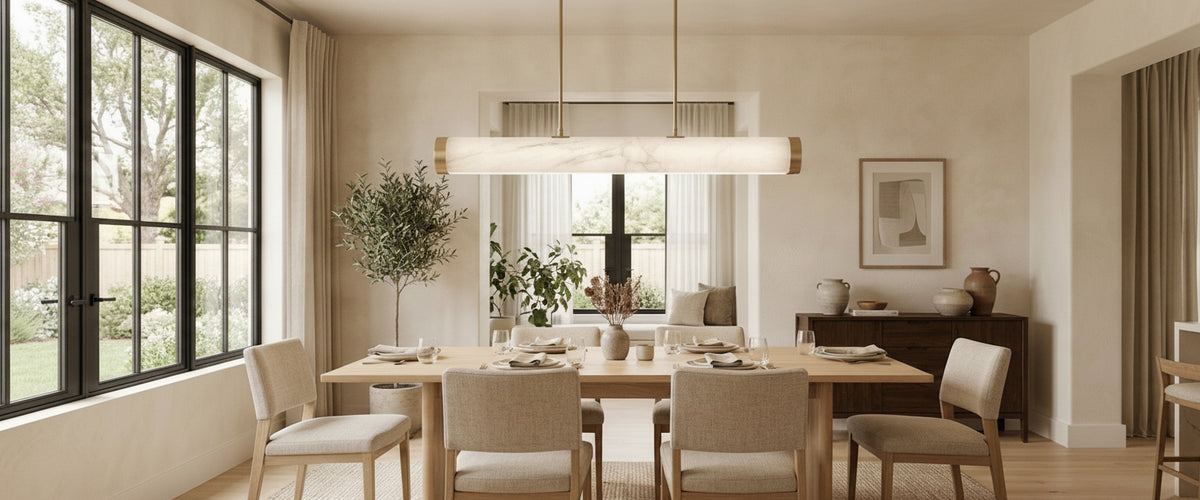

Most dining rooms are lit from the wrong height. Either a single pendant hangs so high it lights the ceiling instead of the table, or a grid of recessed spots rakes down over guests and puts shadows under everyone's eyes. Dining room ceiling lights carry more weight than any other fixture in the house, because they set the mood of the one room where people sit still for two hours and actually look at each other. Get the scale, height and light quality right and the room does the work for you.

At a Glance
The essentials for specifying dining room ceiling lights, before the detail:
- Scale: a round pendant or chandelier wants to be roughly half to two thirds the width of the table; a linear fixture, half to two thirds its length.
- Height: around 75 to 90cm (30 to 36in) from tabletop to the base of the fixture on a standard 2.4m (8ft) ceiling.
- Light quality: alabaster and onyx diffuse from within, so you see a lit surface rather than a bright bulb.
- Colour temperature: 2700K for a warm, evening-led room; 3000K where the space doubles as a working kitchen or office.
- Non-negotiable: dimming, on a driver and switch that are actually compatible.
- Low ceilings: a flush or semi-flush stone disc, not a shortened pendant.

Which Dining Room Ceiling Lights Suit Your Room
Start with the shape of the table and the height of the ceiling, because those two facts eliminate most of the catalogue immediately. In practice, dining room ceiling lights fall into four families.
Single pendants belong over round and square tables up to about 1.2m (4ft) across. One generous alabaster shade reads as a deliberate centrepiece; three small ones over the same table read as indecision.
Linear and multi-shade pendants are the answer for rectangular tables of 1.8m (6ft) and up. A single stone bar, or two to three matching pendants spaced evenly along the table axis, spreads light along the surface instead of pooling it in the middle and letting the ends go dim.
Chandeliers earn their place in rooms with real ceiling height, from period townhouses in Bath and Edinburgh to double-height extensions where a small fixture would simply vanish. Alabaster chandeliers work particularly well here because the stone plates catch light on their faces, so the piece still has presence when it is dimmed to a quarter.
Flush and semi-flush ceiling lights are the honest choice under 2.4m (8ft), in loft conversions with sloping eaves, or in a dining area that shares a ceiling plane with a kitchen. A slim stone or opal disc gives soft ambient light without anyone ducking. Where the ceiling is low but the table is long, width does the work that drop normally would, so a wide flush disc such as the Oracle Black Slim Flush Ceiling Light 2700K, 90cm covers the table far better than a shortened pendant ever will.
For designers and venue owners, add one more consideration: sightlines. In a restaurant or private dining room, a low pendant over a long sharing table blocks the view across it. We supplied a run of alabaster pendants to a Manchester dining room where the original brief called for a single dramatic drop over a 3m (10ft) oak table. We suggested three smaller shades instead, hung higher, and the client kept the sightline down the table for service.
Sizing, Height and Placement That Works
The rules below are the ones we use daily when clients send through room drawings for dining room ceiling lights.
Diameter and Length
Measure the table, not the room. For a round table, aim for a fixture diameter of roughly half to two thirds the table width, so a 1.2m (4ft) table takes something in the region of 60 to 80cm (24 to 32in). A 70cm disc such as the Oracle White Slim Flush Ceiling Light 2700K, 70cm sits squarely in that band. For rectangular tables, a linear fixture at half to two thirds the table length keeps the proportion generous without crowding the ends. If you are hanging multiple pendants, allow at least 60cm (24in) between centres and keep the outer shades comfortably inside the table footprint.
Hanging Height
Base of the fixture to tabletop: 75 to 90cm (30 to 36in). Go lower and tall guests meet the shade; go higher and the light loses intimacy. Add roughly 7cm (3in) for every additional 30cm (1ft) of ceiling height above 2.4m (8ft). One caveat that catches people out: if the shade is open at the bottom and the bulb is visible from a seated position, raise it or choose a diffused stone shade instead.
Centring
Dining room ceiling lights should be centred on the table, not the room, so confirm where the table will actually live before first fix. Ceiling roses rarely sit where you want them. If the existing point is off by 20cm or more, a qualified electrician can move it, or you can use a fixture with a ceiling plate and a discreet cable offset. Both are far better than living with a pendant that hangs off-axis for a decade.
Layering
Ceiling lights should not do all the work. A pair of alabaster wall lights on the flank wall, or a small stone table lamp on a sideboard, lifts the vertical surfaces and stops the room from feeling like a lit island in a dark box. Guidance bodies such as CIBSE set far higher lighting levels for food preparation than for dining, which is exactly why a kitchen-diner needs two separate circuits rather than one bright scheme running at full output all evening.
Materials, Finishes and Light Quality
This is where dining room ceiling lights separate into two camps. Opaque metal shades throw light down in a hard cone; translucent materials glow. Alabaster sits at the top of the second camp because light travels a short way into the stone before scattering, so the surface itself becomes the light source. Veining reads as soft cloud rather than pattern, and the colour temperature warms very slightly as it passes through the stone. Faces look better under it. That is not romance, it is diffusion.
Onyx behaves similarly but with more drama, since the banding is stronger and more directional. Marble is largely opaque and works best as a base, backplate or structural element rather than a shade. Brass detailing pairs naturally with all three, and unlacquered brass will patinate over years into something warmer. In an open-plan room where the table also has to work at 3000K, a brass-rimmed diffused fitting such as the Oracle Brass Slim Flush Ceiling Light 3000K, 90cm keeps the metal warmth in the scheme without introducing a hard downlight. If you want a consistent look across a whole floor plan, our alabaster lighting collection is a sensible place to compare shade forms before committing to a fixture type.
Worth knowing: alabaster is a gypsum stone, soft enough to scratch with a fingernail and sensitive to water. The Natural Stone Institute treats soft gypsum stones as dry-clean-only for exactly that reason. It is a material for a dining room ceiling, not for a steam room or an unsheltered terrace.
Bulbs, Dimming and Colour Temperature
The electrics matter as much as the shade, and these are the numbers we specify for dining room ceiling lights:
- 2700K for dining rooms used mainly in the evening. Warm, candle-adjacent, kind to stone veining.
- 3000K where the dining table doubles as a homework desk or the room opens straight onto a kitchen.
- Avoid 4000K and above directly over the table. It is a fine specification for a utility ceiling light and a poor one for dinner.
- CRI 90+ so food, wine and timber all read true.
- Dim to 10% or lower. A dining scheme that only drops to 40% has no evening setting.
- Match driver to dimmer. Trailing-edge dimmers paired with a compatible LED driver avoid the flicker and buzz that ruin an otherwise good fixture.
- Integrated LED versus replaceable lamp: ask which you are buying. Integrated modules give a slimmer profile; replaceable lamps are simpler to service in ten years.
Common Mistakes and How to Avoid Them
The errors we see most often with dining room ceiling lights are all fixable before the electrician arrives.
Buying too small. The single most frequent error. A shade that looks large in a photograph shrinks the moment it is 2.4m up. When in doubt, size up one step.
Centring on the room instead of the table. Mark the table position on the floor with tape before the electrician commits to a point.
Relying on recessed spots alone. Downlights above head height create shadow under brows and noses. If spots are already in, add a diffused ceiling fixture over the table and dim the spots to a supporting role.
Forgetting the ceiling void and fixing. Stone fixtures weigh more than glass or metal equivalents. Confirm the fixing substrate, joist position and load path with your installer before delivery, and never hang a stone chandelier from a plasterboard box without a proper support.
Skipping dimming to save on the switch. The cheapest part of the scheme does the most for atmosphere.
Cleaning stone with a wet cloth. A dry microfibre cloth or a soft brush, gently, with the power off and the fitting cool. No proprietary sprays, no vinegar, no alcohol.
Installation and Care Checklist
- Confirm ceiling height, table dimensions and final table position.
- Check the fixture weight against the fixing point and agree the support method with a qualified electrician. Mains work should always be signed off by a competent professional.
- Specify dimmer and driver together, and test the pairing before the ceiling is decorated.
- Unpack stone shades on a soft surface and handle by the body, never by the cable or the rim.
- Set the drop, then sit at the table and check the bulb is not visible at eye level.
- Dust every few months with a dry cloth; a soft artist's brush reaches carved edges.
- Keep stone fixtures away from extract vents and steam, and re-check fixings after any building work nearby.
How Niori Can Help with Lighting Projects
Niori designs and supplies alabaster and natural-stone lighting: pendants, chandeliers, wall lights, table lamps, floor lamps and flush ceiling fixtures, shipped worldwide. Because every block of stone is different, no two shades are identical, and that is part of the point. For larger schemes we regularly work from a designer's drawings to agree drop lengths, shade scale, finish pairing and lamp specification across a whole floor plan, so the dining room ceiling lights relate properly to the hallway and kitchen rather than competing with them.
If you are still deciding between a linear pendant, a chandelier and a flush stone disc, browsing the wider lighting range alongside your room measurements is the quickest way to narrow it down. Cost depends on material, scale, engineering, finish and installation complexity, so the honest answer is to ask for a tailored quote. Send a plan, a ceiling height and a table size, and we will tell you what will work and, just as usefully, what will not.