
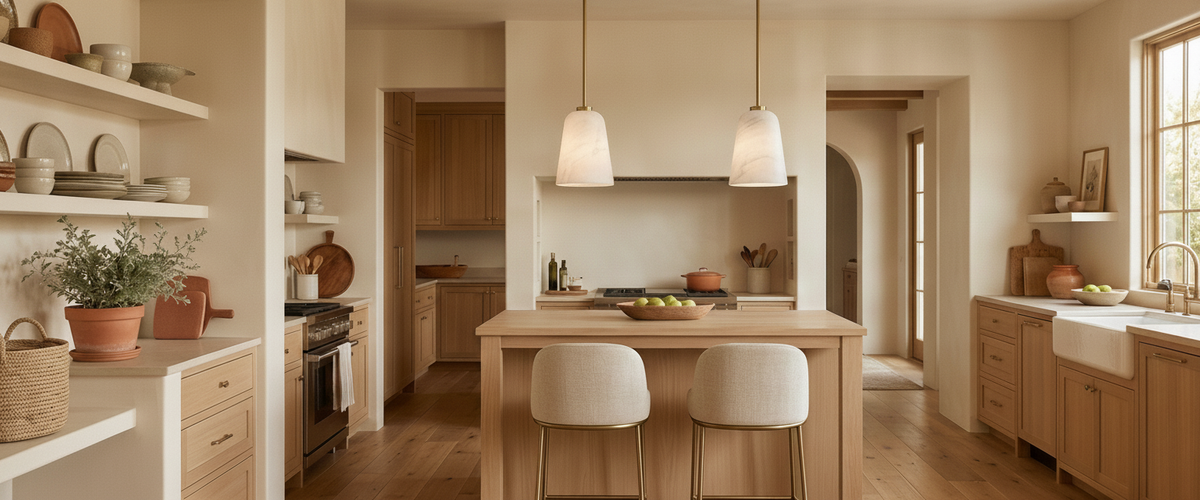

Brass has a habit of outliving the trends that surround it. Chrome dates, matt black swallows light, and painted metal chips at the first knock, yet brass pendant lights keep looking deliberate a decade after installation. The catch is that brass is not one material with one behaviour. It comes lacquered, unlacquered, aged, antiqued, satin-brushed and painted, and each of those choices changes how the fitting looks in six months, how it feels under the hand, and how the light lands on the surface below.
Get the finish and the hanging height right and brass pendant lights become the quiet anchor of a room. Get them wrong and you have a shiny yellow object floating at eye level, glaring at everyone across the table.

Key Takeaways
- Finish matters more than shape. Unlacquered brass pendant lights will darken and patinate; lacquered and painted brass hold their colour. Neither is wrong, but they are not interchangeable.
- Hang for the sightline, not the ceiling. Over a worktop or table, aim for roughly 75 to 90cm (30 to 35in) from the surface to the base of the shade.
- Shade material controls glare. Open metal shades throw a hard pool of light; alabaster, stone and opal glass diffuse it.
- Warm brass wants warm light. Around 2700K, on a dimmer, with a high colour rendering lamp.
- Spacing beats quantity. Two well-spaced pendants usually read better than three crowded ones.
- Fitting is an electrician's job. Especially on heavy stone shades and long drops.

What Brass Pendant Lights Suit, and Who They Are For
Brass reads warm. That single property decides most of the rooms it belongs in. Against oak, walnut, unfilled travertine, limewashed plaster or a deep green cabinet, brass pendant lights settle in without argument. Against cool grey porcelain, blue-toned marble and stark white walls, brass can look like it was airlifted in from another scheme unless you repeat the metal elsewhere: tap, handles, a mirror frame, a picture light.
The buyers who get the most out of brass tend to fall into a few camps. Kitchen renovators hanging a run over an island. Homeowners with a period property who want a fitting that does not fight the joinery. Designers specifying hospitality projects, where brass survives daily handling better than a painted finish. And venue owners who need something that looks composed in photographs at nine in the evening as well as at nine in the morning.
Brass also happens to be the natural companion to stone. At Niori, most of our alabaster and natural-stone fittings use brass detailing precisely because the two materials share an undertone. The warm honey in backlit alabaster and the warm gold in brass sit in the same part of the spectrum, so the fitting reads as one object rather than a shade bolted to a bracket. If you are weighing an all-metal pendant against a stone-shaded one, it is worth browsing the alabaster lighting range to see how differently the two treat the same bulb.
Sizing, Height and Placement That Works
Height is where most installations go wrong, and it is the cheapest thing to fix before the electrician leaves.
Over a Kitchen Island or Peninsula
Leave roughly 75 to 90cm (30 to 35in) between the worktop and the bottom edge of the shade. Lower feels intimate and puts light exactly where you chop; higher spreads the pool wider but risks glare from a bare lamp. If anyone in the household is notably tall, hang a touch higher and accept the wider spill.
For spacing, work from the ends inwards. Keep at least 15cm (6in) of clear worktop beyond the outer pendants, then divide the remaining run evenly. On a 2.4m (8ft) island, two medium brass pendant lights usually look calmer than three; a single-lamp fitting with real presence, such as York 1 Light Pendant Light in Painted Natural Brass, holds a pair of positions better than a trio of small shades competing for the same space. On a 3m (10ft) island, three smaller pendants earn their place. We shipped a set of mini pendants to a client near Bath who had centred three fittings on a 2.6m island and ended up with a row that looked squeezed at both ends; moving to two larger shades on the same drop rods solved it in an afternoon.
Over a Dining Table
Same 75 to 90cm rule from tabletop to shade, but the visual weight changes. A single generous pendant reads more formal; a linear run of three brass pendant lights reads more relaxed. Keep the total width of the arrangement to about two thirds of the table length so the ends of the table do not look abandoned.
Hallways, Stairwells and Bedsides
In a hallway, the clearance rule is simpler: nothing below about 2.1m (7ft) from the floor in a walkway. Stairwells are where long-drop brass pendant lights genuinely earn their keep, because the fitting is seen from three levels at once, and a warm metal stem looks considered from every one of them. Beside a bed, a small pendant hung at roughly shoulder height when seated frees the whole nightstand and gives better reading light than most table lamps. At that scale a compact fitting such as Marvele 1 Light Mini Pendant Light in Aged Brass makes more sense than a full-size shade, and the pre-darkened finish keeps it quiet rather than glinting at eye level.
Finishes, Materials and Light Quality
Unlacquered (living) brass is raw metal. It oxidises, fingerprints, and gradually deepens into a mottled bronze-brown. Some buyers love that; some are horrified by month three. The Smithsonian's conservation guidance on caring for metal objects is a useful reality check on how tarnish forms and why aggressive polishing does more harm than good. If you want the patina but not the surprise, hang unlacquered brass away from the kettle and the hob, where steam accelerates everything.
Lacquered and painted natural brass holds its colour. A clear lacquer or a painted brass finish keeps the tone stable and makes maintenance a dry-cloth affair. For kitchens, rentals and hospitality settings, this is usually the sensible specification for brass pendant lights, and a fitting like Hampstead 1 Light Pendant Light in Painted Natural Brass shows the practical version of that logic: warm metal tone above a worktop, without the steam and fingerprints writing themselves into the surface.
Aged and antiqued brass is pre-darkened at the factory, giving you the settled look immediately with far less movement over time. It is the safest middle ground and pairs particularly well with veined stone, because the darker metal echoes the mineral lines in the shade.
Then there is the shade itself, which does most of the work on light quality. A bare bulb inside an open brass cone gives a crisp, directional pool and a lot of sparkle, which suits a bar or a task run but punishes anyone sitting opposite. Opal glass softens it. Alabaster and onyx go further again: light passes through the stone rather than around it, and the veining becomes visible only when the fitting is lit. That backlit glow is warmer and lower in contrast than any glass equivalent, which is why so many of the pieces across our lighting collection combine a brass frame with a stone or alabaster diffuser.
Bulbs and Dimming for Brass Pendant Lights
Warm metal wants warm light. Specify around 2700K for brass pendant lights; anything at 4000K or above turns the metal slightly green and makes alabaster look like plastic. Ask for a colour rendering index of 90 or better if the pendant hangs over food, artwork or stone worktops, because cheap LEDs flatten reds and browns badly.
Dimming is not optional over a dining table. Fit a trailing-edge dimmer rated for LED loads and confirm compatibility with the lamps you plan to use; mismatched drivers are the usual cause of flicker and buzz. For clear-glass or open-shade brass pendant lights, choose a lamp you are happy to look at, since the filament becomes part of the design.
Common Mistakes and How to Avoid Them
- Hanging too high. The single most frequent error. A pendant floating near the ceiling loses its relationship with the surface below.
- Mixing three metals badly. Brass and blackened steel work. Brass, chrome and nickel in one sightline rarely do.
- Ignoring the ceiling. Sloped, beamed and plasterboard-only ceilings all need different fixings. Stone shades add weight, so the fixing point needs checking before delivery, not after.
- Buying by photograph. Screen images exaggerate yellow. Ask for a finish sample or a detailed close-up before committing to a full run.
- Polishing patina off by accident. Household cream cleaners will strip lacquer and scour raw brass. Dry microfibre first, then a barely damp cloth, then dry again.
- Forgetting the cable and canopy. A beautiful shade on a mismatched white flex undermines the whole fitting.
Your Pre-Purchase Checklist
- Measure the drop from ceiling to the surface below, then subtract your target clearance.
- Confirm the ceiling type and whether a joist or noggin sits where the fitting needs to go.
- Decide between living, lacquered and aged brass based on the room's humidity and traffic.
- Choose your diffuser: open metal for task, opal glass for softness, alabaster or onyx for warmth and depth.
- Set the spacing on paper before drilling. Painter's tape circles on the worktop take five minutes and prevent months of regret.
- Specify lamps and dimmer together, not separately.
- Book a qualified electrician. In the UK, most fixed wiring work should be carried out or certified by a registered competent person.
How Niori Can Help With Lighting Projects
Niori designs and supplies alabaster and natural-stone lighting: pendants, chandeliers, wall lights, table lamps and floor lamps, most with brass detailing, shipped worldwide. Because every block of alabaster and onyx has its own veining, no two shades are identical, and we will talk you through what that means for a matched run before you order rather than after.
For larger schemes, kitchens with awkward ceiling heights, restaurants, hotels and multi-fitting specifications, we work from your drawings and lighting plan to size the pieces properly. If you are comparing brass pendant lights across several rooms at once, send the plan and we will keep the finishes consistent. Costs depend on material, scale, complexity, engineering, installation and finishing, so the honest answer on budget is to send us the details and ask for a tailored quote. Start at the Niori homepage if you want to see the range in one place, or send measurements and photographs and we will come back with a specification rather than a guess.
Brass pendant lights reward patience at the specification stage. Choose the finish for how you want it to look in five years, hang it for the people sitting beneath it, and let the shade do the softening. Do that, and the fitting stops being a purchase and starts being part of the architecture.