
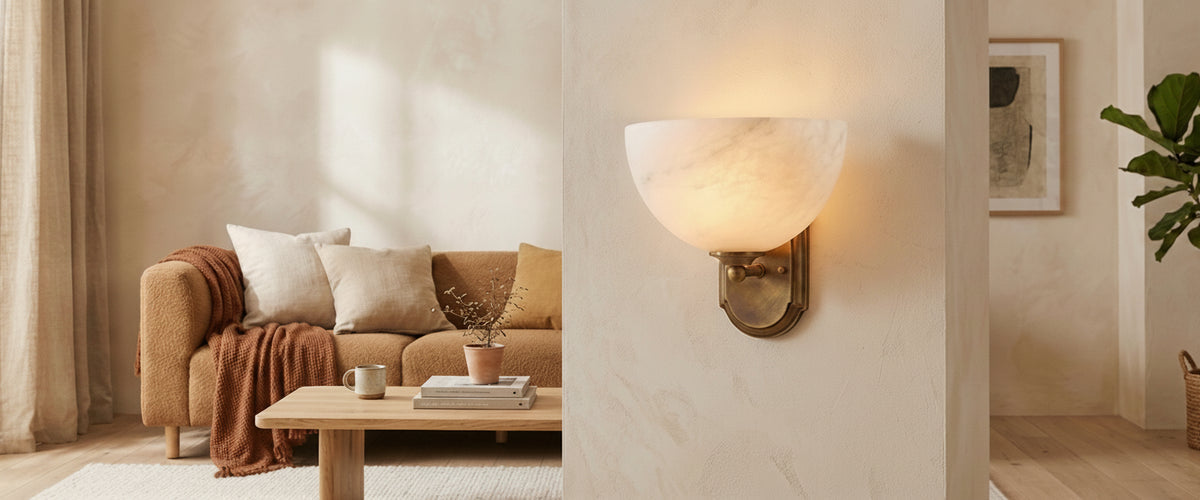

Brass is the finish people misjudge most often, and a wall is the least forgiving place to misjudge it. A pendant hangs in open air where the eye reads it as an object. An antique brass wall lights sits flat against a surface, at roughly eye level, lit from behind by its own lamp, with the colour of the plaster or stone pressing right up against the metal. Every warm tone in that finish either sings or turns muddy depending on what surrounds it. Get the pairing right and the fitting looks like it has been in the house for decades. Get it wrong and it reads as tired hardware.

At a Glance
- Antique brass is a treatment, not a single colour. Ask any supplier whether the ageing is chemical, mechanical or a sprayed simulation, because they weather very differently.
- Wall surface does half the work. Limewash and lime plaster flatter aged brass; cool grey paint and bright white gloss tend to flatten it.
- Diffusers matter more than the shade shape. Alabaster and opal glass hold the warmth; clear glass throws it away.
- Mounting height is a design decision. An antique brass wall light sits comfortably at around 1.5m to 1.7m (roughly 60 to 66 inches) above finished floor in most corridors and living spaces.
- Decide on lacquer before you order. A sealed finish stays put; an unlacquered living finish will keep moving for years.
- Bulbs: 2400K to 2700K, CRI 90+, dimmable. Cool white light kills aged brass faster than anything else.

Antique, Polished or Satin Brass: Why the Distinction Matters Most on a Wall Fitting
Polished brass is mirror-bright and reflects the room back at you. On a ceiling fitting that is often welcome. On a wall, at head height, it can bounce lamp glare straight into your sightline, and it shows fingerprints from the first week. Satin or brushed brass sits calmer, with a fine directional grain that softens reflections without losing the yellow warmth of the alloy.
Antique brass is different again. It is a darkened, tonally uneven finish, usually achieved by chemically ageing the surface and then relieving the high points back so raised edges catch light while recesses stay deep and brown. That contrast is the whole point. On a bracket with a curved arm or a stepped backplate, the shadow lines in the casting fill with darker tone and the form reads more clearly than it would in bright polish. That is why the finish suits sconces, picture lights and up-down fittings so well: it describes the shape. On something like the Marley Up Down Wall Light, Antique Brass, where the beam splits above and below a compact backplate, that tonal relief keeps the body from reading as a flat block on the wall.
The question worth asking before you commit is how the ageing on your antique brass wall light was applied. A genuine chemical patina sits in the metal. A sprayed or powder-applied antique effect sits on top of it, and it will chip at the fixing points rather than wear gracefully. On solid cast or spun brass, the first is preferable and normally more costly to produce. On plated steel components you are almost always looking at the second. Neither is wrong, but they age on completely different timelines, and you should know which one is going on your wall.
Plaster, Stone, Limewash and Paint: How the Wall Changes the Finish
We keep brass swatches in the studio for exactly this reason. Hold the same sample against four surfaces and you will see four different metals.
Against limewash or clay paint, an antique brass wall light is at its best. Those finishes scatter light unevenly and carry a slight chalky depth, so the metal picks up an amber cast and the darker recesses read as intentional rather than dirty. Warm-white and off-white lime plaster does the same thing.
Against natural stone, the result depends on the stone. Honed limestone, travertine and warm-toned marble sit beautifully with aged brass, because both materials share a soft yellow-brown base. Cool grey granite or a hard white engineered surface pushes the brass towards green, and the fitting can look dull. If you are running a fitting onto a stone-clad chimney breast or a marble bathroom wall, get a physical sample of both and look at them together under lamp light, not daylight.
Against flat modern emulsion in cool grey or brilliant white, aged brass frequently disappoints. There is nothing in the wall to echo it, so the darkened tone reads as grubby rather than aged; satin brass or a bronze-toned finish usually serves better. Against dark painted joinery or a deep panelled wall, it performs brilliantly, because the relieved highlights become the only bright thing on the surface.
Shades and Diffusers That Hold the Warmth
The metal supplies the colour; the diffuser decides whether that colour survives when the light is on. Clear glass gives you a visible filament and a hard shadow, which fights the softness of an aged finish. Opal glass is a safer default. Alabaster is better still.
Alabaster is a translucent stone that transmits light through its own body rather than simply blocking it, so the veining glows and the output arrives warm, low-glare and slightly uneven in the way candlelight is uneven. Pair a thin alabaster plate or cylinder with an aged brass backplate and the two materials share a tonal family: both warm, both naturally varied, neither trying to be perfectly uniform. That is the combination we build most of our antique brass wall lights around, and you can compare plate, cylinder and half-moon shapes across our alabaster lighting collection.
Onyx is the more dramatic cousin, with stronger banding and a deeper amber transmission, so it suits a bar, snug or dining room. Marble is denser and works better as a solid element with light spilling above and below it. Fabric shades have their place in bedrooms, though they mute the fitting and hide the metalwork you have just paid for.
One Fitting or a Pair: Mounting Height and Spacing
A single antique brass wall light is a full stop. A pair is a rhythm. That difference is worth settling before you commit the wiring, because moving a chased cable in a plastered wall is genuinely disruptive.
- General wall height: around 1.5m to 1.7m (roughly 60 to 66 inches) from finished floor to the centre of the fitting works for most hallways, living rooms and stairwell landings.
- Flanking a mirror or fireplace: align the light source with eye level for the people using it, and keep the pair equidistant from the centre line rather than from the edges of the wall.
- Bedside sconces: mount lower, so the bottom of the shade clears the headboard and light falls onto the page rather than into your partner's eyes. Swing arms buy you flexibility.
- Corridors: repeat at regular intervals, commonly 2m to 2.5m (about 6.5 to 8 feet) apart, and keep the spacing consistent even if the end gaps differ.
- Ceiling proximity: up-down fittings need breathing room above, or the upward beam scorches a hot spot into the ceiling.
We shipped a run of up-down fittings to a Georgian townhouse renovation in Bath last year where the architect had specified them at 1.4m to suit the dado. On site, with the lime plaster finished, they sat noticeably low against the door architraves. Raising them by 150mm before final fix cost nothing; doing it afterwards would have cost a fortune. Mark your heights with tape and live with them for a day.
Hallway, Dining Room, Bedroom: Where Antique Brass Earns Its Richness
Hallways are the strongest case. They are usually narrow, often lack natural light, and benefit from a low-level warm glow rather than a single overhead fitting. An antique brass wall light with an alabaster diffuser gives a hallway depth without glare, and the finish stands up to the knocks that hallways deliver.
Dining rooms are the second strongest. Low-output fittings flanking a sideboard or a piece of art let you dim the pendant right down and still keep the room readable, and the finish reads especially well against dark walls and timber. Where the job is lighting artwork rather than the room, scale is the decision that matters: a modest framed print is served by something like the Felix Antique Brass LED Picture Light 2.5W 3000K, 26cm, while a wide canvas above a sideboard needs the reach of the 46cm version to wash the full width evenly rather than spotlighting the centre.
Bedrooms suit it, provided you control the beam: reading light should be directional and low enough to miss your eyeline. Living rooms are a maybe. If the scheme is warm and layered, aged brass belongs; if it is cool, minimal and grey, it can look like a leftover from a previous decade. Bathrooms need care, because moisture accelerates tarnish on unsealed brass and the fitting must carry the correct IP rating for its zone. That is a job for a qualified electrician working to the current wiring regulations, and in England it falls under Approved Document P for electrical safety.
Lacquered or Living Finish: Settle This Before You Drill
This is the single most common source of post-delivery disappointment, and it is entirely avoidable with one email to your supplier.
A lacquered antique brass wall light has a clear protective coat over the aged surface. It stays exactly as delivered, cleans with a dry cloth, and will not darken further. If you have specified matching fittings across several rooms and want them to remain matched, lacquer is the sensible choice.
An unlacquered or living finish keeps reacting with the air, your hands and the humidity of the room. It deepens, develops fingerprint shadows near switches and handles, and after a few years it looks like a fitting with a history. Copper alloys tarnish through reaction with sulphur compounds and moisture in the atmosphere, which is why handled areas change fastest; conservation guidance on caring for metal objects is a useful primer. Living finishes reward people who like patina and frustrate people who expected showroom consistency.
Ask three questions before ordering: is it lacquered or unlacquered, is the ageing chemical or applied, and can I have a physical sample to hold against my wall. Any serious supplier will say yes to the third. Browsing our full lighting range is a good way to shortlist forms first; the finish conversation should happen before anything is confirmed.
Bulbs, Dimming and Long-Term Care
An antique brass wall light wants warm light. Specify 2400K to 2700K, and choose lamps with a colour rendering index of 90 or above so the browns in the finish and the veining in alabaster or onyx both read properly. Anything at 3500K or cooler drains the warmth out of the metal and makes stone diffusers look grey.
For dimming, use a trailing-edge dimmer matched to the driver and confirm compatibility with your electrician rather than assuming it. Wall fittings are usually the layer you dim furthest down in the evening, so smooth low-end performance matters more here than on a main pendant.
Care is undramatic. Dust lacquered brass with a dry microfibre cloth, and never use metal polish on it, because polish cuts through the coating and leaves bright patches. Unlacquered brass can be left alone or gently brought back with a proprietary brass cleaner. Alabaster and stone diffusers should be dusted dry and wiped only with a barely damp cloth; the stone is porous and dislikes solvents, acidic cleaners and standing water.
Buyer's Checklist Before You Order
- Confirm the base metal: solid brass, brass-plated steel or another alloy.
- Confirm the ageing method and whether the finish is lacquered.
- Request a physical finish sample and view it against your actual wall colour under lamp light.
- Decide single fitting or pair, then tape out the positions full size on the wall.
- Check the diffuser material and how much light it transmits versus blocks.
- Match the driver, dimmer and lamp specification with your electrician.
- Check IP requirements for bathrooms and any external or covered outdoor position.
- Ask about lead time and whether stone diffusers are natural, which means veining will vary piece to piece.
- Ask for a tailored quote; cost depends on material, scale, casting complexity, stone selection, engineering and finishing.
An antique brass wall light is a small fitting that carries a lot of responsibility. It sets the warmth of a hallway, frames a fireplace, and reads at close range where every detail shows. Pair it with a diffuser that respects the warmth, put it on the right wall at the right height, and settle the finish question in writing before anyone picks up a drill. That is most of the job done. If you want help matching stone to metal for a specific room, our team at Niori works with alabaster, onyx, marble and brass every day and will happily talk through samples.