
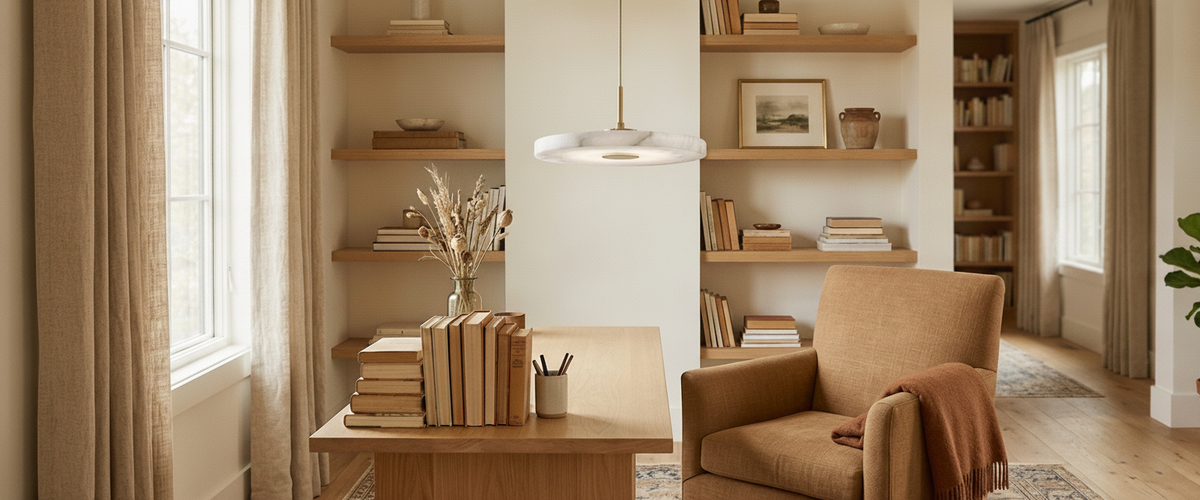

Most disappointing stone lamps fail at the top, not the bottom. The base can be beautifully turned, the brass can be the right tone, the proportions can be textbook, and the thing still lights up like a cloudy bathroom window. Nine times out of ten the fault sits in the alabaster lamp shades: cut too thick, cut too thin, or cut from a block whose veining looks glorious in daylight and disappears completely once a bulb sits behind it. Stone shades are the least forgiving component in the whole fixture, and the one buyers research last.

At a Glance
- Thickness decides colour. An alabaster lamp shade glows honey at roughly 6 to 10 mm (about a quarter to three-eighths of an inch). Thicker reads brown and heavy; thinner reads bleached and glary.
- Veining behaves differently when lit. Grey and amber veins project onto the wall. Fine white-on-white marbling vanishes under a bulb.
- Antique shades glow warmer because of oxidation and old stone, not sentiment.
- Alabaster lamp shade replacements live or die on the fitter. Measure the ring, identify the gallery type, and match the colour cast of the original.
- Floor lamp shades sit at eye level; table shades sit below it. The geometry has to change or you will stare straight into the lamp.
- Alabaster glass is not stone. It is opalescent glass, lighter and more uniform, and it behaves differently on a dimmer.

The Stone in the Shade Sets the Light, the Base Only Sets the Height
People shop bases. They compare turned columns, brass collars, marble plinths, and then treat the shade as an accessory. That is backwards. Everything you actually see in a lit room comes through the shade: the colour temperature after transmission, the softness of the shadow line, the way light lands on a wall behind a console. The base sets the height of the light source and how the piece reads when it is switched off. That is the whole of its job.
This matters most with an alabaster shade lamp, because stone is not a neutral filter. Gypsum alabaster carries iron and clay impurities that warm the beam by a noticeable margin, which is why a 2700K bulb behind a stone shade can read closer to candlelight on the wall. It is the same material tradition that carvers have worked since antiquity, prized precisely because light passes through it; the Metropolitan Museum of Art holds alabaster vessels and reliefs that show how far back this translucency was understood and exploited.
It also explains why stone behaves so differently depending on whether light passes through it or bounces off it. A surface read entirely in reflected light, such as the Circulael 45cm Marble Coffee Table, can carry dense, dramatic veining and only look richer for it. Put that same density behind a bulb and it would swallow the glow. So when you compare two lamps, ignore the silhouette for a minute and ask what the alabaster lamp shade is cut from. Across our own range of alabaster lighting, two pieces with near-identical brass work can throw very different light simply because one shade came from a paler, more even block.
Thickness in Millimetres: Where Alabaster Glows Honey and Where It Goes Muddy
This is the single most useful thing to understand before you spend money. Alabaster transmits light on a curve, not a straight line. Somewhere around 6 to 10 mm (roughly a quarter to three-eighths of an inch), depending on the density of the block, the stone reaches that warm, lit-from-within honey glow that people buy alabaster for in the first place.
Go thicker, say past 15 mm, and the stone starts absorbing rather than transmitting. The shade turns a flat toffee brown, the veining muddies, and you get a lamp that looks handsome switched off and sullen switched on. Go too thin, under about 4 mm, and two problems arrive together: the filament or LED chip shows as a hot spot, and the stone loses its structural margin. Thin alabaster chips at the rim, and a hairline crack in a shade is not repairable in any way you would want in a living room.
Hand-carved alabaster lamp shades are rarely uniform, which is part of the appeal. A good carver leaves the crown slightly thicker for strength and thins the walls where the light needs to escape. Hold a shade up to a window before you commit if you can; you are looking for a gentle gradient, not blotches. Blotchy transmission means uneven cutting or a block with dense mineral pockets, and no bulb will rescue it.
Reading Veining Before You Buy
Alabaster lamp shades are photographed unlit far too often. That is a problem, because backlighting rewrites the pattern entirely.
Grey, ochre and rust veins have enough mineral density to stay visible when the lamp is on. They read as darker rivers across the glow and, on a pale wall, they project as a soft shadow pattern. Some clients love that. Others are horrified to find their bedside table casting faint stripes across the headboard. Fine white-on-white marbling, by contrast, all but disappears when lit; you get a smooth, even wash and lose the drama you paid for in the showroom.
Ask for a lit photograph. Any serious supplier of natural-stone lighting can send one, because we all know the piece looks different with power behind it. If a listing only shows daylight shots of the stone, treat that as a gap in the information rather than a design choice.
One more practical point on veining: on a floor lamp or a large pendant, strong veining reads as texture from across the room. On a small table lamp shade, the same veining can look busy at close range. Scale the pattern to the viewing distance. Where a room genuinely wants pattern at arm's length, that is a job for cloth rather than stone; a shade like the Leaf Pleated Fabric Lamp Shade in Shell Bay Blue holds its motif when lit, which no amount of subtle white-on-white marbling will do.
Why an Antique Alabaster Lamp Shade Glows Warmer
Buyers hunting an antique alabaster lamp shade or an alabaster lamp shade vintage listing usually assume the warmth is nostalgia. It is chemistry and stone selection.
Older shades were cut from quarry faces that are now worked out or protected, and much of that stone had a higher iron content, which pushes the transmitted light towards amber. Decades of handling add a thin patina from oils and airborne particulates that settle into the surface porosity. Old shellac or wax finishes yellow with age. Put those together and you get a shade that reads several hundred kelvin warmer than a freshly cut equivalent.
The trade-off is fragility. A vintage shade has usually seen heat from incandescent bulbs for years, which dries the stone and opens micro-fissures around the fitter aperture. Before rewiring anything old, get the fixture checked; wiring standards have moved on considerably, and any alteration to a mains fitting should be done by a qualified electrician working to current UK wiring regulations, which the IET publishes and updates. Never re-lamp an antique shade with anything that runs hot.
Alabaster Lamp Shade Replacement: Matching Fitter, Gallery and Colour Cast
An alabaster lamp shade replacement is a measuring job, not a shopping job. Three things have to line up.
- The fitter aperture. Measure the internal diameter of the hole in the top or bottom of the shade, in millimetres, at two points at right angles. Stone shades are hand-cut and rarely perfectly round.
- The gallery type. Older stone shades often sit in a brass gallery ring or rest on three arms rather than clipping to the bulb. Photograph the existing hardware from directly above and from the side before you order anything. A shade that fits the aperture but not the gallery is money wasted.
- The colour cast. If you are replacing one shade in a pair, or one of five on a chandelier, match the warmth of the surviving stone. New alabaster next to old alabaster reads cold and blue-white by comparison. Sometimes the honest answer is to replace the set.
We had a client in Bath replacing a single cracked shade on an inherited three-light fitting. The new shade was technically a better piece of stone: paler, more even, beautifully cut. Lit alongside its two older siblings, it looked like a mistake. She ended up rehoming the two old shades onto wall lights and running the fitting as a matched set. That is usually the more elegant solution.
Floor Lamp Shades Sit at Eye Level, Table Shades Sit Below It
Height changes everything about how a shade should be cut. A table lamp sits below seated eye level, so you look down onto it. The lit surface you see is the outside of the shade and the pool of light on the table. Openings can be generous; a little downward glare is useful for reading. Where a console or bedside needs warmth without a visible aperture, a lower piece with a squared shade such as the Bianco Alabaster Table Lamp keeps the light source below the sightline rather than in it.
An alabaster floor lamp shade sits at or above seated eye level, which means the aperture is pointed straight at your face when you sit down. Alabaster lamp shades at that height therefore need either a deeper drop, a smaller lower aperture, or a diffuser disc at the base. Get this wrong and you have installed a very beautiful glare source. The same logic applies to tall bedside lamps flanking a high headboard, which is a surprisingly common failure in bedroom schemes.
Pendants invert the problem again: you are looking up at the underside, so the lower rim thickness and the finish of the inside surface matter more than the outer face. If you are weighing a floor lamp against a pendant for the same corner, it is worth browsing the wider lighting collection with sightlines in mind rather than style alone.
Alabaster Glass Lamp Shade or Real Stone?
An alabaster glass lamp shade is opalescent or alabastrine glass, not quarried stone. It is lighter, cheaper to produce, far more uniform, and completely consistent from one piece to the next. That consistency is exactly what some projects need, particularly hospitality installations with twenty matching pendants.
What glass cannot do is vein. It has no mineral depth, so the glow is even but flat, and it tends to go slightly grey on a low dimmer setting where real stone keeps warming up. If someone offers you a quarried alabaster lamp shade at a price that seems impossible, check whether that word is describing the material or simply the colour.
Bulbs, Dimming and a Pre-Purchase Checklist
Stone rewards restraint. Use 2700K or warmer, choose a high colour rendering index (CRI 90 or above) so the veining keeps its depth, and keep wattage modest since alabaster amplifies apparent brightness by diffusing it across the whole surface. Avoid clear filament bulbs in thin shades; a frosted or opal envelope hides the hot spot. Always pair a dimmable lamp with a compatible LED driver, or you will get flicker that the stone makes more obvious, not less.
Before you buy any alabaster lamp shade, run through this:
- Have you seen a lit photograph, not just a daylight one?
- Is the wall thickness in the honey range rather than the muddy one?
- Does the veining suit the viewing distance and the wall behind it?
- For a replacement, have you measured the aperture in millimetres and photographed the gallery?
- For a floor lamp, will you be looking into the aperture when seated?
- Is the bulb warm, frosted, high-CRI and dimmer-compatible?
- Is the fitting going to be installed or rewired by a qualified electrician?
Living With Stone Shades
Gypsum alabaster is soft, around 2 on the Mohs scale, and it is soluble in water. That rules out glass cleaner, damp cloths and every spray in the cupboard. Dust with a dry, soft brush, working from the crown down, and lift rather than drag so grit does not score the surface. If a shade picks up a greasy mark, a barely damp cotton bud and immediate drying is the limit of what is sensible at home; anything worse needs a stone conservator.
Heat is the other enemy. Keep shades away from radiators and direct sun, both of which dry the stone unevenly and can open fissures along the veining. Handle by the body, never by the rim. Niori works almost exclusively in alabaster and natural stone, and the pieces that come back to us damaged have nearly always been lifted by the thin edge. Support the widest part with two hands, every time, and a good alabaster lamp shade will outlast the wiring inside it several times over.