
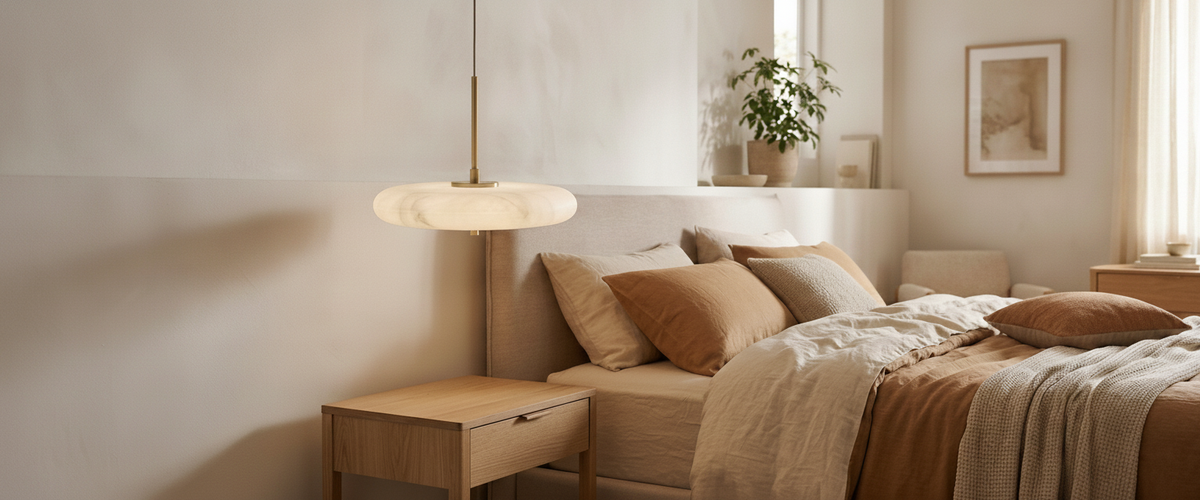

A small bedside table gets picked for its footprint and then quietly punished for it, because the lamp lands on top and suddenly there is nowhere to rest a glass of water or a book. The table was never the problem. The problem is choosing the surface and the light as two separate purchases instead of one balanced pairing. Get the relationship right and a compact bedside table reads calm and deliberate; get it wrong and the whole corner feels cramped from the first night.
We ship a lot of bedside lamps, and the returns we see are almost never about the lamp itself. They are about proportion: a base too wide for the top, or a table too low for the mattress. So before you measure anything else, measure the gap.

Key Takeaways for a Small Bedside Table
Measure the wall gap first. The table has to clear the mattress, the frame overhang, and any door or radiator swing.
Match table height to the mattress top, ideally within a couple of inches (about 5 cm) of it.
Size the lamp base to the top, leaving room for a book, a glass, and a phone.
Round tables ease tight traffic; square tops give you more usable surface.
Bedside lamps do not have to match exactly, but they should share a family: scale, warmth, and material feel.

Read the Gap Between Bed and Wall Before Anything Else
Pull the bed into position, then look at what is actually left. A small bedside table has to fit the true gap, not the gap you imagined. Account for the headboard, any frame that overhangs the mattress, skirting boards, and the arc of a door or wardrobe as it opens. In a narrow room, a table that is even an inch (about 2.5 cm) too deep turns the walk to the window into a shuffle.
This is where a compact top earns its keep. A slim single-drawer piece, roughly 15 to 18 inches wide (around 38 to 46 cm), can sit comfortably in a spot where a wider chest would block the route past the bed. Where the gap is genuinely tight and you still need a drawer for cables, something like the Carvora 1 Drawer Small Bedside Table keeps the footprint honest without giving up storage. Once you know the footprint you can shop honestly, because now you know how much lamp the surface can support.
Height to the Mattress: Why a Table Too Low Ruins the Reach
The single most common mistake is buying on looks and ignoring height. Your bedside table should land close to the top of the mattress, so the lamp switch and your bedtime glass sit within an easy, half-asleep reach. A table that finishes several inches below the mattress forces you to reach down and out, which is exactly the movement that knocks a glass over.
Mattress heights vary far more than they used to, especially with deep hybrid and pillow-top builds, so measure your own bed rather than trusting a standard. If your mattress top sits at, say, 25 inches (about 64 cm), aim for a table around 24 to 27 inches (roughly 61 to 69 cm) tall. Height also changes how the light falls. Set the table right and a bedside lamp throws a warm pool across the pillow at reading level; set it low and the same lamp glares up into your eyes.
What a Small Top Can Actually Hold Once the Lamp Lands
A small top is a budget you spend the moment you place the lamp. If the base swallows two-thirds of the surface, you have bought a lamp stand, not a bedside table. Work backwards: decide what you need within reach, usually a glass, a book or e-reader, and a phone on charge, then leave that space clear and let the lamp take what remains.
This is why alabaster and natural-stone lamps suit small bedsides so well. A carved alabaster base has visual weight without a sprawling footprint, and the material glows softly when lit, so a modest fixture reads as considered rather than fussy. The translucency of alabaster diffuses light through the stone itself, giving a warm, low-glare wash that flatters a bedroom far better than a bright bare bulb. You can see how that quality plays out across our alabaster lighting range, where the base often does the decorating without the sprawl.
How Big Should Bedside Table Lamps Be?
A safe rule: the lamp base diameter should take up no more than about a third of the table's depth, and the total lamp height should sit so the bottom of the shade is roughly at your shoulder or eye level when you are sitting up in bed. For most beds that means a lamp between 20 and 26 inches tall (about 51 to 66 cm). On a genuinely small top, a compact table lamp or even a slim wall light frees the surface entirely.
Round Versus Square in a Tight Bedroom
Shape is not just a style choice in a small room; it steers how you move. A round table has no corners to catch a hip or a duvet, so it eases traffic in the pinch point beside the bed. That soft edge is quietly forgiving in the dark. The trade-off is usable area: a circle gives you less flat surface than its width suggests.
A square or rectangular top hands you more real estate for the same footprint and lines up neatly against a wall, which helps a lamp sit square and stable. Where the passage is clear and you want a warmer, more decorative silhouette in an alcove, a turned form such as the Artisan 1 Drawer Bobbin Bedside Table gives that grounded square footprint while softening the visual line. If the table lives in a walkway rather than a dead corner, lean round. If it tucks into an alcove or against a headboard wall with clear passage, square usually wins on function.
Pairing a Compact Table With a Proportioned Bedside Light
Think of the table and lamp as a single silhouette. A tall, slender lamp on a tiny round top looks top-heavy and tips easily; a wide drum-shaded lamp on a narrow table overhangs the edges. The pleasing pairings share a centre of gravity. A stone or alabaster lamp with a low, grounded base steadies a small bedside table both visually and literally, because the weight sits down low.
Consider the switch too. A base-mounted rotary or an inline switch you can find without looking beats a fiddly shade switch when you are reaching over in the dark. If you dim, a warm-dimming LED that shifts to a lower colour temperature as it fades keeps the bedroom feeling restful. Warmer, lower light late in the evening supports the wind-down toward sleep, and the Sleep Foundation notes that bright light in the evening can suppress melatonin and delay sleep, which is why bedside lighting benefits from a dimmable, warm bulb over a cool, bright one. Browse fixtures scaled for bedside use across our wider lighting collection when you want to compare forms side by side.
The Clutter Trap That Makes a Small Table Feel Smaller
Every extra object on a small top steals from the light. A phone, a charger, a hand cream, a stray book, and a candle, and suddenly the lamp is fighting for space it was promised. A single drawer solves most of this: cables, chargers and readers drop out of sight, and the surface stays as a clean stage for the lamp and one glass.
Keep the visible surface to a rule of two: the lamp plus one other thing. That discipline is what makes a genuinely compact table feel generous. It also protects the lamp, because a crowded top is where knocks and chips happen, and a stone base does not enjoy being nudged onto a hard floor.
A Quick Buyer's Checklist
Gap: confirm the table clears the frame, skirting, and any door swing.
Height: table top within about 2 inches (5 cm) of the mattress top.
Surface budget: lamp base under a third of the top, with room for a glass and a book.
Shape: round for tight traffic, square for maximum usable surface.
Lamp scale: shade bottom near seated eye level; grounded, weighted base.
Storage: at least one drawer to keep the top clear.
Switch and dimming: easy-reach switch, warm-dimming bulb for evenings.
Choose the table for the room and the lamp for the table, in that order, and a small bedside table stops feeling like a compromise. Niori designs its alabaster and natural-stone lamps to carry a bedroom on a modest footprint, which is precisely the balance a compact table needs.