

Most small bedroom chandeliers go wrong before anyone looks at a fixture. The buyer measures the room, maybe the ceiling, and forgets the person who will lie underneath the thing every night. A small bedroom chandelier is seen from the pillow far more than from the doorway. Glare, visual clutter and a fitting that hangs too low over the bed matter more than how good it looks in a product photo.
At Niori we make alabaster and natural-stone lighting, and we answer a steady stream of questions about bedrooms where the ceiling is modest, the rose is in an awkward place and the buyer still wants a small bedroom chandelier. It can be done well. It just needs a different order of decisions.

Quick Answer: Sizing a Small Bedroom Chandelier
If you are choosing a small chandelier for bedroom ceilings of ordinary height, these are the numbers to start from:
Start with clearance. Measure from the mattress top to the ceiling before you think about diameter.
Keep the total drop short. On a typical UK ceiling of about 7 ft 10 in (2.4 m), the whole fixture, canopy included, usually wants to stay within roughly 12 to 16 in (30 to 40 cm).
Size down on diameter. In a compact room, 14 to 20 in (35 to 50 cm) wide is the usual comfortable range.
Judge visual weight, not dimensions. An open frame reads smaller than a solid body of the same size.
Use warm, dimmable light. 2700K or lower, on a compatible dimmer, or the fitting will feel harsh at night.
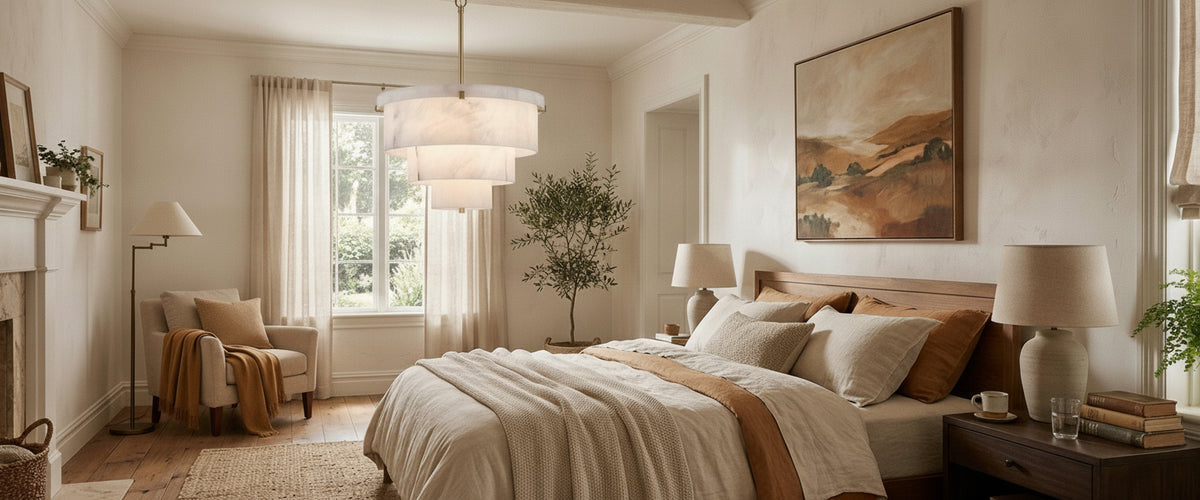
A short-drop alabaster fitting keeps clearance above the bed while still reading as a proper small bedroom chandelier.

Why Ceiling-to-Pillow Clearance Is the Measurement That Matters First
Room size tells you how big a chandelier can be. Clearance tells you whether a small bedroom chandelier can hang where you want it at all. In a small bedroom the fitting usually sits over or near the bed, and the bed is where your head goes up and down: sitting up to read, getting in, changing the sheets.
Measure from the top of the mattress to the ceiling. Then sit upright against the headboard and have someone measure from the top of your head to the ceiling. That second number is your real working space. If the bottom of a small bedroom chandelier comes within about 18 in (45 cm) of a seated head, the room will feel low even if nobody ever touches the fitting.
If the chandelier sits over a walkway rather than the bed, the rule changes: aim to keep the lowest point around 7 ft (2.1 m) from the floor so nobody ducks on the way to the wardrobe. In many period conversions and loft rooms that simply rules out a hanging small bedroom chandelier in the walkway, which is useful to know before you fall for one.
Open-Frame Versus Solid-Body Fittings
When you are comparing designs for a small bedroom chandelier, visual weight has very little to do with the tape measure. A 20 in (50 cm) open-arm chandelier with slim candle arms can look lighter in a small room than a 14 in (35 cm) drum with a solid shade, because the eye reads straight through the frame to the ceiling behind it.
Solid-body fittings, such as a fabric drum or a carved alabaster bowl, do the opposite. They read as one object, so a solid small bedroom chandelier needs more restraint on diameter. Its advantage is that it hides the bulbs, which matters enormously when you are looking straight up from a pillow.
A simple test: lie on the floor under a fitting before you commit to it for a bedroom. It feels faintly ridiculous. It also tells you in about ten seconds whether you will be staring into four bare lamps at midnight.
Crystal, Fabric and Bare Arms in a Chandelier for a Small Bedroom
Crystal
A small crystal chandelier in the bedroom is the classic choice, and it works when the crystal count is modest. Four lights in polished nickel with restrained drops give sparkle without turning the ceiling into a glitter ball, which is why a compact design such as the Aries 4 Light Small Crystal Chandelier in Polished Nickel sits more comfortably over a bed than a multi-tier piece. Crystal throws small points of light onto the walls, which makes a compact room feel livelier by day. At night, with bare bulbs, it can glare, so plan on dimming it low and pairing it with bedside lamps.
Fabric Shades
Shaded chandeliers are the most forgiving option for small chandeliers in the bedroom. Each shade softens its own bulb, the light lands downward and sideways, and the view from the pillow is calm. If glare from the pillow is your main worry, a four-light brushed nickel frame with soft gray shades, such as the Lucerne 4 Light Chandelier, is closer to the right design language than any bare-bulb fitting. The trade-off is bulk: several shades close together can read heavy, so keep the arm spread tight.
Bare Arms and Open Frames
Wire-frame and bare-arm designs in black, brass or nickel are the lightest visually and suit modern rooms. They depend entirely on the bulb, so choose decorative lamps that look good lit and dimmed, or fit shallow glass or stone cups over them.
Where Alabaster Fits
Alabaster behaves differently from all three. It is translucent, so light passes through the stone and comes out as an even, warm glow with the natural veining showing. There is no hard point source and no scattered sparkle, only a soft surface of light. For a small bedroom chandelier that is often the best compromise: the presence of a chandelier with the comfort of a shade. The alabaster lighting collection includes bowl, tiered and semi-flush forms that suit lower ceilings. One care note: alabaster is soft and dislikes water, so dust it with a dry, soft brush and keep it away from en-suite steam.
The Canopy and Drop Calculation
Drop is the number that decides whether a chandelier in a small bedroom looks deliberate or crowds the bed. Add three figures together:
Canopy depth, the plate that covers the ceiling rose.
Suspension, meaning chain, rod or flex, at its shortest adjustable length.
Body height, from the top of the frame to the lowest crystal, shade or finial.
Subtract that total from your ceiling height and check the result against the clearance numbers above. Many buyers forget the canopy and the minimum chain length on a small bedroom chandelier, and those two can add several inches before the fixture even starts.
On lower ceilings, look for a small bedroom chandelier sold with adjustable or removable chain links, or choose a semi-flush design that tucks up close to the ceiling. As a visual guide, a fitting over the bed should rarely be wider than about half the bed's width. Beyond that it starts to feel like it belongs to a larger room. The same logic applies within a single design: a scaled-up version such as the Aries 4 Light Large Crystal Chandelier belongs in a principal bedroom with generous height, while the small version is the one to run through these numbers for a compact room.
Color Temperature and Dimming: Why Getting This Wrong Cancels Everything Else
You can size a small bedroom chandelier perfectly and still ruin the room with the wrong bulb. Cool white light at 4000K flattens alabaster, makes crystal look clinical and turns a bedroom into a hotel corridor.
Color temperature: treat 2700K as the upper limit for a bedroom. Warm-dim LED lamps that drop toward 2200K as they dim are better still.
Color rendering: choose CRI 90 or above so skin tones, textiles and stone veining look natural.
Output: in a small room, several low-output candle lamps beat a few bright ones. A small bedroom chandelier rarely needs full brightness.
Dimming: use dimmable lamps with a dimmer rated for LED loads, usually trailing-edge. Mismatched pairs cause flicker and buzz.
Treat your small bedroom chandelier as the mood layer and leave reading to bedside lamps or wall lights. The chandelier sets the tone. A shaded or alabaster fitting dimmed to around a third of its output is what most people actually live with.
Measuring for Off-Center Roses When the Room Won't Cooperate
In British houses the ceiling rose is usually centered in the room, while the bed is pushed against one wall. The result is a small bedroom chandelier that hangs over the foot of the bed or the middle of the floor, belonging to neither.
Take a typical Victorian terrace bedroom: 10 ft by 11 ft (3 m by 3.4 m), rose dead center, bed against the chimney breast. The sensible fix is a compact alabaster semi-flush on the existing rose, placed so it lights the room evenly, with a pair of wall lights over the bed doing the intimate work. Moving the rose could mean lifting floorboards in the room above, and in a room this size the centered fitting is rarely missed once the wall lights are in.
Leaving the rose centered works when the fitting is compact and wall lights handle the bed.
Your options, roughly in order of disruption:
Leave it centered and choose a low, compact fitting so its position reads as architectural rather than accidental.
Swag the fitting across to a ceiling hook over the bed. It suits relaxed interiors and some bare-arm designs, less so formal crystal.
Relocate the rose. This is proper electrical work and needs a qualified, registered electrician; in the UK look for a contractor registered with a scheme such as NICEIC, working to the IET Wiring Regulations (BS 7671). Do not treat it as a DIY job.
Also check what is above the rose. A heavier crystal or stone small bedroom chandelier needs a secure fixing into a joist or a rated support, not just plasterboard. Your electrician can confirm this when fitting.
Buyer Checklist Before You Order
Run through these points before you commit to a small bedroom chandelier:
Measured mattress-to-ceiling and seated-head-to-ceiling clearance.
Calculated total drop, including canopy and minimum chain length.
Diameter chosen for the room and roughly half the bed width or less.
Decided between open frame (lighter look) and solid body (hidden bulbs).
Checked the view from the pillow for bare-bulb glare.
Chosen 2700K or warm-dim lamps, CRI 90+, with an LED-compatible dimmer.
Confirmed the fixing point and booked a qualified electrician.
Planned bedside lamps or wall lights for reading.
If you are still weighing crystal, shaded and stone options for your small bedroom chandelier side by side, the wider lighting collection is the quickest way to compare forms and finishes. Budget depends on material, scale, engineering and finishing, so for bespoke sizes or project quantities, ask Niori for a tailored quote.