
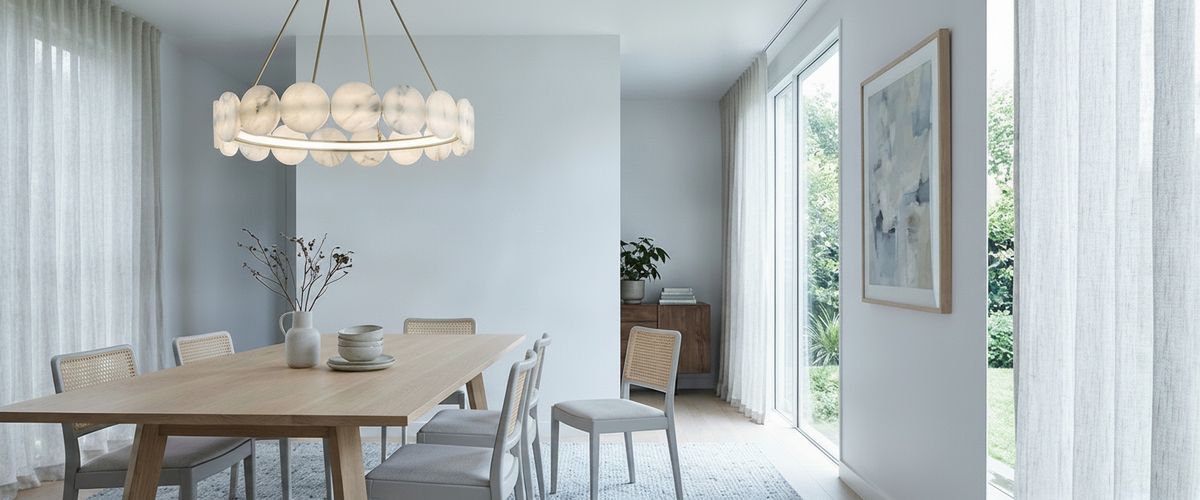

Most chandeliers disappoint for one of two reasons: the scale is wrong for the room, or the light it throws is unpleasant to sit under. Neither problem shows up in a product photograph, which is why so many people buy the same fixture twice. Get the diameter, the drop and the diffusion right and the piece stops being decoration and starts doing actual work, shaping how a dining table, stairwell or hotel lobby feels after dark.

Chandelier Buying at a Glance
- Scale first, style second. A rough guide: add the room's length and width in metres, multiply by 10, and treat that figure in centimetres as a sensible diameter.
- Material decides the light. Crystal scatters and sparkles, clear glass shows the bulb, alabaster and onyx glow from within and hide the source.
- Drop is not decorative. Over a dining table, 75 to 90cm (roughly 30 to 36in) from tabletop to the base of the fixture is the usual comfort zone.
- Dimming is part of the purchase. Specify bulbs and driver compatibility before installation, not after.
- Weight changes the job. Stone and multi-arm metal frames need a proper fixing and, in most cases, a qualified electrician.
- Budget varies enormously with material, scale, engineering and finishing, so ask for a tailored quote rather than assuming a band.

What a Chandelier Actually Is, and Who Should Buy One
Strictly speaking, a chandeliers is a branched or multi-source ceiling fixture, suspended rather than flush, designed to be looked at as well as to light. That definition covers an eighteenth-century candle frame dripping with cut glass and a spare modern piece with three alabaster discs on a slim brass stem. Both qualify. The word itself comes from the French chandelle, or candle, which explains the spelling that trips people up: c-h-a-n-d-e-l-i-e-r.
A chandelier earns its place when a room has a clear centre of gravity and enough ceiling height to carry a hanging form. Dining rooms, entrance halls, stairwells, principal bedrooms, private dining spaces and reception areas are the natural candidates. If the ceiling sits below about 2.4m (8ft) and there is no table or void to hang over, a flush ceiling light or a pair of wall lights will serve you better. Designers and venue owners should also think about sightlines from the doorway and from seated height, because the fixture is seen far more often from a sofa or a dining chair than from standing.
How to Compare Chandelier Options Before Buying
Set aside the styling for a moment and compare on four things: light quality, mass, maintenance and mounting. A crystal chandelier throws refracted points of light across walls and ceilings, which is glorious in a formal dining room and merciless in a low-ceilinged snug. Clear glass is honest and architectural but leaves the lamp visible, so the bulb choice becomes part of the design. Metal-only modern chandeliers give direction and drama but can create hard shadows on faces. A graphic open frame such as Sabina 5 Light Chandelier, Black works best when the lamps themselves are warm and softly finished, since nothing in the fixture is doing the diffusing for you.
Alabaster and natural stone behave differently from all of them. Because the material is translucent rather than transparent, light passes through the body of the stone and comes out softened, warm and glare-free, with the veining lit from behind like a slow-moving watercolour. That is the whole argument for stone at Niori: it gives you a chandelier light you can sit directly beneath for three hours without squinting. You can see how that reads across pendants, wall lights and larger suspended pieces in the alabaster lighting collection.
One practical comparison point that buyers forget: cleaning. A cut crystal fitting with hundreds of drops is a genuine annual project. A stone piece is a dry dust once a season. If it is going into a restaurant or a client's holiday let, that difference matters more than the showroom impression.
Crystal, Glass, Alabaster and Stone Compared
- Crystal chandelier: maximum sparkle, formal register, high maintenance, best above 2.7m (9ft) ceilings.
- Glass: lighter visually, good for contemporary schemes, bulb quality is exposed.
- Alabaster: warm diffused glow, sculptural mass, soft veining that changes character when lit, gentle on the eye.
- Marble and onyx: stronger figuring and deeper colour, heavier, dramatic when backlit but less uniform.
- Metal-only modern chandeliers: graphic and precise, but plan the diffusion or you will get glare.
Materials, Finishes and Scale Decisions
Alabaster is a gypsum stone, soft enough to carve into thin translucent panels and, importantly, soluble in water, which dictates everything about how it is finished and cared for. Mineral collections such as those catalogued by the Natural History Museum place gypsum near the bottom of the hardness scale, which is exactly why it takes such fine detail and exactly why you never take a damp cloth to it. Marble and onyx are harder and heavier, so they tend to appear as discs, cylinders and shades rather than long carved arms.
Finish choices sit alongside the stone. Antique brass warms the whole fixture and flatters cream and honey alabaster. Polished nickel and blackened steel cool it down and suit greyer stone with strong veining. In a room with a lot of existing brass ironmongery, matching the fixture's metal too precisely can look flat; a half-tone difference usually reads better. In a room that already has exposed timber and aged metalwork, a mixed-material frame like Aberdeen 6 Light Chandelier, Distressed Grey Wood Effect & Old Bronze sits more comfortably than a single uniform finish trying to match everything at once.
On scale, err larger than instinct suggests. Anything that looks generous in a warehouse showroom shrinks the moment it is 3m up. For a dining table, aim for a fixture roughly half to two-thirds the width of the table. This is where families that run across several light counts are useful: a six-arm frame handles a modest round table, while a wider span calls for something closer to the Brianna 9 Light Chandelier, Black, which grows the diameter without changing the design language. For a stairwell, think about the vertical composition from the ground floor upward rather than the diameter alone. And check the weight before you fall in love: stone pieces are considerably heavier than metal ones of the same size, and the ceiling fixing must be specified accordingly.
Where to Place a Chandelier for the Strongest Impact
Over a dining table is the obvious answer and still the best one. A single wide fixture suits a round table; a long rectangular table often takes two smaller chandeliers or a linear stone pendant better than one enormous piece. Keep the base high enough to clear sightlines across the table.
Entrance halls reward drama, because the fixture is seen briefly and from below. Stairwells and double-height voids are where alabaster performs best of all, since the light is viewed from multiple levels and a bare lamp would be visible from the landing. In principal bedrooms, choose warmth over sparkle; a diffused stone chandelier at the foot of the bed reads as luxury without turning the room into a stage set.
Commercially, we see the strongest results in private dining rooms, spa reception areas and boutique hotel lobbies, where guests are seated and looking up. Last winter we worked with a couple converting a mill house in West Yorkshire with a 5m void above the entrance. Their first instinct was a crystal piece; once they saw a lit stone sample against the raw plaster, they switched to alabaster and dropped it a full metre lower than planned. The lesson we now repeat to everyone: get a sample of the actual stone, hold it against the wall finish, and light it from behind before you commit. Photographs flatten veining.
Bulbs, Dimming and Getting the Light Right
Choose lamps at 2700K or below. Anything cooler makes warm stone look grey and drains the honey tones out of alabaster. High colour rendering matters too, ideally CRI 90 or above, so that food, skin and timber look correct beneath the fixture.
Dimming needs deciding at specification stage. Trailing-edge dimmers generally suit LED loads better than older leading-edge units, and mixing dimmable and non-dimmable lamps on one circuit causes flicker. Any hardwired installation should go to a qualified electrician working to the current wiring regulations; the IET's electrical guidance is the reference point in the UK. Heavy fixtures may also need a joist-mounted plate rather than a standard ceiling rose.
Budget, Lead Times and Delivery
Price tracks material, scale, complexity of the frame, engineering, installation requirements and finishing. A hand-carved stone piece with matched veining across multiple panels sits in a different world from a mass-produced metal frame, and a bespoke diameter changes the calculation again. Rather than guessing, send the room dimensions, ceiling height and a photograph and ask for a quote against the actual brief.
Natural stone also brings a scheduling reality: blocks are quarried and cut, veining varies between batches, and matched sets take longer. Build that into project programmes, especially for hospitality fit-outs with fixed opening dates. Crating for stone is substantial, and someone needs to be on site to receive and check it.
Care Checklist for a Stone Chandelier
- Dust with a dry, soft microfibre cloth or a clean natural-bristle brush, lamps off and cool.
- Keep water, glass cleaner and anything containing ammonia or bleach away from the stone.
- For marks, ask the supplier before trying anything; alabaster stains easily and is difficult to reverse.
- Check the ceiling fixing and suspension annually, and after any building work nearby.
- Replace lamps as a matched set so colour temperature stays consistent across arms.
- Avoid siting the fixture directly above a steam-heavy kitchen island or an unvented bathroom.
How Niori Helps with Chandelier Projects
Niori works in alabaster and natural stone, from wall lights and table lamps through to large suspended chandeliers, with brass and glass detailing where it earns its place. For designers and venue owners we can talk through scale, drop, weight and lamping before anything is ordered, which is usually a shorter conversation than replacing a fixture that turned out too small. Start by browsing the full lighting range to see how the forms behave at different sizes, then come back with the room dimensions and we will point you to the right family of pieces.