
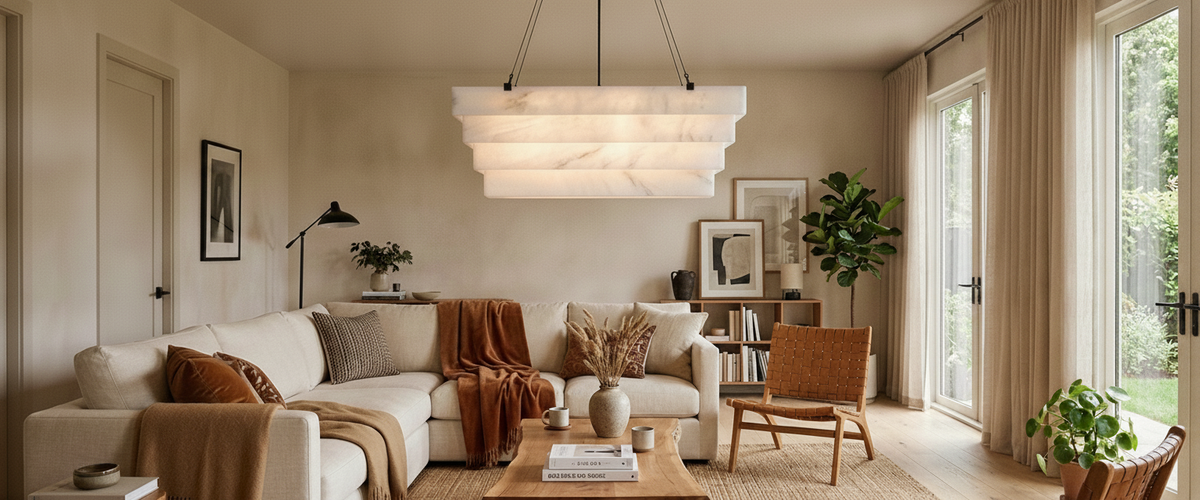

A chandeliers for living room use fails in one of two ways. Either it hangs too low over the wrong spot and clips the room, or it is far too small and floats up near the ceiling like an afterthought. Both mistakes come from treating a lounge like a dining room, where a fixture can sit tight over a table and do its job. A living space asks for a wider, softer throw, because people spread out across sofas, chairs and floor. The light needs to reach all of them without glare.
That single difference, wide diffusion over a broad seating area rather than a focused pool over furniture, changes how you size, hang and light a chandelier for living room use. Alabaster and natural stone do that diffusion job beautifully, which is why we spend so much time on it in the studio.
An alabaster fixture spreads soft, low-glare light across a whole seating group.

Key Takeaways for a Living Room Chandelier
Size to the room, not the coffee table. Add the room's length and width in feet, and the sum in inches is a workable diameter for a chandelier for living room use.
Ceiling height sets the drop. Leave at least 7 feet (2.1 m) of clearance below the fixture in a walkway, more over open floor.
Wide, soft light beats a bright point source. Stone diffuses; crystal sparkles. Choose for the mood you want after dark.
Dimming is not optional. A lounge fixture has to work at reading brightness and at low evening glow.
Watch top-heavy proportions. An over-tall fixture on a standard ceiling shrinks the room instead of lifting it.

Why a Lounge Wants a Softer, Wider Throw
A table lamp lights a corner. A chandelier in the living room has to light people scattered across the whole floorplan, and it has to look good doing nothing when the sun is up. That is a harder brief. You want ambient light that fills the space evenly, without a hard hotspot burning at the centre.
This is where material matters more than most buyers expect. Alabaster is naturally translucent, so light passes through the stone and comes out warm, even and low in glare. You see the glow, not the bulb. Crystal does the opposite; it refracts and scatters light into bright points, which reads as sparkle rather than a calm wash. Neither is wrong. But for an evening lounge where you want to relax, a stone chandelier for living room comfort flatters faces and furniture in a way a hard crystal source rarely manages. Browse how that plays out across our alabaster lighting range to see the difference in shade thickness and veining.
Sizing to Seating and Ceiling Height
Forget matching the fixture to your coffee table. Size your chandelier for living room use to the room itself. The classic rule interior designers use: measure the room's length and width in feet, add them together, and treat that total in inches as a sensible diameter. A 14 by 16 foot lounge gives you 30, so a piece around 30 inches (76 cm) across looks proportionate.
Ceiling height sets the vertical scale. For every foot of ceiling height, allow roughly 2.5 to 3 inches of fixture height. An 8 foot ceiling suits a piece around 20 to 24 inches tall; a 10 foot ceiling can carry more. Get this wrong and the piece either dominates or disappears.
One more sizing note for open plan spaces. If your living area flows into a dining zone or kitchen, do not scale the light to the whole open floor. Scale it to the seating group it sits above. A single enormous fixture trying to cover the entire ground floor looks confused. Where a living zone runs long rather than square, a linear form such as the Essence Linear Pendant Light in Brass spreads light along the seating group instead of pooling it in one spot. Two well-placed pieces, or one chandelier for living room use plus wall lights, read far better.
Contemporary Stone Versus Crystal for an Evening Lounge
living room contemporary chandeliers have moved a long way from the tiered crystal look. The current preference in most projects we ship to leans toward cleaner geometry: linear bars, single rings, sculptural stone forms and brass detailing rather than swags of glass.
Clean geometry and brass detailing suit a room you actually live in.
Crystal still has its place in a formal, high-ceilinged room where sparkle is the point. But it demands more cleaning, throws harder shadows, and can feel cold on a grey evening. Stone gives a warmer, quieter presence. Alabaster in particular carries visible veining that catches light from within, so the fixture stays interesting even when it is off. For a room you actually live in, that matters. One client in a converted warehouse swapped a crystal piece for a carved alabaster ring specifically because the crystal was too busy for evenings; the stone settled the whole room down.
If you want a chandelier for living room warmth without losing that clean geometry, a six-arm form like the Dynamite 6 Light Chandelier in Brass gives you spread across a seating group while the brass keeps the profile open rather than heavy. If you are weighing the wider options, look across the full lighting collection to compare stone, glass and brass finishes side by side before you commit.
Drop Height Over a Sofa Versus Dead Centre
Hanging height is where most installs go wrong. The rule of thumb: keep at least 7 feet (2.1 m) of clear space below the bottom of the fixture in any area people walk through. In a lounge with a standard 8 foot ceiling, that leaves little room to play with, so choose a chandelier for living room use that does its work in a shallow drop.
Placement depends on the room's centre of gravity. In a symmetrical lounge with a clear seating group, centre the light over the seating arrangement, not necessarily the geometric middle of the room. If your sofa and chairs cluster off to one side around a fireplace, the fixture should follow them.
Over an open plan floor, treat it as the anchor for the main sitting zone. It does not need to be dead centre of the whole space; it needs to feel deliberate above the sofas. If you have a coffee table below, the fixture can sit a touch lower than a walkway install, because nobody walks directly under it, but keep it high enough that it never blocks sightlines across the room.
Dimming and Warm Output That Earns Its Keep
A living space fixture has two jobs: bright enough to read and play cards by, low enough to unwind by later. Without dimming, it can only do one. Fit the circuit with a dimmer and choose LED bulbs rated for smooth dimming, ideally with a warm colour temperature around 2700K. That warmth is what makes alabaster glow like candlelight rather than a cold office panel.
Watch the bulb type. Alabaster shades are thick, so an underpowered bulb can look dull, while an over-bright one can create a hotspot through a thinner section of stone. Go for warm-white LEDs with enough lumens to fill the shade evenly, then rely on the dimmer to pull the level down. The Chartered Institution of Building Services Engineers publishes useful guidance on comfortable lighting levels for living spaces if you want to get technical about it.
Layer the light too. A chandelier for living room use, however good, cannot do everything on its own. Pair it with a table lamp or two and a floor lamp in the reading corner. The chandelier sets the ambient wash; the lamps handle task and mood. That layered approach is what stops a room feeling flatly overhead-lit.
Top-Heavy Mistakes That Shrink a Room
The most common error we see is a fixture that is too tall and too dense for the ceiling. A chunky multi-tier piece on an 8 foot ceiling pushes the visual weight down into the room and makes it feel smaller. Choose a chandelier for living room use with an open form or a shallow profile if your ceilings are standard height, and save the dramatic vertical drops for double-height spaces and stairwells.
A short buyer checklist before you commit:
Measure twice. Room length plus width in feet, read as inches, for diameter. Ceiling height for drop and overall height.
Confirm clearance. At least 7 feet (2.1 m) below the fixture in walkways.
Check the ceiling. A stone fixture has real weight; make sure the fixing point and back box can carry it. Use a qualified electrician for the install.
Plan the dimming. Compatible dimmer plus warm LED bulbs before you switch on for the first time.
Think about the off state. A good stone piece should look like a considered object when it is not lit.
Get the scale and the light right and a chandelier for living room use does more than fill a gap in the ceiling. It gives the room a clear centre and a warmth that a downlight grid never will. Stone, in particular, keeps that warmth soft. That is the whole point of choosing it.