
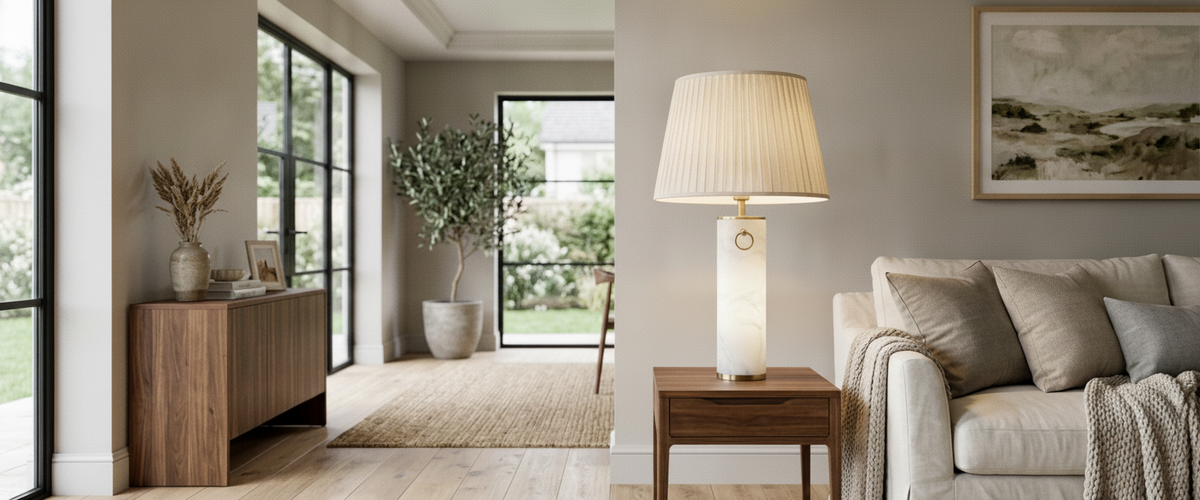

A traditional table lamp is judged after dark, and plenty of them fail the test. Too tall for the nightstand. Shade too shallow, so the bulb glares straight into your eye from the sofa. Or fitted with a cold LED that turns antique brass the colour of a hospital corridor. Choosing traditional table lamps well has far less to do with style labels than with height, shade depth, and how the body of the lamp handles light. That last point is where alabaster and natural stone change the conversation completely, because the material itself becomes part of the light source. The best traditional table lamps do two things at once: they light the surface they sit on, and they still read as an object when switched off.

Key Takeaways
Height rule: the bottom edge of the shade should sit near seated eye level, roughly 102 to 107 cm (40 to 42 inches) from the floor. Measure your table first, then subtract.
Shade rule: width around twice the widest point of the base, and deep enough to hide the socket and bulb from a seated view.
Light quality beats wattage: a dimmable, warm bulb at 2200K to 2700K with high colour rendering will always read better than a brighter, cooler one.
Material changes everything: traditional table lamps in ceramic and metal bounce light off the shade only; alabaster and onyx glow from within, adding a second, softer layer of light.
Buy in context: a traditional table lamp that looks right on a showroom plinth can look stranded on a 41 cm (16 inch) bedside table.

What Traditional Table Lamps Suit, and Who They Are For
Traditional table lamps carry a recognisable set of cues: a turned or carved base with visible mass, a fabric or stone shade with real depth, honest metalwork at the neck and finial, and proportions that reference classical urn, column or baluster forms. They belong in rooms with layered furniture and some architectural detail, but they are far more flexible than the label suggests. Some of the best pairings we see are deliberately mixed: a carved alabaster lamp with a pleated linen shade sitting on a slab-front walnut console, in a house that is otherwise entirely contemporary.
The buyers of traditional table lamps fall into predictable groups, and for good reason. Homeowners furnishing a formal living room or principal bedroom, where a ceiling fixture alone leaves the room flat. Interior designers building a lighting plan across a country house guest suite or a city drawing room, who need three or four light sources at different heights. And hospitality clients, particularly boutique hotels and private members' clubs, where table lamps on side tables and reception desks do more for the atmosphere at 9pm than any amount of downlighting. In each case, traditional table lamps are doing the job that overhead light cannot: creating pools of warmth at human height.
Sizing, Height and Placement That Works
Start with the surface, not the lamp. A bedside table is usually somewhere between 61 and 71 cm (24 to 28 inches) tall, which means traditional table lamps sitting on it want to be around 61 to 69 cm (24 to 27 inches) overall so the shade edge lands close to your eye line when you are sitting up in bed. Get this wrong by 10 cm and you either stare into the bulb or lose the light behind the mattress. Where a nightstand has to hold a book, a glass and a lamp at once, a compact piece such as the Inglenook 1 Light Small Table Lamp keeps the shade edge low and the surface usable, which a tall statement lamp rarely manages. A living room side table is often lower, so the lamp needs to be taller to compensate. Console tables in an entry hall sit higher again, and here a shorter, wider lamp usually reads better than a tall one.
Shade edge at seated eye level is the one measurement that decides whether a bedside lamp works.
Lamp shade proportions decide whether traditional table lamps glare. As a working guide, the shade should be roughly twice the width of the widest point of the base and about three quarters of the base height. Depth is the part people skip. A shallow drum shade on a tall base exposes the socket, and you will see the bulb every time you sit down. If you are choosing an alabaster or onyx shade rather than fabric, the calculation shifts, because the stone itself diffuses the light and softens the edge you would otherwise notice.
Living room lighting is about spacing more than symmetry. Aim for two or three light sources at different heights so the eye has somewhere to rest: a pair of traditional table lamps flanking the sofa, a floor lamp in the far corner, and a low-level accent somewhere else. The surface matters as much as the lamp: on a reflective hall piece like the Barroque Stainless Steel & Glass Console Table, light bounces back off the glass, so a deeper shade and a lower output stop the whole arrangement from looking harsh. Matched pairs work beautifully on either side of a bed or a fireplace. Everywhere else, consider breaking the pair. One larger lamp on a console and a smaller companion across the room often looks more collected than two identical pieces staring at each other.
Materials, Finishes and Light Quality
Ceramic, turned wood and cast metal bases are all opaque. Whatever light they produce comes off the inside of the shade and out through the top and bottom openings. That is perfectly good lighting, and it is what most traditional table lamps deliver. Glass sits between the two extremes: a base such as the Icaro 1 Light Glass Table Lamp lets light pass through the body but reads as clear brightness rather than a held glow. Stone works differently again. Alabaster is translucent, so a carved base or shade takes on the light and holds it, glowing gently from the inside with the veining drawn into the surface. The effect is closer to candlelight than to a bulb behind fabric, and it is the reason we build so much of the alabaster lighting range around it.
Translucent stone adds a second layer of light: the body glows as well as the shade.
Worth knowing before you buy: two different minerals are sold under the name alabaster. Gypsum alabaster is the softer, finely carvable stone used for much historical sculpture, while calcite alabaster (often called Egyptian alabaster or onyx marble) is harder and typically shows stronger banding. The distinction is well documented in conservation literature, including at the J. Paul Getty Trust, and it matters practically, because the two stones respond differently to moisture and to cleaning products. Onyx and marble sit alongside them in the same family: onyx gives dramatic amber and honey banding when lit, marble is generally denser and reads as a solid, sculptural mass with only a faint edge glow.
Metalwork is the other half of the equation, and on traditional table lamps it sets the temperature of the whole piece. Warm metals suit warm stone. Antique brass, aged bronze and brushed gold pick up the honey tones in alabaster and onyx and hold their own once the lamp is lit. Polished nickel and blackened steel work too, but they cool the whole piece down, which can be exactly right in a grey-toned room with pale stone and less right in a room built around walnut and terracotta.
One thing we have learned in the studio: alabaster veining looks nothing like its unlit appearance once there is a bulb behind it. A block that seems quiet and uniform under workshop lights can turn out to have a strong caramel seam running through it. We backlight material before cutting for exactly this reason, and it is why we tell clients specifying a matched pair for a bedroom that natural variation between the two is guaranteed, not a fault.
Bulbs, Dimming and Colour Temperature
The bulb undoes more traditional table lamps than any other single factor. Three practical rules:
Stay warm. 2200K to 2700K. Anything at 3000K or above drains the honey out of alabaster and makes brass look silver. Cool white in traditional table lamps is a mistake you will notice every evening.
Ask for high colour rendering. A CRI of 90 or above keeps stone veining, timber and textiles reading correctly. The Illuminating Engineering Society publishes useful background on why rendering quality affects how finishes appear.
Dim everything. Specify a dimmable bulb in LED form and a compatible dimmer. Trailing-edge dimmers generally handle LED loads more gracefully than older leading-edge units, and a lamp you can take down to 20 percent is a lamp you will use far more often.
Traditional table lamps in translucent stone reward restraint, so resist the urge to go bright. Alabaster is a diffuser, and pushing too many lumens through it flattens the veining and creates hot spots around the bulb. A modest output usually produces a better-looking glow than a high one. For reading, add a directional source nearby rather than overloading the lamp.
Wiring, plugs and any hardwired switching should go to a qualified electrician, especially on pieces shipped internationally, where voltage and plug standards differ by market. It is a short conversation that saves a long problem.
Common Mistakes and How to Avoid Them
Buying traditional table lamps before measuring the table. Check the surface height and depth, and leave room for a book and a glass. A lamp that swallows the whole nightstand is a daily irritation.
Ignoring where the switch sits. An inline cord switch that ends up behind the headboard is useless. Ask about switch position and cord length before ordering.
Choosing a shade that is too small. The most common visual error in this category, and the easiest to fix.
Assuming stone is delicate. Alabaster is softer than granite, but a properly finished traditional table lamp lives happily in a family living room. It just needs sensible care.
Cleaning with the wrong products. Vinegar, lemon-based sprays and ammonia cleaners etch calcite-based stone. Dry dust with a soft cloth or clean brush, and use only a barely damp cloth with pH-neutral cleaner when you need more.
Putting stone lamps in damp or steamy locations. Bathrooms and conservatories need careful thought and the right sealing and specification.
A Quick Pre-Purchase Checklist
Measure table height, then set your target shade-bottom height at seated eye level.
Confirm the shade width against the base width, and check the socket is concealed from your usual seat.
Decide opaque or translucent. Do you want the body of the lamp to glow, or just the shade?
Match the metal finish to the room's warm or cool bias, not just to the lamp.
Specify a dimmable warm bulb with high colour rendering, and check dimmer compatibility.
Check cord length, switch type and the electrical fitting for your market.
Ask about natural variation if you are ordering a pair of traditional table lamps in stone.
Confirm care guidance in writing for the specific stone you are buying.
How Niori Can Help with Lighting Projects
Niori works in alabaster and natural stone across pendants, chandeliers, wall lights, floor lamps and table lamps, and ships internationally. For single-room buyers, the practical value is usually in matching lamp scale to the furniture you already own and getting the light quality right first time. Browsing the full lighting collection is a reasonable starting point if you want to see how traditional table lamps sit alongside wall and ceiling pieces in the same material language.
For designers, architects and hospitality clients, the work usually goes further: matched stone across multiple fixtures, bespoke sizing, specific metal finishes, and coordinated specification so the traditional table lamps in a suite relate to the pendants in the lobby. Budget on projects like these depends on the stone selected, the scale and complexity of the piece, the engineering behind it, and the installation and finishing required, so the honest answer is to send us the scheme and ask for a tailored quote rather than working from a headline figure.
Traditional table lamps are one of the few purchases where a small change in proportion produces a large change in how a room feels at night. Measure carefully, choose the bulb deliberately, and let the material carry the rest.