
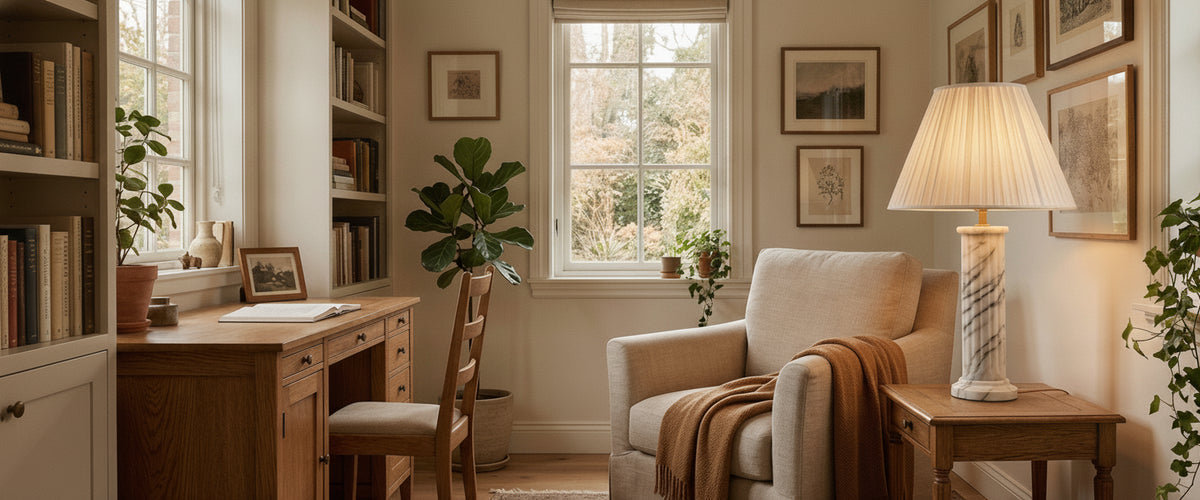

Plenty of the "vintage" marble lamps listed online are not old, and a few are not marble. That is the honest starting point for anyone shopping for a vintage marble table lamps. Genuine 1920s bases, 1970s salvage, last year's reproductions and resin castings all turn up under the same search terms, often at similar asking prices. Stone tends to give itself away, though, if you know where to look and what to touch.

Quick Answer
- Genuine marble feels cool, weighs more than you expect, and shows veining that runs through the stone rather than sitting on the surface.
- Real age shows up as soft edges, fine surface wear and old hardware, not as artificial distressing.
- Shade choice decides whether the base reads as a centrepiece or a doorstop. Plain, warm-toned shades usually win.
- Wiring on any vintage piece should be inspected, and usually replaced, by a qualified electrician before regular use.

Patina, Vein Depth and Age: Reading a Vintage Marble Table Lamp
Start with the surface. Marble that has lived on a side table for decades picks up a particular kind of wear: a faint haze where polish has softened, rounded arrises (the crisp edges where two faces meet), and the occasional dull ring where a glass once stood. Marble is calcium carbonate, so acids etch it, and those dull rings are very hard to fake convincingly. The Natural Stone Institute publishes care guidance that explains why citrus, wine and harsh cleaners leave those marks. A seller's "distressed" finish, by contrast, tends to look evenly scuffed all over, which is not how real use works.
Vein depth matters next. On solid marble, a vein that appears on the front of the base should continue around the side and, ideally, show up again on the underside or inside the drilled cable channel. Printed or cast imitations repeat the same pattern, stop at the edge, or look a little too graphic under raking light. Cultured marble (stone dust bound in resin) feels warmer to the touch and lighter in the hand than its size suggests.
Age is confirmed by the supporting cast: slotted screws rather than cross-heads, brass with a natural brown patina, old felt on the base, and sockets stamped with a maker's mark. Mixed signals are common. An auction lot described as Edwardian might have the right stone but a bakelite switch and cross-head fixings that point to a mid-century rewire. Nothing wrong with that; it simply changes what you should pay.
Four Marbles You Will Meet Most Often, and How Each Carries Light
Lamp-base marble is too thick to glow the way alabaster does. It works with light by reflection, so colour and polish decide the effect.
- White Carrara and Statuary. The most common vintage base. It bounces shade light back into the room and reads soft and bright, but it also shows every yellowed patch and etch ring.
- Black marble (Nero Marquina and similar). A black marble table lamp absorbs light and lets the polish do the talking: you see crisp highlights and white veins picked out like lines on a map. It hides wear better than white, though dust shows quickly.
- Portoro. Black with gold or buff veining, a favourite of Art Deco makers. Under a warm shade the gold veins pick up the glow and look almost metallic.
- Green stones (Verde Antico and Verde Alpi). Technically many are serpentinite rather than true marble, but the trade calls them marble. Deep green reads moody in low light and pairs well with aged brass.
Set offcuts of each beside a dimmable lamp and the difference is obvious. Turned down to a low glow, the black and green pieces almost disappear, while white Carrara still reads as a pale shape. That is worth knowing if your vintage marble table lamp will mostly be used at dimmed evening levels.
What "Vintage" Actually Means When You Are Buying
Three very different products sit under the vintage marble table lamp label, and each is a legitimate buy as long as it is described honestly.
Antique Bases
Usually pre-1950, often converted from oil or gas lamps or turned from architectural off-cuts. Expect heavier stone, hand-turned profiles and original wiring that is unsafe by modern standards.
Mid-Century Salvage
Roughly 1950s to 1970s. Cleaner columns, block bases and lots of black stone and travertine. This is the sweet spot for many buyers because the stone is real and the shapes suit contemporary rooms.
Honest Reproduction
New stone cut to period profiles. A good reproduction marble base table lamps can be a better daily lamp than a tired original, with modern wiring and no hidden cracks. The problem only arises when it is sold as old.
If you love the material but want light that comes through the stone itself, that is where alabaster comes in. It is translucent in a way marble is not, and a carved shade or body glows from within. You can see how that differs in our alabaster lighting collection, which sits comfortably alongside a vintage marble piece in the same room.
Shades That Flatter a Veined Stone Base, and Ones That Fight It
Busy stone needs a quiet shade, and that goes double for a vintage marble table lamp with strong figuring. Natural linen, ivory silk or a warm parchment in a simple drum or empire shape lets the veining be the pattern in the room. Pleated shades work well on Art Deco bases, especially over Portoro, because the pleats echo the period without competing.
Avoid patterned fabric, glossy black shades on a black base (the lamp reads as one heavy block), and cool white shades on Carrara, which make the stone look grey and clinical. Proportion matters as much as fabric. A shade whose bottom diameter is narrower than the widest part of the base looks undersized and nervous. An alabaster or glass shade on a marble base is a strong combination too, provided the shade has enough visual weight to balance the stone.
For bulbs, a dimmable LED at 2700K keeps veining warm and true. Higher colour temperatures flatten white marble and make green stones look murky. LEDs also run cooler, which protects older fabric and parchment shades.
Height, Visual Weight and Placement by Room
A marble base lamp carries more visual weight than a ceramic or wood lamp of the same height, so it needs a surface that can hold it physically and visually. A solid column can easily weigh more than 7 kg (about 15 lb), so check that glass-topped or delicate side tables can take it.
- Living room. For reading beside a sofa or armchair, aim for the bottom of the shade to sit around eye level when seated, roughly 97 to 107 cm (38 to 42 inches) from the floor. Lamps in this position usually fall between 61 and 76 cm (24 to 30 inches) tall, depending on table height.
- Bedroom. Slimmer columns suit bedside tables. Black marble works well here because it reads calm at low light levels.
- Hallway console. The place for a tall, sculptural vintage marble table lamp. It is viewed from a distance, so bold veining and height earn their keep.
- Hospitality. In hotel lounges and restaurant banquettes, a weighted marble base resists knocks better than a light lamp. Specify rewired, PAT-tested pieces and a consistent colour temperature across the room.
If you are planning the wider scheme, the full lighting range helps you balance a statement table lamp with pendants and wall lights so the stone piece is not doing all the work.
Condition, Socket Type and Rewiring: Before You Commit
Cracks are the first worry when inspecting a vintage marble table lamp. Run a fingernail along any line in the stone; a vein is smooth, a crack catches. Look closely at the drilled channel and the joint where stone meets metal, as both are common failure points. Old repairs with filler often show as a slightly different sheen.
Check the socket. UK lamps typically use B22 bayonet or E27 and E14 screw fittings. Imported American pieces often carry E26 sockets wired for 110 to 120 volts, which is not suitable for UK mains as found. Cloth flex, missing earth connections on metal parts and two-pin plugs are all signs a lamp needs rewiring. Do not attempt this yourself. Have a qualified electrician rewire and test the lamp; in the UK, the NICEIC register is a sensible place to find one.
Pre-Purchase Checklist
- Weight and temperature match genuine stone.
- Veining continues around edges and into the drill hole.
- Wear is uneven and logical, not uniformly distressed.
- Hardware dates are consistent with the claimed age.
- No cracks at the base, neck or fixing points.
- Socket type and voltage identified, with rewiring budgeted.
- Shade included, or a suitable replacement planned.
A well-chosen vintage marble table lamp will outlive several sofas. Buy the stone first, the story second, and treat the wiring as the part you replace. If you want a new piece with the same depth of material, Niori's alabaster and natural-stone lamps are made to be lived with for decades, and we are happy to provide a tailored quote for larger design or hospitality projects.