
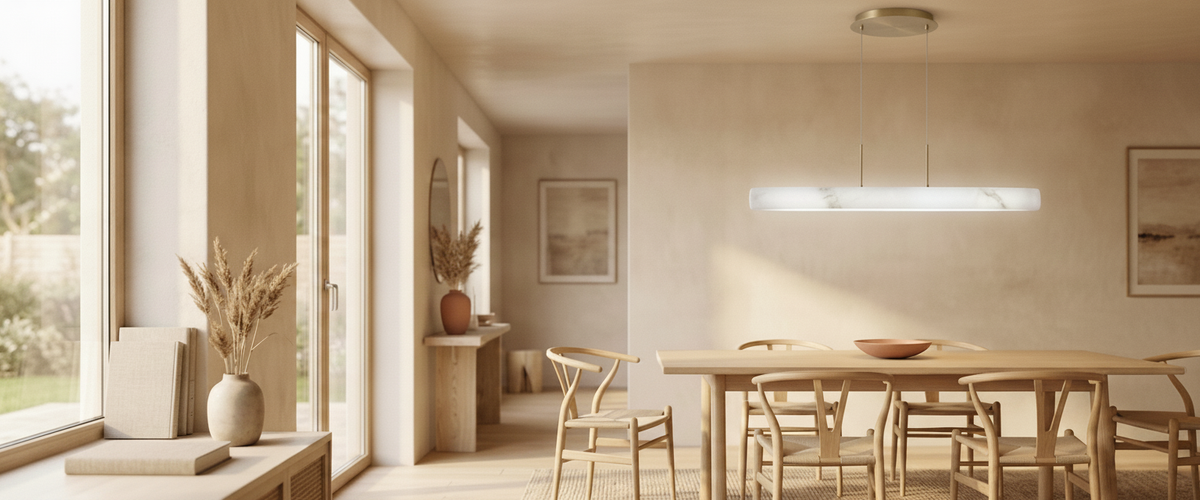

Switch on the wrong stone pendant lights and you get a pretty ornament with a bulb behind it. Switch on the right one and the stone itself becomes the light source, veins lifting into view, the whole piece warm from the inside out. That difference comes down to a single property most buyers never think to ask about: how much light the material actually lets through. Get that right and a single stone pendant light can carry a room. Get it wrong and you have spent money on a shade that stays stubbornly dim.
At Niori we work almost entirely in alabaster and natural stone, so we spend a lot of time explaining why two pendants that look identical in a photograph behave completely differently once they are lit. This guide walks through what to look for in a stone pendant light, color by color, before you commit.
A translucent alabaster piece glowing from within at night.

Key Takeaways for Choosing a Stone Pendant Light
Translucency is everything. Pale alabaster and onyx glow from within; dense black stone reflects light rather than passing it through.
Read the veining. Heavier veins and blue tones can look like cracks or shadows once the piece is lit, so judge the stone illuminated, not just on the shelf.
Match drop and diameter to the room, not to the ceiling height alone. One well-scaled stone pendant light beats a cluster of timid ones.
Warm, dimmable bulbs keep the stone honest. Cool light drains alabaster to gray and flattens the veining.
Budget depends on material, scale, engineering and finishing. Ask for a tailored quote rather than trusting a headline figure.

What Lighting a Stone From Within Reveals
Hold a slab of alabaster up to a window and you will see the material change character. Light does not bounce off the surface so much as sink into it, scatter, and come back out softened. That scattering is why a good stone pendant light reads as a warm mass of light rather than a bright point. Denser stones stop the light at the surface; translucent ones let it travel a few millimeters before releasing it, which is what produces the glow.
The practical takeaway is simple. Before you buy a stone pendant light, you want to know how thick the stone is cut and how translucent the specific piece is. A thick, dense cut looks reassuringly solid in daylight and disappoints the moment you switch it on. A well-chosen translucent cut does the opposite: quiet by day, quietly luminous at night. If you are browsing our range of alabaster lighting, that lit-versus-unlit distinction is the first thing worth picturing in your own room.
Alabaster and Onyx: the Translucency That Makes a Pendant Glow
Alabaster is the classic choice for a reason. It is a soft, fine-grained stone (a form of gypsum) that transmits light beautifully and carries subtle, cloudy veining that looks almost lit from behind even in daylight. It has been carved for lamps and decorative work for centuries precisely because it takes fine detail and glows under light. The Encyclopaedia Britannica notes that the gypsum form is fine-grained, soft enough to carve, and slightly translucent, which is exactly what makes it useful for lighting. When it is lit, the color warms toward honey and cream, and the veins turn into soft internal shadows rather than hard lines. This is why alabaster stone pendant lights remain the default when a room needs an even, atmospheric wash rather than a hard beam.
Onyx behaves similarly but with more drama. It tends to carry bolder banding in amber, caramel and occasionally green or blue, so an onyx stone pendant light lights up with far more visible pattern. That can be gorgeous over a bar or a dining table where you want the fixture to be a talking point. It can also be too busy above a calm bedroom seating area. The rule of thumb: alabaster for a soft, even glow, onyx when you want the stone's markings to perform.
Both materials reward a slightly thinner, more translucent cut. Ask how the piece transmits light, not just what it weighs. Two pendants of the same diameter can differ by a couple of kilograms (about 4 to 5 lb) depending on wall thickness, and the lighter one often glows more evenly.
A dense black stone pendant working as a sculptural, reflective piece.
Why a Black Stone Pendant Reflects Rather Than Lights
A black stone pendant light works on the opposite principle, and it helps to know that going in. Dark marble and near-black stone are dense and largely opaque, so they do not glow from within. What they do instead is catch light on the polished surface, throw a controlled beam down from the aperture, and read as a sculptural silhouette against a pale ceiling. That is a legitimate and often striking effect; it is simply a reflective piece, not a translucent one.
Choose a black stone pendant when you want definition rather than diffusion: over a kitchen island where you need directed task light, or as a graphic full stop in a scheme full of soft, pale surfaces. Where the room needs stone used as form and finish rather than a glowing shade, something like the Gemini Pendant Light 61cm, Black reads as a controlled sculptural mass rather than an internal glow. Over a longer island, the larger Gemini Pendant Light 105cm gives you the same reflective language at a scale that anchors the run. Just do not expect the warm inner light you get from alabaster; a reflective stone pendant light and a translucent one do genuinely different jobs. You will find both approaches sitting side by side in the wider lighting collection.
Pale Blue and Heavily Veined Stone: Read the Surface First
A light blue stone pendant is one of the more seductive options in a showroom and one of the easiest to misjudge. Blue-gray stones and heavily veined marbles look serene unlit, but lighting changes them. Under a warm bulb the blue can shift and warm; under a cool bulb the veining can look like fracture lines or dirty shadow. Neither is a flaw in the stone, it is just physics, but you want to see it before it arrives. This is exactly the kind of pendant light stone that rewards a careful look while it is switched on.
Two things protect you here. First, always judge a veined or colored stone pendant light illuminated, and ideally at the color temperature you will use at home. Second, remember that natural stone is not printed: no two pieces are identical, and heavy veining that reads as elegant in one cut can look chaotic in another. Ask for images or a sample of the actual stone rather than a marketing render. A reputable supplier expects this question. The pattern that arrives should be the pattern you agreed to.
Drop and Diameter That Let One Pendant Carry a Room
Scale is where confident buyers separate from nervous ones. A stone pendant light has visual weight, so an undersized piece looks apologetic and a slightly generous one looks intentional. A few working guides we use in the studio:
Over a dining table: aim for the pendant to be roughly one-half to two-thirds the width of the table, hung so the base sits around 30 to 36 inches (76 to 91 cm) above the surface.
In a hallway or stairwell: keep at least 7 feet (about 2.1 m) of clearance beneath the fixture so no one walks into it, and let a taller drop do the drama.
Over an island: two or three smaller pendants often beat one large piece; space them evenly and treat the group as a single line.
In a room with high ceilings: a larger single stone pendant light with a longer drop reads calmer than several small ones fighting for attention.
One client fitting out a double-height entrance hall had planned three small stone pendant lights at different heights. We swapped them for a single larger alabaster piece dropped low into the void. The room went from busy to composed in one change. When in doubt, go bigger and simpler.
Warm Bulbs and Dimming That Keep the Stone Honest
The fastest way to ruin a beautiful piece is a cold, blue-white bulb. Alabaster and onyx are warm materials; light them with cool LEDs and the honey tones drain to gray, the veining flattens, and the glow that sold you on the stone pendant light simply vanishes. Stay in the warm range, roughly 2700K to 3000K, so the stone reads as it should.
Dimming matters just as much. A pendant that is glorious at full output can be too much over an intimate dinner, so pair it with a dimmable, high-quality LED and a compatible dimmer. Flicker and buzz usually come from a mismatch between the driver and the dimmer, not the fixture, so check compatibility before you install. And as with any hard-wired lighting, have a qualified electrician handle the connection; these pieces carry real weight and the fixing needs to be right.
The Rooms Where Stone Beats Glass, and Where It Doesn't
Stone earns its place where you want atmosphere and mass: dining rooms, principal bedrooms, snugs, a hotel lobby that needs presence, a restaurant that wants warmth rather than glare. The diffused glow flatters skin and food, and the material feels considered in a way that blown glass sometimes does not.
Glass still wins in a few places. If you need maximum brightness from a small fixture, or a genuinely weightless look in a tight space, glass or metal may serve better. A very humid, poorly ventilated bathroom is not ideal for softer stones either. Match the material to the job. A translucent alabaster stone pendant light over a dining table is doing something a glass globe cannot; a black stone pendant over a busy island is doing something an alabaster shade cannot. Both are right when the room asks for them.
A Quick Buying Checklist
Ask to see the piece lit, not just photographed unlit.
Confirm the stone type and, for colored or veined pieces, request the actual cut you will receive.
Check wall thickness and translucency for glow; check finish and aperture for a reflective black piece.
Size drop and diameter to the room, then go one notch bolder.
Specify warm, dimmable LEDs and a compatible dimmer.
Book a qualified electrician for installation and confirm the ceiling fixing can carry the weight.
Buy on translucency, scale and light quality rather than on the daytime photograph, and a stone pendant light will keep earning its keep every evening you switch it on.