
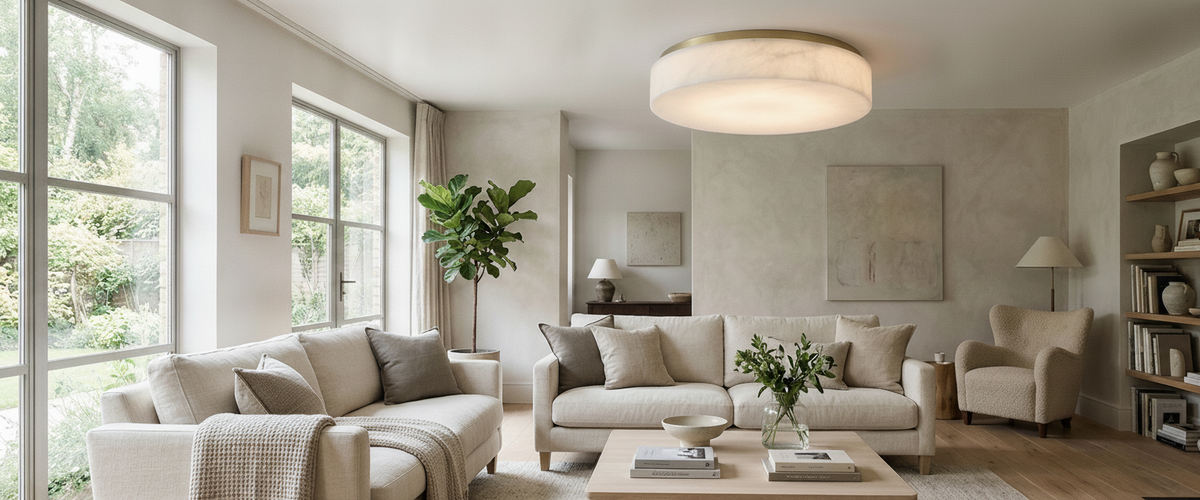

Choosing ceiling lights living room shoppers actually enjoy comes down to one shift: stop asking a single central pendant to light the whole space. That lone fitting on one switch is why so many rooms swing between glary and gloomy. The fix is a soft, even base layer overhead that you then build on with lamps and wall lights, and it starts with matching the right fitting to your ceiling. Good ceiling lights living room schemes work in layers, not from one bulb. This guide walks the practical decisions in order: materials, scale, placement, bulbs and care, so you can specify with confidence rather than guess.
Alabaster and natural stone change the terms of that decision. Because the material is faintly translucent, light passes through the stone rather than bouncing off a hard reflector, so the glow arrives softened and the fitting itself becomes part of the light. That is the quality Niori is built around, and it matters most when you are picking ceiling lights living room evenings depend on, where a badly chosen fitting sits in your eyeline all evening.

Key Takeaways
Flush and semi-flush fittings suit standard ceiling heights; a pendant or chandelier suits taller rooms and a defined seating zone.
Alabaster and stone diffuse light through the material, so the fitting glows softly instead of producing a hard hotspot.
Layer your lighting. The overhead fitting is the base; add lamps and wall lights so you are not relying on one switch.
Warm color temperature (around 2700K) and a dimmable circuit do most of the work in setting the mood.
Scale to the room and the seating, not to the ceiling void, and always have mains work done by a qualified electrician.

What Ceiling Lights for the Living Room Really Means
The phrase covers more than one fixture type, and the differences matter before you buy. A flush ceiling light sits tight against the ceiling and throws light outward across a wide area; it is the workhorse for rooms with normal ceiling heights of around eight feet (2.4m). A semi-flush drops a few inches lower and adds a little presence without demanding a double-height room. A pendant or chandelier hangs lower still and becomes the room's centerpiece, which only works when you have the height and a clear zone beneath it. Good ceiling lights living room buyers rely on start with picking the right one of these for your ceiling.
This guide is for anyone furnishing a room from scratch, replacing a tired builder-grade fitting, or specifying lighting for a project. Interior designers and venue owners tend to already think in layers; homeowners often do not, and that single overhead fitting is usually where the frustration starts. The right living room ceiling lights fix that in an afternoon.
How to Compare the Options Before Buying
Start with the ceiling itself. Measure the height, note where the existing rose sits, and decide honestly whether you want the fitting to disappear or to be looked at. When you compare ceiling lights for the living room, a flush alabaster disc that glows quietly is a very different brief from a stone pendant meant to anchor a sofa arrangement.
Then think about the light quality you want in the evening. Hard, downward-only fixtures create sharp shadows and a slightly clinical feel. Diffusing materials such as alabaster, onyx and frosted glass spread the light and take the edge off, which is why they read as more restful. If you are weighing several living room ceiling lights, our full lighting range is a useful way to see how flush fittings, pendants and wall lights behave side by side before you commit.
A few practical checks worth making on any ceiling lights for the living room:
Light spread: does it wash the ceiling and walls, or only point down?
Dimming: is the fitting dimmable, and does it need a specific dimmer type for its LED driver?
Bulb access: can you reach the lamps easily, or is it a two-person job every time one goes?
Weight and fixing: stone fittings are heavy, so the ceiling needs a suitable fixing point.
Materials, Finishes and Scale Decisions
Alabaster is the material we come back to most for living room ceiling lights, and for good reason. Each piece carries its own veining, so no two shades are identical, and the stone glows with a warmth that manufactured diffusers struggle to copy. The alabaster lighting collection is the natural place to start if you want that soft, lit-from-within effect overhead. Onyx pushes further, with stronger color banding and more drama; marble tends to be used as a solid element around a diffuser rather than as the glowing part itself.
Metalwork sets the tone around the stone. Brushed brass reads warm and traditional and flatters cream and honey-toned alabaster. Polished chrome and burnished silver feel cooler and more contemporary, and pair well with crystal or clear detailing. Where a room leans classic and you want the ceiling light in the living room to catch the light with a little sparkle, a crystal flush piece such as the Lucia 6 Light Flush Ceiling Light in Burnished Silver Crystal carries that cooler, more decorative language well. Black metalwork gives a graphic, defined edge that suits a modern scheme. None of these is right or wrong; match the finish to your existing hardware, from door handles to curtain poles, and the room hangs together.
Scale is where people slip up most when specifying ceiling lights living room projects call for. A common designer starting point is to add the room's length and width in feet, then read that total in inches as a rough fixture diameter; a 14 by 16 foot room lands somewhere around a 30 inch (76cm) fixture. Treat it as a guide, not gospel. Where a large room needs a broad, even wash rather than a statement centerpiece, a wide flush fitting such as the Gemini Flush Ceiling Light 81cm in White covers more area cleanly than a smaller disc stranded in the middle. For a pendant over a seating group, the base of the fitting should clear head height comfortably, which usually means the lowest point sits well above seven feet (2.1m) from the floor in a walking area.
Where to Place the Fittings
Centering a single fitting on the ceiling is the default, and it is fine as a base layer. The stronger visual result usually comes from thinking about zones instead. If your seating clusters around a coffee table, hang a pendant or chandelier over that group so the light gathers where people actually sit. If the room is long and open-plan, two matching flush ceiling lights for the living room spaced evenly often beat one large fitting stranded in the middle.
Recessed downlights, or can lights, are the other half of the conversation. They are excellent for even background light and for washing walls and artwork, but a ceiling of downlights alone tends to feel flat and a little commercial. Space them roughly four to six feet (1.2 to 1.8m) apart, keep them off the perimeter so they graze the walls rather than the sofa backs, and put them on their own dimmable circuit. A decorative alabaster fitting as the centerpiece, with can lights doing the quiet fill, is the layout that flatters most living room ceiling lights schemes.
We recently shipped a pair of matching flush alabaster ceiling lights for the living room to a client redoing a wide reception room; a single central pendant had always left the far corners dim. Splitting the light across two points, each on its own dimmer, fixed the problem in an afternoon and made the room feel considerably longer.
Bulbs, Wattage and Dimming
For living room ceiling lights, aim for a warm color temperature. Around 2700K gives the amber, relaxed light most people associate with a comfortable evening room; 3000K is a touch crisper. The cooler 4000K found on some flush fittings suits kitchens and workspaces more than a room you unwind in, so check the spec before you buy.
On wattage, think in the light output the room needs rather than a single bulb figure, because it depends on how many fittings share the load and how much daylight the room gets. As a rough target, a living room reads well at somewhere between 1,500 and 3,000 lumens total across all your overhead sources, spread over several fittings rather than concentrated in one. With modern LED lamps that is comfortably efficient. The US Department of Energy notes that LED lighting uses a fraction of the energy of older incandescent bulbs for the same output, which is why building your ceiling lights for the living room around lumens rather than old wattage habits pays off. Put everything on a dimmer and you can drop from bright and social to low and calm on the same fitting.
Budget, Quality and Delivery
Natural stone lighting is not priced like a mass-produced fitting, and it should not be. What you are paying for is the raw material, the cutting and finishing of stone that varies block to block, the metalwork, and the engineering that carries real weight safely on a ceiling. Because those factors move with scale and complexity, the honest answer on cost is that it depends; the best route is to describe your room and request a tailored quote rather than work from a headline figure. That holds for any of the living room ceiling lights in the range, and it is worth planning your ceiling lights living room budget around the specific fitting rather than a rough average.
Delivery deserves a mention too. Stone ceiling lights for the living room are heavier and more fragile than metal ones, so they travel packed accordingly, and larger pendants often ship in stages. Confirm the fixing point can take the weight before installation day, and have the mains connection made by a qualified electrician; this is not a job to improvise. Getting delivery right is part of buying ceiling lights living room projects can trust to arrive intact.
How Niori Can Help
Niori designs and supplies alabaster and natural-stone lighting for homes, hospitality and design projects, from flush ceiling fittings to pendants, chandeliers, wall lights, table lamps and floor lamps. If you are planning your ceiling lights for the living room and are unsure which fitting type and scale will suit the space, start on the Niori homepage to see the range, then get in touch with your room dimensions and ceiling height for specific guidance. For anything involving several living room ceiling lights, matched finishes or a full project, we are happy to help work the layout through with you. Whatever your ceiling lights living room plans call for, a quick conversation about the space usually saves a return.