
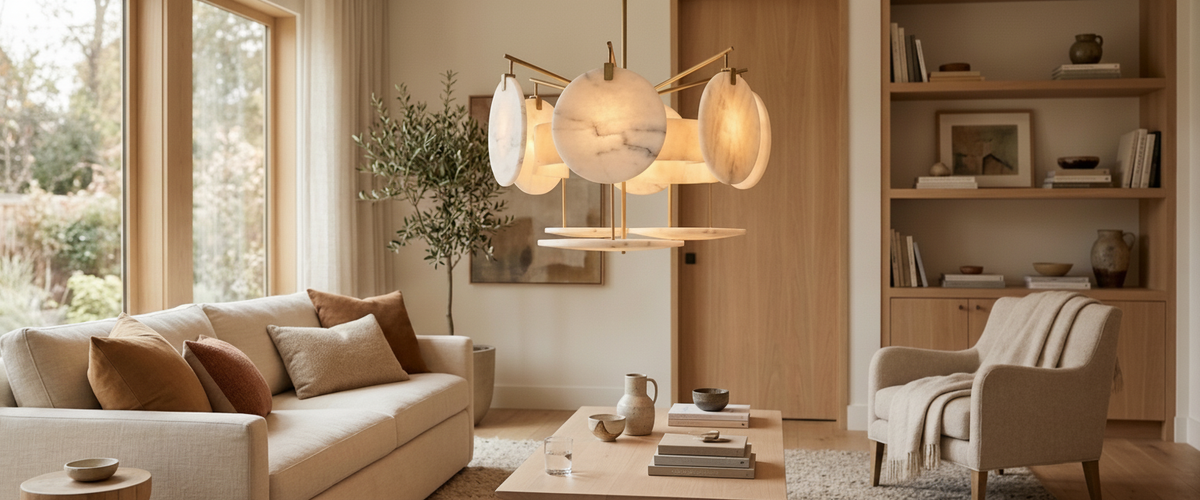

Two designer chandeliers can look near-identical in a photograph and behave nothing alike once they are hanging over your table. One has a stamped canopy plate and a chain rated well above the fitting's weight. The other has a decorative cover hiding a fixing that was never meant to carry it. The difference does not show up in the styling shot; it shows up on installation day, when the electrician stops work and asks who signed off the ceiling. If you are specifying designer chandeliers for a client project or your own home, the spec sheet matters far more than the mood board.

Key Takeaways
- Ask who made it. Designer chandeliers split into studio-made, factory-produced and licensed reissue pieces, and those sit at very different points on quality and price.
- Weight is the first conversation, not the last. Canopy plate, chain or rod rating and the ceiling structure need checking before you order.
- Finish decides how it ages. Lacquered brass, plated chrome and unsealed metal respond differently to heat, humidity and fingerprints.
- Scale behaves differently in a period room than an open-plan one, even at identical ceiling heights.
- The lamp you fit matters more than the fitting's spec sheet. Colour temperature, CRI and dimming compatibility do most of the visible work.
- Spares availability in three years' time is a legitimate buying question. Ask it in writing.

Who Actually Made It, and Why the Answer Changes the Price
"Designer" covers at least three business models. A studio-made piece is cut, assembled and finished in small batches, often with hand-selected stone or glass, and the maker can tell you which block a slab came from. A factory-produced range is tooled for repeatability, which is not a criticism; consistent tolerances are exactly what you want when you are hanging six matching fittings down a hotel corridor. A licensed reissue is a historic design produced under agreement, where you are partly paying for the archive, the drawings and the right to call it by its original name.
Buyers often begin with a large catalogue design house they already trust from furniture, then discover its designer chandeliers are sourced from a completely different supply chain. That is worth knowing rather than worrying about. What you want is a straight answer to three questions: where the components are made, where the fitting is assembled, and who tests it. Any supplier of genuine designer chandeliers should answer without hedging.
With alabaster and natural stone, the maker question carries extra weight. Stone is not a print. Every slab has its own veining, translucency and density, and a workshop that hand-selects material will tell you the piece you receive will not be an exact clone of the photograph. At Niori, that variation is the point. Our alabaster shades transmit light through the mineral itself, so the glow shifts with the grain of the stone rather than sitting flat like an opal glass diffuser. You can see the range of that effect across the alabaster lighting collection, where designer chandeliers of the same form read warmer or cooler depending on the block they came from.
What Holds the Weight: Canopy, Chain and Ceiling
Stone designer chandeliers are heavy. A multi-arm alabaster fitting can run to 18 to 27 kg (40 to 60 lbs) or more, and that load has to reach the building structure, not just the plasterboard. Three things need to line up.
- The canopy plate. Look for a steel plate with proper fixing centres, not a thin decorative cup. Ask what the plate is rated to carry.
- The chain, rod or cable rating. Reputable suppliers state a safe working load. If the answer is vague, treat the vagueness as an answer in itself.
- The ceiling itself. Lath and plaster in a Georgian or Victorian property will not take a heavy fitting without a timber noggin or a spreader plate fixed back to joists. Historic England's guidance on traditional building materials is a useful primer on why old ceilings behave the way they do.
Always use a qualified electrician, and get them to inspect the ceiling void before the fitting arrives rather than on the morning of installation. We once had a client in Edinburgh order a large stone chandelier for a first-floor drawing room with an original decorative ceiling. The electrician opened up a small access panel above, found the joists ran the wrong way for the intended position, and the fitting shifted 30 cm (about 12 inches) off the room's centre line. Better to know in advance than to drill and discover.
Which Finishes Survive Heat and Hands
Metalwork is where designer chandeliers quietly succeed or fail over a decade.
Lacquered brass holds its colour, but the lacquer is a sacrificial layer. Heat from lamps sitting too close, and repeated cleaning with anything abrasive, will break it down and let patchy tarnish through. The Smithsonian's conservation guidance on caring for metal objects makes the point plainly: once a coating fails in one spot, the corrosion underneath is uneven and much harder to correct than uniform patina.
Unlacquered or living brass will darken, and around a kitchen island it will darken fastest where hands touch it. Some clients love that. Others call three months later asking why it looks different from the showroom. Decide which camp you are in before ordering. An aged brass finish sidesteps that argument by starting part-way along the ageing curve, which is why a fitting like the Marvele 8 Light Chandelier in Aged Brass tends to settle into a room rather than shift on you.
Plated chrome and nickel are hard-wearing but show fingerprints and water spotting, particularly in bathrooms and over polished dining tables where the reflection doubles every mark.
Where designer chandeliers combine stone and metal, ask how the two are joined. Alabaster is a gypsum stone, softer than marble, and it does not enjoy being clamped hard against metal with no allowance for movement. Good makers use bedding, felt or a shaped seat. Poor ones rely on pressure alone, and you find out during the first heating season.
How Designer Chandeliers Scale in a Period Room Versus an Open Plan
The old formula (add the room's dimensions in feet and use that number in inches as the diameter) is a starting point, not an answer. It ignores what the room is doing around the light.
In a period room with cornicing, a picture rail and a ceiling rose, the architecture already frames the fitting. A chandelier that reads correctly there is usually tighter in diameter and taller in profile, because it needs to sit within the rose and the cornice line without crowding either. Go too wide and it fights the plasterwork.
In an open-plan space at the same ceiling height, there is no frame at all, so modestly sized designer chandeliers simply disappear into the volume. Here you want either more diameter or more visual mass, which is usually a question of arm count rather than sheer width; where a six-arm frame holds a period dining room, something with the density of the Brianna 9 Light Chandelier in Black is closer to what an open-plan volume needs to feel resolved. Two matched chandeliers spaced along a long island often work better than one oversized piece, and they even out the shadows falling across the worktop. For dining, keep the lowest point roughly 76 to 90 cm (30 to 36 inches) above the tabletop, and in circulation zones keep at least 2.1 m (7 feet) of clear headroom.
Contemporary Chandelier Design and the Motif Question
Contemporary chandeliers design has moved away from tiered crystal towards geometry: rings, staggered bars, cascading discs, sculptural stone slabs held in slim brass frames. The sunburst or starburst arrangement has had a long run and shows up everywhere from ceiling plasterwork to tattoo flash, which tells you something about its graphic strength. In a real room it needs breathing space. A radiating chandelier design over a narrow hallway reads as clutter; the same piece centred in a square stair void reads as architecture. Where the space calls for a graphic silhouette rather than a broad canopy of light, a tighter black-framed piece such as the Sabina 5 Light Chandelier is closer to the right design language.
Stone changes how those forms behave. A brass ring fitted with alabaster panels gives you the geometry of a contemporary piece and the light quality of something much older, because the stone diffuses rather than sparkles. If you are comparing designer chandeliers against pendants and wall lights before committing, browsing the wider lighting range is a quicker way to calibrate scale than looking at chandeliers alone.
Bulbs and Dimming Do More Than the Fitting Does
Even the best designer chandeliers look cheap fitted with the wrong lamps, and there is no styling trick that fixes it. Specify carefully.
- Colour temperature: 2400K to 2700K for alabaster and onyx. Anything cooler kills the honey tone in the stone and turns cream veining grey.
- CRI: 90 or above. Natural stone has subtle mineral colour that low-CRI lamps flatten.
- Dimming: confirm the driver or lamp is compatible with your dimmer type (leading edge, trailing edge or 0-10V). Mismatches cause flicker and buzz, and a translucent stone shade will not hide either.
- Lamp shape: in a translucent shade, a compact bulb placed off-centre will show as a bright spot through the stone. Ask the supplier where the lamp sits relative to the shade wall.
- Heat: keep filament-style lamps away from lacquered surfaces and thin stone sections.
Can You Get a Spare Arm, Crystal or Driver in Three Years?
This is the question almost nobody asks and everybody eventually needs. Integrated LED modules fail. Crystals get knocked off during redecoration. A stone arm can chip in transit or when a ladder catches it.
Ask the supplier, in writing, whether individual components are available separately, whether the driver is a standard replaceable unit or bonded into the body, and roughly how long a spare typically takes to source. Do not accept "we can look into it". For designer chandeliers made from stone specifically, ask whether a replacement component will be cut from the same material batch or matched as closely as possible, since alabaster from a different block will not be identical.
Red Flags Worth Pressing On Before You Commit
- No stated weight, or a weight given without the chain and canopy rating.
- Vague material description. "Stone effect", "alabaster style" and "marble finish" usually mean resin or printed glass.
- No dimming information at all, or a claim that it works with "all dimmers".
- Fixed cable length with no drop adjustment stated, which is a problem in double-height spaces.
- Photographs that all show the same slab, with no acknowledgement of natural variation.
- No IP rating mentioned for a fitting being sold for bathroom or covered outdoor use.
- No named point of contact for spares or technical questions after delivery.
Budget for designer chandeliers depends on material grade, overall scale, the complexity of the metalwork, the engineering behind the suspension, and the level of hand finishing, plus installation. Any supplier quoting a single figure without knowing your drop height, ceiling type and lamp specification is guessing. Ask for a tailored quote against your actual drawings.
The designer chandeliers that still look right after a decade are rarely the ones that photographed best. They are the ones where the maker thought about load, heat, finish and replacement parts before they thought about the styling shot. Start your search from the Niori homepage if you want to see how alabaster and natural stone handle those demands in practice.