

The brass looks warm and settled in the product photo, then arrives on your wall reading brighter, yellower and busier than you expected. That gap between the picture and the fitting is the single most common thing people get wrong when buying a brass wall sconce in the UK, and almost all of it comes down to finish, placement and what sits beside it. Get those three right and a pair of sconces will do more for a hallway or a bedroom than a much larger ceiling light ever could.
At Niori we build most of our range around alabaster and natural stone, with brass detailing that carries the metalwork, so we spend a lot of time watching how a brass wall sconce behaves once it is fixed to a real wall next to real materials. What follows is the guidance we actually give buyers, designers and hospitality clients before they commit.
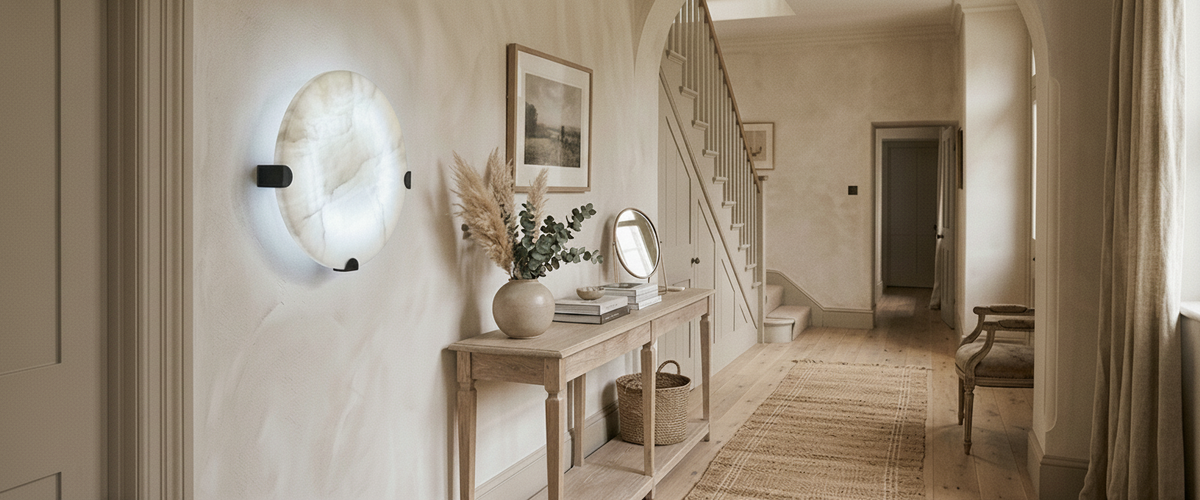
Warm brass detailing against a glowing alabaster shade in a plastered hallway.

Key Takeaways
Finish decides everything. Polished, brushed and unlacquered brass wall sconces age differently; pick the one you can live with, not just the one that photographs well.
Hurricane glass and open shelf styles throw light in opposite directions. One glows, one washes the wall.
Hardwired reads cleaner; plug-in is faster and rentable. Either way, use a qualified electrician for any mains work.
Height and spacing turn two lights into one gesture. Roughly eye level, evenly balanced around the feature.
Brass and alabaster flatter each other because warm metal and translucent stone share the same color temperature of glow.

Polished, Brushed or Unlacquered: Which Patina You Are Actually Signing Up For
A brass wall sconce comes in one of three broad finishes and they are not interchangeable. Polished brass is bright, reflective and formal; it holds its shine because it is usually lacquered, a thin protective coat that locks the color in place. Brushed or satin brass has a fine directional grain that scatters light, so it reads softer and hides fingerprints better, which is why it suits kitchens and bathrooms. Unlacquered (sometimes called raw or natural) brass has no seal at all, so it is exposed to the air and will change.
The buying decision is really a question of temperament. If you want your brass wall sconce to look exactly the same in five years as it does on day one, a lacquered piece such as Bray 1 Light Wall Light holds its color without upkeep. If you like the idea of metalwork that softens and deepens with age, a natural finish like Vetivene 1 Light Wall Light is the one, but go in with your eyes open about what that means month to month.
Why a Raw Brass Sconce Keeps Shifting Tone for Its First Two Years Indoors
An unlacquered brass wall sconce is a living surface. Left alone, it oxidises as the copper in the alloy reacts with oxygen and moisture in the air, and the bright yellow gradually warms towards amber, then browner tones, before settling into a mellow patina. The Smithsonian's preservation guidance on metals describes this same tarnishing process on copper alloys, and it is entirely normal rather than a fault.
The first eighteen months to two years are the most visible stretch, because that is when the surface moves fastest from factory-bright to lived-in. Handling accelerates it; the oils from fingertips leave darker marks around switches and edges. Some buyers love this and lean in, letting the piece record how it is used. Others find it uneven and reach for a soft cloth and a little brass polish to bring back the shine, which resets the clock. Neither is wrong. The mistake is buying an unlacquered brass wall sconce and then being surprised that it will not stay gold.
Where Brass Warms a Plaster Wall, and Where It Starts Fighting Nearby Stone
A brass wall sconce sits beautifully against soft, matte surfaces. A limewashed or plastered wall in a warm off-white gives the metal something quiet to glow against, and the reflected light picks up the brass tone and spreads it gently across the surface. Deep colors work too; brass against a dark green or an inky blue reads jewel-like.
The friction starts when brass has to compete with cool-toned stone. A gray marble with blue veining, or a pale quartzite with silvery flecks, pulls in the opposite temperature direction, and a bright polished finish beside it can look brassy in the pejorative sense. The fix is usually to drop to a warmer, more muted tone. Where a wall needs the metal to settle rather than shout, a heritage tone such as Mercer 1 Light Small Wall Light reads warmer against cool stone than a polished finish would. If you are staring at a cool worktop or a gray stone splashback, test the finish against it before you fix a brass wall sconce to that wall.
A hurricane glass sconce throwing a soft vertical column of light beside a mirror.
Hurricane Glass Versus Open Shelf Styles: What Each Throws Onto the Wall
The shade or shield changes the whole character of the light. A hurricane wall sconce, named for the tall glass chimney that shelters the flame or bulb, does two jobs: it protects the light source and it shapes a soft vertical column of glow. Clear hurricane glass keeps the light crisp and lets you see the filament; frosted or ribbed glass diffuses it into something gentler and easier to sit near. These read well in hallways, on either side of a mirror, or flanking a bed where you want warmth without glare.
An open shelf style, where the fitting carries a small platform or the bulb sits proud with no glass, throws light more freely. It washes the wall above and below and casts crisper shadows, which suits picture walls and reading corners. A wall sconce with a shelf also gives you somewhere to rest a small object, a candle or a stem of greenery, so it earns its keep as a shallow ledge as well as a light. The trade-off is that an exposed bulb needs a considered lamp choice, because you will see it.
If you are weighing up different sconce wall lights across a UK home, think about what each wall actually needs: a column of diffused glow, or a broader wash with shadow and texture. The same test settles which brass wall sconce belongs where. Our full lighting collection shows both approaches in stone and glass so you can compare the effect rather than just the shape.
Plug-In or Hardwired: The Honest Trade-Off
Hardwired brass wall sconces are fed from a cable inside the wall, so there is no visible flex and no plug. They look the cleanest, they are the right choice for a new build or a full refurbishment, and they let you run the fitting off a wall switch or a dimmer. The cost is disruption: you need a cable chased into the plaster and a competent installation. Always use a qualified electrician for mains work; wiring a sconce yourself is not a sensible DIY job, and in the UK it may fall under Part P building regulations.
Plug-in brass wall sconces carry a visible flex that runs to a nearby socket, sometimes routed through a discreet cord cover. They are quicker to fit, they suit renters and listed buildings where chasing walls is not allowed, and you can move them. The visible cable is the compromise, though a well-chosen fabric flex in a matching tone can look deliberate rather than apologetic. For a matched pair, decide early, because a plug-in and a hardwired version of the same fitting will not hang identically.
Height and Spacing That Let a Matched Pair Read as One Gesture
Two brass wall sconces only look intentional when they are balanced, and the two numbers that matter are height off the floor and spread around the feature. As a general starting point, center a fitting at roughly eye level, around 5 to 5.5 feet (1.5 to 1.7 m) from the floor, though a mirror, a headboard or a piece of art will shift that. The light should fall where you use it, not where the maths is tidy.
For a pair of brass wall sconces flanking a mirror or bed, keep them symmetrical about the center line and leave enough gap that they frame rather than crowd. Scale matters as much as position here: on a narrow stretch of wall between a mirror and a door frame, a compact fitting like Saylor Small Wall Light holds the balance where a broader fixture would crowd the gap. A common error is hanging them too close together, so they read as one fussy cluster instead of a clean pair. Step back across the room and check the balance before the electrician commits; a fitting that looks right at arm's length can look mean once you see the whole wall.
Brass Beside Alabaster and Marble: The Pairing That Flatters Both
This is where our range really lives. Alabaster is faintly translucent, so when it is lit the stone glows from within with a soft, warm, honeyed light rather than a hard point of glare. Brass shares that warmth, which is why a brass wall sconce and an alabaster shade read as a set rather than a clash. The metal carries the structure and the switches; the stone carries the glow.
Marble behaves a little differently. It is denser and less translucent than alabaster, so it reflects and edges the light rather than passing it through, which gives a crisper, more architectural feel. Warm-toned marbles with cream or amber veining sit happily beside a brass wall sconce; cool gray marbles are the ones to watch, as covered above. The Natural Stone Institute is a useful reference on how different stones vary in density and translucency, which is worth understanding before you match a stone to a metal.
If you want to see the pairing done deliberately, our alabaster lighting collection is built around exactly this relationship between warm brass detailing and glowing natural stone. It is the quickest way to judge whether a warm or a cooler brass wall sconce suits the stone you have in mind.
A Quick Buyer's Checklist
Decide the finish first: lacquered to stay put, unlacquered to age, brushed to hide marks.
Match the metal to nearby surfaces: warm plaster and warm stone flatter a brass wall sconce; cool gray stone fights it.
Pick the light effect: hurricane glass for a soft column, open or shelf styles for a wall wash.
Choose the fixing early: hardwired for a clean look, plug-in for flexibility, and an electrician for the mains work.
Set height by use, not by rule: around eye level, balanced around the feature.
Test the pairing: brass and alabaster or warm marble, checked against your own wall color.
A good brass wall sconce is a small piece of joinery, lighting and material all at once. Spend the thought up front on finish, effect and what it sits beside, and it will look considered for years. Skip that and you end up with a fitting that is technically fine and quietly wrong.