
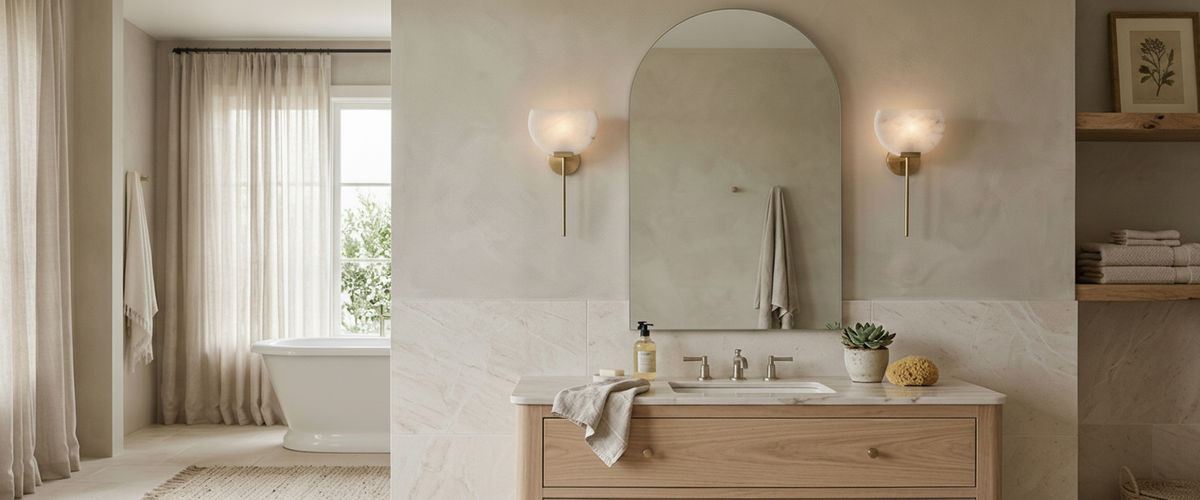

The single overhead spot is the least flattering way to light a bathroom, and most people know it the moment they lean into the mirror and find a shadow across half their face. Good bathroom wall lights fix that by putting soft light where you actually use it, at eye level, on either side of the glass. The catch is that a bathroom is the wettest room you own, so the bathroom wall lights you fit have to earn their place on more than looks alone. Get the rating and the finish right and they will glow for years. Get them wrong and they pit, corrode and buzz within months.
This is the room where the physics of moisture, the electrical zones, and the quality of the light all decide the outcome together. Below is how to read all three before you buy bathroom wall lights.

Key Takeaways Before You Buy
Zone first, style second. Where the light sits relative to the bath, basin and shower dictates the minimum IP rating you are allowed to fit.
Flanking beats overhead. A pair of bathroom wall lights either side of the mirror lights faces evenly; a single ceiling fitting drops shadow into the eyes.
Finish is a durability decision. Solid brass, marine-grade fixings, sealed alabaster and quality glass survive daily steam; thin plated metal does not.
Warm and honest. Aim for around 2700K to 3000K with a high colour rendering index so skin tones read true.
Get a qualified electrician. Bathroom wiring in the UK is governed by Part P and the zoning rules, so fitting bathroom wall lights is not a casual DIY job.

IP Ratings and Zones: The Rule That Decides What You Can Fit
Before you fall for a fixture, you need to know which zone it is going into. UK bathrooms are split into zones based on distance from water. Zone 0 is inside the bath or shower tray; Zone 1 sits directly above it to a set height; Zone 2 covers the area just beyond, including the space around a basin. Everything else is outside the zones. Each demands a minimum IP (ingress protection) rating, and the IEC standard behind those two IP digits is set out clearly by the International Electrotechnical Commission.
The short version for most bathroom wall lighting: fittings near the basin or in splash-prone spots usually need IP44 as a floor, which means protection against splashing water from any direction. For a basin position that needs to meet that splash rating without looking utilitarian, a fitting such as the Concord 1 Light Bathroom Wall Light carries the IP44 rating while keeping the profile slim enough to flank a mirror. This is exactly the kind of bathroom wall lights pairing that reads well at the vanity. Anything closer to the shower or bath climbs higher. If a light carries no IP rating at all, treat it as a dry-room fitting and keep it outside the zones entirely.
One studio note from experience: the question we get most is whether clients can sit a stone or alabaster piece near the basin. The honest answer is that natural stone and alabaster shine in the vanity and dressing zones just outside the wet areas, where they get the diffusion job without the constant splash. Plan the layout around that and you keep both the rating and the material happy.
Can You Have Wall Lights in a Bathroom at All?
Yes, and bathroom wall lights are often the better choice, provided the fixture matches the zone. The nervousness usually comes from mixing water and electricity, which is a fair instinct. The zoning system exists precisely so that lighting a bathroom wall is safe. Match the IP rating to the position, use a qualified electrician, and a wall light is no riskier than any other bathroom fitting. Electrical Safety First publishes plain-language guidance on bathroom zones that is worth a read before you brief your installer.
Glass, Metal and Stone Finishes That Hold Up to Daily Moisture
Steam is relentless. It condenses on every surface twice a day, so the finish is doing quiet structural work long after the styling has stopped mattering. A few materials that behave well on bathroom wall lights:
Solid brass. Whether burnished, aged or lacquered, brass resists corrosion and ages gracefully. A living finish will shift tone over time, which many buyers want.
Polished chrome over solid metal. Bright, clean and easy to wipe. The key phrase is over solid metal; chrome plated onto thin, low-grade base metal is where trouble starts.
Quality glass shades. Opal and ribbed glass diffuse the source and shrug off moisture. They also clean up in seconds.
Sealed alabaster and marble. In the drier vanity zones, natural stone gives a warm, glowing diffusion that no glass quite matches. Alabaster is soft and porous, so it wants sealing and a position away from direct spray. Placed well, it turns a functional wall light into the warmest thing in the room.
You can see how those materials read across our range on the alabaster lighting collection, where the stone is worked thin enough to pass light through the body of the piece rather than just around a shade.
Scale and Mounting Height: Lights That Flank Rather Than Fight the Mirror
The most common mistake is buying wall lights for a bathroom that are too big and hanging them too high. A wall light for a bathroom mirror should sit at roughly eye level, around 1.5 to 1.7 metres from the floor to the centre of the fitting, so light lands on the face rather than the top of the head. Flank the mirror with a matched pair spaced to suit its width. For a standard basin mirror that usually means the fittings sit a little wider than the glass, throwing even light across both cheeks.
Scale matters too. A slim single-light sconce reads elegant beside a narrow mirror; a chunky three-light bar over a wide vanity balances the mass of a double basin. Where the mirror is wide enough to want two sources of light rather than one, a twin fitting such as the Huguenot Lake 2 Light Bathroom Wall Light spreads the glow across a broader span than a single sconce can manage. If you only have room for one fitting, mount it above the mirror rather than to one side, and accept that the light will be slightly less even.
Warm, Honest Light That Reads Faces Without Harsh Shadows
Colour temperature is where a lot of bathrooms go cold and clinical. For grooming, shaving and make-up you want light that tells the truth about skin, and that means a warm white around 2700K to 3000K paired with a high colour rendering index, ideally 90 or above. Cheaper lamps skimp on CRI, which is why some bathrooms make everyone look faintly grey.
Diffusion is the other half of the equation. A bare bright LED throws hard shadows; a glass or stone shade softens the source so the light wraps around a face instead of stabbing at it. This is where flanking bathroom wall light sconces genuinely outperform a single downlight, because two soft sources at eye level cancel each other's shadows. If you can wire the circuit to a compatible dimmer, do it. A bathroom that runs bright for the morning routine and low for a late soak is a far more usable room.
Where Wall Lights Beat a Single Ceiling Fitting
A ceiling light fills a room but flatters nothing. It sits above everyone, so it drops shadow into the eye sockets and under the chin. Bathroom wall lights work at the height where the room is actually used. In a considered bathroom, the ideal is layered: recessed downlights or a central fitting for general brightness, then bathroom wall lights at the mirror for the task that matters. If you are lighting a guest cloakroom or a small en-suite where a full ceiling scheme feels like overkill, a well-placed pair of sconces can carry the whole room on their own. Browse the wider lighting collection if you want to plan the ceiling and wall layers together rather than piecemeal.
Signs of a Fixture That Will Pit and Corrode Within a Year
Some warning signs on bathroom wall light fixtures are visible before you ever install:
No stated IP rating. If the listing is coy about it, assume it is not rated for the zone you want.
Suspiciously light in the hand. Thin, hollow metal is usually low-grade and thinly plated. Weight often tracks quality here.
Painted rather than plated or solid finishes. Paint chips and blisters in steam, then water gets underneath.
Cheap ferrous fixings. The bracket and screws corrode first. Look for brass or stainless fixings behind the plate.
Unsealed porous stone in a splash zone. Beautiful, but the wrong place. Keep raw alabaster out of Zones 1 and 2.
A Quick Care Routine
Wipe glass and metal with a soft, damp cloth; skip abrasive sprays that strip lacquer.
Dry brass fittings after heavy steam to preserve the finish you paid for.
Dust sealed stone with a dry microfibre cloth and reseal per the maker's guidance.
Run an extractor fan; the single best thing you can do for any bathroom fixture is move the moisture out.
How to Remove a Light Fixture From a Bathroom Wall
If you are swapping old bathroom wall lights, isolate the circuit at the consumer unit first and confirm it is dead with a tester. Remove the shade or glass, unscrew the mounting plate, and disconnect the wiring at the terminal block, noting which cores went where. In a bathroom, though, the safe advice is to have a qualified electrician handle the disconnection and the new install, because the zoning and earthing requirements are stricter here than anywhere else in the home.
Getting the Tones Right: Cabinets, Walls and Floors
Two questions come up constantly. Should bathroom cabinets be lighter or darker than the walls? There is no rule, but a subtle contrast reads more considered than a perfect match; slightly darker cabinets ground the scheme, slightly lighter ones open it up. And should the floor be lighter or darker than the walls? A floor a shade or two darker than the walls tends to feel stable and anchors the room, while a lighter floor makes a small bathroom feel larger. Whatever you choose, warm bathroom wall lights with good CRI will keep those tones honest instead of washing them flat.
Budget and Where to Spend
Cost on bathroom wall lights depends on the material, the scale, the quality of the metal and glass, the IP engineering, and any natural-stone work involved. Solid brass and sealed alabaster cost more than thin plated fixtures because they last and because the finish is doing real work. Rather than chase a headline price, decide which bathroom wall lights are on daily show at the mirror and spend there; those are the ones your face lives with every morning. For a tailored figure on a specific piece or a matched pair, request a quote.