
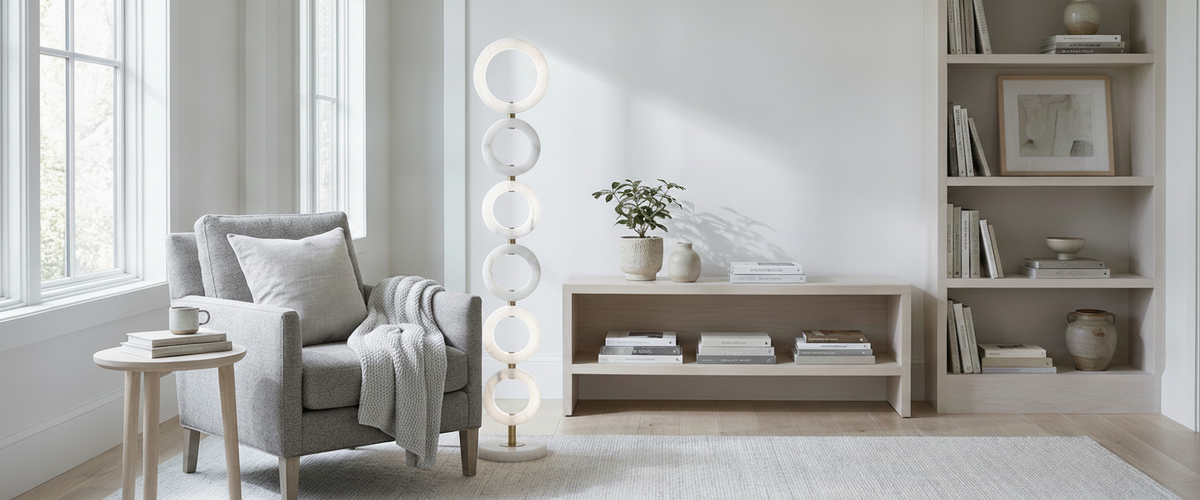

Most antique alabaster floor lamps for sale are not what the listing claims. Some are genuine period pieces with decades of soft handling in the stone. Others are competent reproductions with an artificially warmed finish, priced as though the years were real. A trained eye reads the tells in seconds; an untrained one hands over the money and hopes. The difference sits in the patina, the repairs, the shade seams, and the wiring hidden inside the column, and once you know where to look, an antique alabaster floor lamp stops being a gamble and starts being a considered purchase.
At Niori we work with alabaster and natural stone every day, so we spend a lot of time looking at aged stone under lamp light. What follows is how we would judge an antique alabaster floor lamp before buying, and how we would place it once it arrived.
Genuine age shows as uneven wear and cloudy, irregular translucency.

Key Takeaways
Genuine age shows as soft, uneven surface wear and warm mineral staining, not a uniform tinted coat.
Hairline repairs and mismatched shade seams are normal in old pieces; hidden ones are the problem.
Torchiere forms wash light upward; totem-style columns glow outward through the stone itself.
Any antique alabaster floor lamp should be rewired by a qualified electrician before use, without exception.
Aged stone reads as heirloom in rooms with texture and layered light, and as junk-shop clutter in stark ones.

Period Piece or Clever Reproduction
Start with the stone, not the fittings. Alabaster is a soft mineral, so genuine age leaves it with rounded edges where hands and dusters have passed for decades. Look along the base and the top rim: real wear is uneven, slightly glossier where fingers grip, matte where nothing touches. A reproduction dressed to look like an antique alabaster floor lamp tends to carry an even tint across the whole surface, as though someone stained it in one pass. They did.
Veining is the next tell. Alabaster forms in banded layers, and the translucency shifts as those bands catch the light. Hold a torch behind a section and a real piece glows in an irregular, cloudy way, with denser mineral zones staying darker. A resin cast or a heavily filled piece lights up flat and even, because there is no true crystal structure to break the light. The Natural Stone Institute keeps good reference material on how gypsum-based stones behave, which is worth reading before you view any antique alabaster floor lamp in person.
Check the metalwork against the stone. On an honest antique the brass or bronze has darkened in the recesses and brightened on the raised edges where it has been polished over the years. If the metal looks uniformly aged, or worse, freshly antiqued, the whole lamp is likely assembled rather than survived.
Patina, Hairline Repairs and Shade Seams
A century-old alabaster floor lamp with no repairs is rare, and slightly suspicious. Stone chips. Columns get knocked. Someone, at some point, glued something back. That is fine; what matters is whether the repair was honest and stable, or hidden and failing.
Run a fingernail gently across the surface and around any join. A well-done historic repair often has a very faint ridge and a slight color shift where old adhesive has yellowed. That is character. What you do not want is a repair line that has started to open again, or a filled crack that flexes when you press near it. Ask the seller directly where the piece has been mended. A dealer who knows the antique alabaster floor lamp will tell you; one who deflects is telling you something else.
An alabaster floor lamp shade dates a piece honestly too. Older stone shades were carved or cast in sections and joined, so you will often see faint seam lines and slight thickness variation when the light is on. A modern replacement shade tends to sit too clean, too uniform, and sometimes too white against the warmer column. That mismatch is not a dealbreaker, but it should shift the price in your favor, because you are buying a part-original antique alabaster floor lamp.
Torchiere bowls wash light upward; totem columns glow outward at eye level.
Torchiere or Totem: How the Form Throws Light
The two classic silhouettes behave very differently in a room, and the choice matters more than the age.
An alabaster torchiere floor lamp carries a wide, shallow bowl at the top that opens upward. The bulb sits inside the bowl and the stone diffuses light onto the ceiling, which then bounces back down as a soft, ambient wash. This is the form to choose when you want to lift a whole corner or add gentle fill light to a room with a decent ceiling. If you want to see how a modern torchiere handles that upward wash before committing to an aged one, a warm-finished piece such as the Opera Torchiere Floor Lamp in Firenze Gold shows the type clearly: the bowl does the softening, the metal stem does the drama.
An alabaster totem floor lamp works the opposite way. The stone forms a tall column or stacked drum that glows from within, spilling light outward at eye level rather than up. This reads more like a piece of lit sculpture. It gives you less ceiling wash and more presence, so it belongs where you want a focal point rather than general brightness. If you are weighing both, think about whether the room needs more light or more object. You can see how these forms sit within a wider range across our lighting collection.
Why Rewiring an Antique Is Non-Negotiable
Here is the part buyers skip and regret. Old lamps carry old wiring, and cloth-covered flex from the mid-twentieth century degrades from the inside. It can look intact and still be brittle, cracked, or ungrounded. An alabaster column that has been drilled for cable is not a place you want a fault.
Any antique alabaster floor lamp you buy should be rewired to current standards before it is plugged in, and that work should be done by a qualified electrician, not improvised at home. Guidance from Electrical Safety First is clear on the risks of old and damaged flex. A proper rewire means new internal cable, a new plug, a modern lampholder rated for your bulb, and a check that the earth is continuous where the fitting needs one. Treat this as part of the purchase cost, not an optional extra.
We had a client in the studio last year who bought a genuine period totem lamp at auction and asked us how it should be finished. The stone was beautiful. The flex was original and sun-hardened, close to a short. Rewired and refitted with a warm dimmable LED, it now runs for hours a day. Untouched, that antique alabaster floor lamp was a fire risk in a lovely disguise.
The Rooms Where Aged Stone Reads as Heirloom
Alabaster wants company. Put an aged, faintly veined column against bare white plaster and hard flooring and it looks orphaned. Put it in a room with texture, layered wood, wool, worn leather, a rug with some age, and the stone suddenly belongs.
A white alabaster floor lamp works beautifully beside a reading chair in a library or study, where its warm glow does real work after dark. A torchiere earns its place in a high-ceilinged sitting room, lifting the corner the overheads never reach. A totem suits a hallway or a landing, where a low, glowing presence guides you through the evening without a harsh switch. An alabaster traditional floor lamp with a carved shade sits well in period homes, next to panelling or a fireplace. Where the room already leans traditional but you want a fabric shade rather than glowing stone, a piece such as the Stateroom 2 Light Floor Lamp in Antique Nickel keeps the aged metal language without the fragility of the stone.
What aged stone does not want is direct competition from cool downlights. Keep the surrounding light warm, around 2700K, and the alabaster reads as amber and honey rather than gray. If you are building a scheme from scratch, our alabaster lighting collection shows how the same warmth carries across pendants, wall lights and lamps, which helps an antique alabaster floor lamp feel intentional rather than solitary.
What to Inspect Before You Hand Over the Money
Stability: stand the lamp up and check it does not rock. A cracked or repaired base can look fine and still be weak.
Translucency: light it from behind if you can. Cloudy, irregular glow is real stone; flat even glow suggests resin or heavy filler.
Repairs: ask where it has been mended, then verify by feel around every join and the base rim.
Shade match: confirm whether the shade is original or a later replacement, and price accordingly.
Wiring: assume any antique alabaster floor lamp needs rewiring and budget for a qualified electrician, whatever the seller claims.
Bulb fit: check the lampholder will take a modern warm LED without cooking the stone above it.
Provenance: a dealer who can tell you the lamp's history is worth more than one selling it blind.
Budget on an antique alabaster floor lamp depends on the stone quality, the scale, the condition of the carving, whether the shade is original, and the cost of proper rewiring and any restoration. Rather than trust a round number in a listing, work out what the piece needs to be safe and sound, then decide what that finished lamp is worth to you. If you would rather have the character of an antique alabaster floor lamp without the auction-house guesswork, request a tailored quote on a new piece and let someone else carry the risk.