
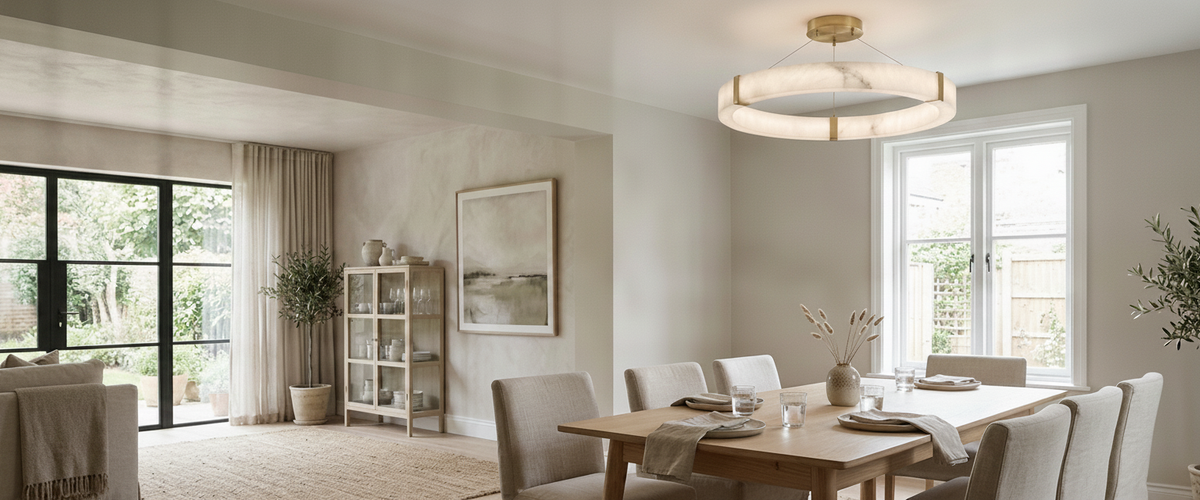

The difference between an alabaster modern ceiling lights that glows and one that looks like a grey lid stuck to the plaster comes down to a few millimetres of stone. Get the slab thickness right and the fitting warms a whole room from above. Get it wrong and you have paid for natural stone that reads as concrete. Most buyers never see this coming, because the problem with an alabaster modern ceiling light only shows up once the light is on and mounted three metres up, where returning it is a genuine nuisance.
A well-graded stone fitting glows evenly across its underside.
At Niori we work with alabaster and natural stone every day, and the questions that save people money are almost never about style. They are about how thick the stone is, how the fitting sits against the ceiling, and which LED goes inside an alabaster modern ceiling light. Sort those and the aesthetics take care of themselves.

Key Takeaways Before You Shop
Slab thickness is the single biggest driver of light quality. Too thick and the glow dies; too thin and you see hotspots and the bulb behind.
Flush and low-profile mounts need to be judged from directly below, not from a product photo shot side-on.
Warm LEDs at 2700K suit any alabaster modern ceiling light; cooler temperatures turn honey veining a dull grey.
Veining and silhouette decide whether the piece reads modern or period. Heavy ornament dates a room fast.
Genuine alabaster can be told from resin by weight, temperature and how the veining behaves, if you know what to check.

Why Slab Thickness Is the Line Between a Warm Glow and a Grey Slab
Alabaster is translucent, but only within a range. A slab cut too thick blocks light and the fitting sits dark and heavy overhead. Cut too thin and it turns fragile, shows the bulb as a bright spot, and loses the depth that makes stone worth buying in the first place. The sweet spot for an alabaster modern ceiling light is usually thicker than you would expect for a table lamp, because the light source sits further from the eye and needs more stone to soften.
This is why a photo alone is a poor guide. Two stone ceiling lights can look identical unlit, then behave completely differently once the LED is running. The honest tell is how the maker describes the light output and whether the stone has been graded for translucency rather than just picked for looks. Alabaster is a form of gypsum, softer and more workable than marble, which is exactly why it can be cut to a glowing thinness; the Smithsonian notes its long history as a carving stone precisely because it works so easily under the tool.
When you browse an alabaster modern ceiling light, ask what the stone does when backlit, not just how it photographs cold. That answer tells you more than any styling shot.
Flush and Low-Profile Mounts: Judging Translucency From Directly Below
Ceiling lights are seen from underneath, always. Yet most are photographed at an angle that flatters the silhouette and hides the one thing you will actually look at every day: the underside of the stone. A flush or semi-flush alabaster modern ceiling light lives or dies on how even that lower face glows.
From directly below, an even glow across the underside is what matters most.
Look for a piece where the light spreads across the whole underside rather than pooling in a bright centre with dim edges. Bright centres usually mean the slab is uneven or the bulb sits too close to the stone. In a low-ceilinged room, a hallway, a compact bedroom, a landing, a flush mount is the sensible choice and the underside matters even more because your eye passes right beneath it. Where the priority is a soft, even wash held tight to the ceiling rather than a downward beam, a diffused flush alabaster modern ceiling light such as the Tamar 1 Light Large Flush Ceiling Light shows the kind of low-profile form that reads well from directly below.
We once shipped a semi-flush piece to a client redoing a Victorian terrace with 2.3-metre ceilings upstairs. A pendant would have loomed. The flush stone fitting held the glow tight to the ceiling and the room felt taller for it. That is the quiet advantage of a low-profile mount done well. You can see the range of forms across our alabaster lighting collection to compare how flush and drop fittings sit differently in a space.
Pairing a Pared-Back Fitting With the Right 2700K Warm LED
An alabaster modern ceiling light wants a modern light source, and that means a good-quality LED at around 2700K. Warm white brings out the honey and cream tones in the stone and makes the veining glow. Push the colour temperature up to 4000K or beyond and the same stone turns flat and slightly clinical, the warmth drains out, and you lose the reason you chose this material over glass.
Two more things matter as much as the number on the box. First, colour rendering: aim for a high CRI (90 or above) so the stone's real colour comes through. Second, dimming. An alabaster modern ceiling light looks its best dimmed down in the evening, so pair the fitting with a compatible dimmer and check the driver supports it. The CIBSE guidance on lighting quality is a useful reference if you want to understand how colour temperature and rendering shape the feel of a room.
If the design language you are after leans warm and organic rather than metallic, a round E27 fitting in a wood finish such as the Jasmin Ø280 Round Ceiling Light in Sonoma Oak sits closer to the same soft, honeyed palette that alabaster brings to a ceiling. Any electrical work should go to a qualified electrician. That is not us being cautious for form's sake; a ceiling fitting carrying real stone deserves a proper fixing and a correctly wired driver.
Veining and Silhouette That Read as Contemporary, Not Period
Alabaster has been used in grand, ornate settings for centuries, so it carries period associations if you let it. The way to keep an alabaster modern ceiling light current is through restraint in both the veining and the shape. Clean discs, shallow domes, simple cylinders and soft rectangles read contemporary. Fussy scalloping, tiered ornament and heavy brass filigree pull the eye back a hundred years.
Veining is a taste call, but a useful rule holds. Subtle, even veining suits minimal interiors and lets the stone act almost as a texture. Bold, dramatic veining wants space and a plain ceiling around it so the pattern can be the event. In a busy room with patterned wallpaper or a strong colour scheme, quieter stone stops the ceiling from competing.
Brass detailing works with alabaster when it is thin and intentional, a slim rim or a discreet stem, rather than a chunky frame. The stone should lead. Metal supports it.
Placement Errors That Flatten a Modern Stone Fitting
Even a well-made alabaster modern ceiling light can be let down by where it goes. A few mistakes come up again and again.
Hanging it too high or too low. Over a kitchen island a pendant should clear sightlines but stay close enough to read as intentional; over a table it wants to feel connected to the surface, not marooned near the ceiling.
One light doing too much. An alabaster modern ceiling light gives a soft, diffused glow, which is lovely as ambient light but weak as a task light. Do not ask a single stone fitting to light a whole working kitchen. Layer it with downlights or under-cabinet strips.
Fighting the daylight. A fitting placed against a bright window can look dead in the daytime. Alabaster earns its keep in the evening, so plan the room around when the light will actually be on.
Ignoring the ceiling colour. A warm stone glow reflects off the ceiling. A cool grey ceiling can cancel the warmth you paid for.
If you are lighting a larger open-plan space, it often pays to combine a statement stone fitting with more discreet sources rather than scaling up one piece. Browsing the wider lighting range helps you see how ambient, task and accent layers can share a room.
Telling Genuine Alabaster From Resin Before Your Money Leaves
Resin imitations are everywhere, and some are convincing in photographs. In the hand and on the ceiling, they give themselves away. Before you commit to an alabaster modern ceiling light, here is what to check.
Weight. Real alabaster is dense and noticeably heavy for its size. Resin feels light and hollow.
Temperature. Natural stone feels cool to the touch and stays cool for a moment after you hold it. Resin warms up almost immediately to your hand.
Veining behaviour. Genuine veining runs through the stone with depth and slight irregularity. Printed or cast veining sits on or near the surface and can look repetitive or too perfect.
Backlit character. Lit from behind, real alabaster glows with variation and subtle shadow. Many resins glow evenly and a little plasticky, without that depth.
The maker's language. A seller working in real stone will talk about grading, thickness and where the stone was cut. Vagueness on those points is a flag.
None of this is about snobbery. It is about knowing what you are paying for. Natural stone carries small variations and even the occasional fine natural line; that is the material being honest, not a fault. If you want the full picture on how stone is finished and cared for, the Natural Stone Institute publishes solid technical guidance.
A Short Buyer's Checklist
Ask how the stone behaves when backlit, not just how it looks unlit.
Judge the underside glow of any flush or semi-flush alabaster modern ceiling light.
Specify a 2700K, high-CRI LED and confirm the driver dims.
Choose veining that fits the room's busyness, subtle for minimal, bold for plain.
Plan for the evening; alabaster is at its best after dark.
Confirm it is genuine stone by weight, temperature and veining depth.
Book a qualified electrician for the fixing and wiring.
Get these right and an alabaster modern ceiling light stops being a gamble and becomes the warmest source in the room. The stone does the work. You just have to read it properly before you buy.