
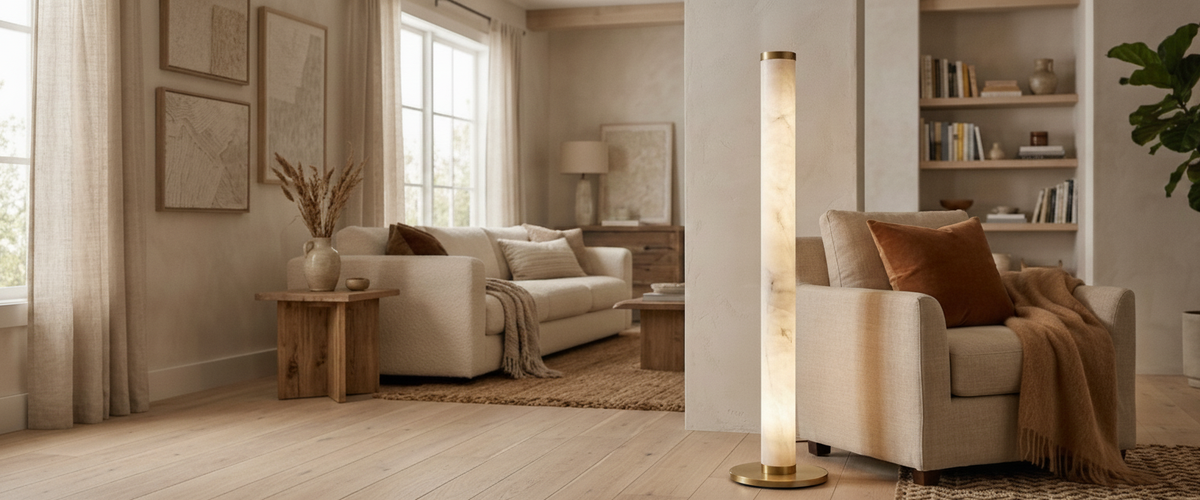

The floor lamp that gets photographed most in a showroom is rarely the one people still like six months later. That is the honest problem with shopping for unique floor lamps: novelty reads brilliantly in a single frame and wears thin in a real sitting room, where you walk past the thing four times an evening and switch it on in the dark without looking. A lamp earns its place through light quality, physical steadiness and how the material behaves as the seasons change the room around it. Silhouette comes fourth.

Key Takeaways
- Novelty fades, material doesn't. A sculptural silhouette is a one-note joke after a while; a translucent stone column changes with every dimmer setting.
- The best unique floor lamps get their character from the block. Alabaster, onyx and marble are cut from natural seams, so veining and glow vary piece to piece even within one design.
- Look for hand-finishing tells: subtle tool marks, slightly asymmetrical veining, hand-turned brass joins, a weighted base that does not rock.
- Boring engineering protects the beautiful part: low centre of gravity, clean cable exit, proper switching and dimming.
- Placement decides everything. A remarkable lamp in the wrong corner is just furniture you bump into.

Novelty Silhouettes Photograph Well and Live Badly
Run the six-month test in your head before you buy. Imagine the lamp on a wet Tuesday in February with the curtains shut, no styling, no camera. Does it still do something useful? Sculptural shapes with sharp cantilevers, oversized arcs and articulated arms tend to answer no. They dominate the corner, cast one fixed pool of light, and offer nothing new once the novelty has worn off. Worse, exaggerated forms are usually the ones that get knocked; an arc that reaches 1.2m (roughly 4ft) over a sofa is a hazard in a room where anyone actually lives.
Most unique floor lamps that fail this test fail on outline alone. The ones that pass are quieter in profile and richer in surface. Light moving through stone is never the same twice because the material is not the same twice. That is the difference between a lamp with a gimmick and a lamp with a life.
Unique by Material, Not by Gimmick
Alabaster is a gypsum stone, soft enough to carve by hand and translucent enough that light travels a few millimetres into the surface before it scatters back out. The Natural History Museum's notes on gypsum explain why it has been a carver's stone for thousands of years: it is one of the softest minerals, it works easily with hand tools and it takes a fine polish. That softness is exactly what gives a shade its glow rather than the flat brightness of opal glass.
Because each blank is cut from a natural seam, no two columns light up identically. In the studio we photograph every alabaster piece before it ships, and the frustrating, wonderful part of the job is that the shots never match. One column carries a honey-coloured cloud through the middle. The next is almost milk-white with a single grey seam running off-centre. A client fitting out a Marylebone flat once ordered two of the same design for either side of a chimney breast and asked, politely, whether we had sent the wrong second lamp. We had not. That is what buying stone means, and it is the most defensible form of uniqueness there is. The more stone a design puts in front of the light source, the more obvious that variation becomes: on a stacked column like the Vellum LED Alabaster Column Floor Lamp, the veining runs the full height of the piece rather than being confined to a small shade. If you want to see how much variation sits inside one design language, browse the range of alabaster lighting and compare the veining across pieces that share a silhouette.
Onyx pushes further, with banded amber and caramel layers that read almost geological when backlit. Marble is denser and mostly reflects rather than transmits, so it works best as a base or a solid stem paired with a translucent shade above. Understanding which stone does what is more useful than any style label when you are choosing between unique floor lamps.
The Tells of Hand-Finishing
Machine-made stone parts have a slightly dead uniformity. The unique floor lamps worth the money do not. Here is what to look for, in person or by asking for close-up photographs before you commit:
- Wall thickness that varies slightly. Hold a shade up to light and you will often see the glow deepen where the stone thins. Perfectly even brightness usually means resin or moulded glass rather than natural stone.
- Softened tool marks. Fine lathe or rasp lines under a hand-polished surface catch raking light. They are a signature, not a defect.
- Hand-turned brass. Look at the join where the stem meets the base. A turned collar has a faint spiral witness mark; a stamped one has a seam.
- Brass that is finished, not coated. Brushed and unlacquered brass will patinate over years. Plated finishes on steel will not, and will eventually chip at the edges.
- Matched but not identical parts. On multi-section columns, a good maker cuts adjacent blanks from the same block so the veining runs on through the joins.
Why Unique Floor Lamps Still Need a Boring Base
All the character in the world is wasted if the lamp wobbles. Stone is heavy, which helps, but weight in the wrong place is a liability. What you want is a low centre of gravity: a solid marble or cast-metal foot, ideally with felt or cork on the underside so it grips timber and stone floors without scratching them. Ask what the piece weighs. Anything in the 8 to 20kg range (roughly 18 to 44lb) for a tall column is reassuring; feather-light tall lamps tip.
Then check the dull details. Where does the cable exit, and can it be routed towards a skirting board rather than across a walkway? Is the switch on the cable, on the body, or handled by a wall dimmer? Is the lamp LED-integrated or does it take a replaceable lamp? On a plug-in floor lamp, the safe answer to trailing cable is a repositioned lamp, not a rug thrown over the flex. If you want a floor socket installed so a lamp can sit mid-room, that is work for a qualified electrician, and it should be planned before the floor goes down, not after.
What a Distinctive Shade Does to the Light It Throws
Shade shape changes the pattern of light on your walls far more than most buyers expect, and it is where unique floor lamps quietly prove their worth. A slender alabaster column throws a soft vertical wash and lights itself, which is why it works beautifully as ambient light and badly as a reading lamp. A stone dome or bowl directs most output downward into a defined pool, ideal beside an armchair. An open-topped drum does both, spilling light onto the ceiling to lift a low room. Where the room needs a soft diffused glow in every direction rather than a hard downlight, a globe form such as the Selvano 1 Light Alabaster Globe Floor Lamp is the better answer, since the stone itself becomes the light source rather than a hood over one.
Match the bulb to the stone. Alabaster is naturally warm, so a 2700K lamp keeps that honeyed quality; 3000K already starts to cool it, and anything higher kills the effect entirely. Choose a high colour rendering source, ideally CRI 90 or above, or the veining goes muddy. Dimming matters more here than with almost any other material. Confirm the driver is genuinely dimmable and compatible with your dimmer type before you order; trailing-edge dimmers suit most LED drivers, and a mismatch shows up as flicker at low levels.
Mass-Made "Unique": Phrases That Should Stop You
Some product copy is designed to imply craft without claiming it. These are the phrases that most often dress up mass production as unique floor lamps, and each one is a prompt to ask a direct question:
- "Alabaster-effect" or "stone-look". That is resin, acrylic or printed glass. It will yellow under heat and never glow the same way.
- "Marble-inspired finish". A film or a spray, not a slab.
- "Each piece is unique" with no mention of the material. If the uniqueness is real, the seller will tell you it comes from natural veining and that variation is expected.
- Identical hero photography across every colourway. One rendered image reused six times means nobody photographed a real lamp.
- No weight listed. Real stone makers publish it, because shipping depends on it.
- "Handcrafted" alongside a very large stock figure. Ask how many are made per batch and where.
Where to Put a Floor Lamp in a Living Room
Placement is where unique floor lamps either earn their keep or become an obstacle. Four positions work reliably. Behind and slightly to the side of a sofa arm, about 20 to 30cm (8 to 12in) clear, so light falls over the shoulder without glare in the eyeline. Beside a reading chair, with the bottom of the shade roughly level with a seated person's eye, generally 100 to 125cm (40 to 49in) from the floor. In the corner diagonally opposite your main window, which balances the room after dark. Or flanking a fireplace or joinery run, where a pair of columns behaves almost like architecture.
Two floor lamps in one living room is not only allowed, it is usually better than one. Just avoid parking them on the same wall. Place them on a diagonal so the light crosses the room and fills the shadow corners, and vary the height or type if the pair is not deliberately symmetrical: a tall column at one end, and at the other something lower and quieter beside the chair, where a compact piece such as the Atria Small LED Alabaster Floor Lamp sits nearer seated eye level without crowding the seat. Layer in table lamps and wall lights and you can run an entire evening without the ceiling fitting. If you are working out how the pieces should relate, comparing scale across the full lighting range settles it faster than sketching.
Buying Checklist for Unique Floor Lamps
- Confirm the material is natural stone, not an effect finish, and ask which stone.
- Ask for photographs of the actual piece or batch, lit and unlit.
- Check the stated weight and the base footprint against your floor type and traffic route.
- Establish switching: inline, body-mounted, or wall dimmer.
- Confirm dimmability, driver type and whether the light source is replaceable.
- Specify 2700K and CRI 90+ if you are choosing your own bulb.
- Plan the cable route and the nearest socket before delivery day.
- Ask how the finish is protected and how the stone should be cleaned.
Living With Stone: Care That Actually Matters
Alabaster dissolves in water to a degree that surprises people. Never use a wet cloth, never use vinegar, citrus or a proprietary bathroom spray. Dust with a dry microfibre or a soft brush, and if you must lift a mark, use a barely damp cloth followed immediately by a dry one. Historic England's technical advice on the care of building stone makes the same point in a conservation context: moisture is the enemy, and gentle dry methods come first. Keep alabaster away from radiators and out of unheated conservatories, where condensation comes and goes with the weather.
Brass is easier. Lacquered brass wants nothing more than a dry dust. Unlacquered brass will darken at the points you touch most, which most owners come to like; if you prefer it bright, a light polish twice a year is enough. Handled this way, a stone lamp is a thirty-year object rather than a three-year one. That is the real case for unique floor lamps built around material instead of outline, and it runs through the pendants, wall lights and floor lamps in the main range.