
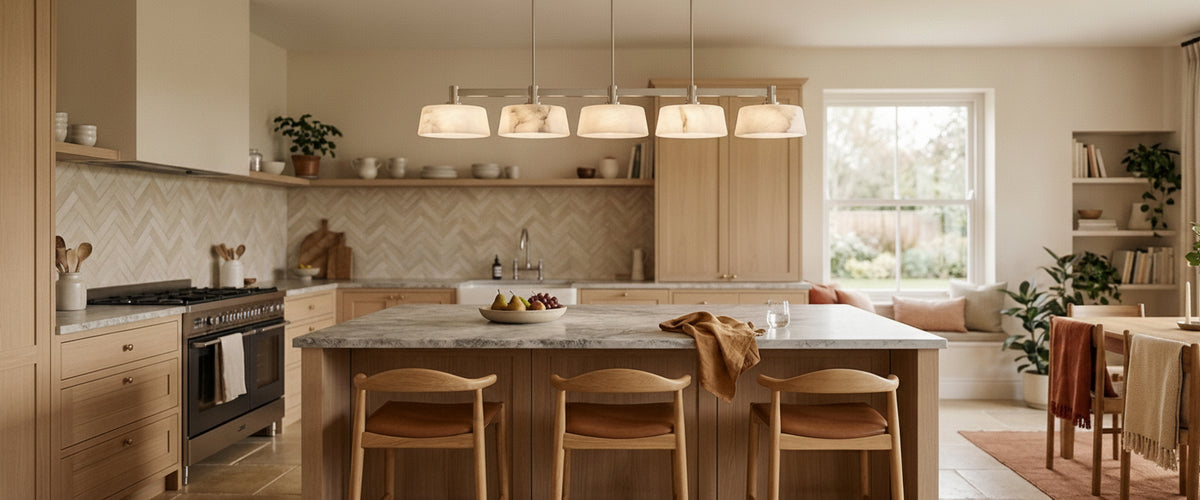

Silver reads cool. That is the whole appeal, and the whole risk. A polished metal frame photographs beautifully under showroom spotlights, then turns slightly clinical at eight in the evening when the only light in the room is the fixture itself. Most disappointing silver chandeliers are not badly made; they are simply bare metal and bare bulbs with nothing to soften the output. Get the finish, the scale, and the diffusion right and a silver chandelier gives you the crispest, most architectural ceiling light in the house.

Key Takeaways Before You Shop
- Finish matters more than shape. Polished nickel and antique silver leaf carry warmth; mirror chrome does not.
- Diffusion fixes the coldness. Alabaster, honed marble, or frosted glass shades turn a hard silver fixture into a soft light source.
- Size up, not down. Undersized chandeliers are the single most common mistake we see in client photos.
- Bulb colour temperature is not optional. Stay at 2700K with a high colour rendering index, and always specify a dimmer.
- Weight drives installation. Stone and metal fixtures need a properly rated ceiling box and a qualified electrician.

What Silver Chandeliers Suit, and Who Actually Buys Them
Silver chandeliers sit naturally in rooms with a cool or neutral base: grey-veined marble, pale oak, limestone floors, off-white plaster, black steel window frames. They flatter contemporary and transitional interiors far more easily than heavily traditional ones, where warm gilt and aged brass tend to hold their own better against dark wood and deep colour.
The buyers we hear from most often fall into three camps. Homeowners renovating a kitchen or dining room who want something less predictable than brass. Interior designers specifying for coastal and mountain projects, where cool metals echo water, glass, and stone. And hospitality clients fitting out lobbies and private dining rooms, where a silver finish reads clean under camera flash and holds up to constant cleaning. A designer we worked with recently put the brief bluntly: the metal should disappear at night and the stone should do the talking. That is usually the right instinct with silver.
Where silver struggles is in a room already committed to warm materials. Terracotta tile, honey-toned oak, aged brass hardware, and a silver chandeliers overhead will fight each other. If your fixed finishes lean warm, you have two sensible options. Go warm overhead instead, since a muted wood-and-bronze frame such as the Aberdeen 3 Light Chandelier in Distressed Grey Wood Effect & Old Bronze sits far more comfortably against oak and terracotta. Or choose a silver tone with enough grey-brown in it to bridge the gap, which is exactly what antiqued and lightly tarnished silver leaf does.
Sizing, Height, and Placement That Works
Over a Dining Table
Aim for a fixture roughly half to two-thirds the width of the table. On a 42-inch-wide (107 cm) table, that puts you between 21 and 28 inches (53 to 71 cm) across. Hang the lowest point 30 to 34 inches (76 to 86 cm) above the tabletop in an 8-foot (2.4 m) room, then add around 3 inches (7.5 cm) of drop for each additional foot of ceiling height. Arm count is really a proxy for diameter, which is why families of fixtures come in several sizes: a four-seat table is usually happier with a three-arm frame, while a table for six or eight needs the spread of something like the Kristy 5 Light Chandelier before the fixture stops looking apologetic. Long rectangular tables usually want either a linear fixture or two smaller chandeliers spaced evenly rather than one lonely centrepiece.
In an Entry or Stairwell
Entries are where undersizing hurts most, because you see the fixture from the front door, from the landing, and often through a window from outside. Add the room's length and width in feet, and treat that number in inches as a sensible diameter: a 12 by 14 foot entry suggests something near 26 inches (66 cm) wide. This is the one place where a high arm count earns its keep, since a wide multi-tier frame in the manner of the Marvele 10 Light Chandelier reads properly from two floors rather than vanishing into the void. Keep at least 7 feet (2.1 m) of clearance below the fixture in a walkway, and in a double-height stairwell, hang it so the body of the chandelier lands in the upper third of the void where it is visible from both floors.
Bedrooms and Living Rooms
Bedrooms need restraint. A silver chandelier centred over the foot of the bed rather than directly above the pillows keeps glare out of your eyes when lying down, and pairing it with alabaster wall lights or stone table lamps means you rarely need the ceiling fixture at full output. In living rooms, centre the chandelier on the seating arrangement rather than the room, or it will look off-axis from every sofa. Browsing by fixture type across the wider lighting collection is the fastest way to work out whether a room wants one statement piece or a layered scheme of pendant, wall, and floor lighting.
Finishes, Materials, and Light Quality
"Silver" covers several very different metals, and they behave differently under a bulb.
- Polished nickel: a warm grey-white with real depth. The most forgiving silver tone and the easiest to live with alongside cream and stone.
- Chrome: blue-white, mirror-hard, and unforgiving. It suits genuinely modern rooms and shows every fingerprint.
- Brushed nickel or satin steel: matte, low-glare, and practical in kitchens and family spaces.
- Antique silver leaf or pewter: the softest option, with grey-brown shadow in the recesses that keeps the metal from looking flat.
What the light passes through matters more than the metal itself. This is where alabaster changes the conversation. Backlit gypsum alabaster glows with a warm amber-cream cast and visible veining, and that warmth counteracts the coolness a silver frame introduces. Honed white marble does something similar, though it reads more opaque and directs light down rather than out. Pale white onyx has more drama and more banding, so it wants a simpler frame. Our own alabaster lighting pieces are built around exactly this pairing: a cool, precise metal structure carrying a warm, imperfect stone.
One practical note on the stone. Alabaster is gypsum, soft enough to scratch with a fingernail, and it dislikes moisture; the Natural Stone Institute publishes clear guidance on handling soft, water-sensitive stones. Dust it with a dry, soft brush or a lint-free cloth. Skip sprays, skip anything with acid or ammonia, and never let water sit on the surface.
Bulbs and Dimming: The Detail Most People Skip
Specify 2700K, not 3000K, on any silver chandelier. That extra warmth offsets the cool metal and keeps skin tones flattering over a dinner table. Look for a colour rendering index of 90 or above, which is where reds and wood tones stop looking muddy; the US Department of Energy's solid-state lighting research covers why colour quality varies so much between LED products at the same nominal temperature.
Clear candelabra LED filament bulbs suit open silver frames with visible sockets, because the filament becomes part of the ornament. Frosted or opal bulbs are better behind alabaster or marble, since a bright point source can print a visible hot spot through thinner sections of stone. Put the circuit on a dimmer, confirm the driver is compatible with your dimmer type, and get a qualified electrician to handle the wiring and confirm the ceiling box and support will carry the load. Stone-shaded fixtures are meaningfully heavier than glass equivalents.
Common Mistakes with Silver Chandeliers
- Buying too small. A chandelier that looks large in a warehouse photo shrinks the moment it is 9 feet (2.7 m) in the air.
- Matching every metal in the room. A silver chandelier does not need silver taps, silver handles, and silver frames. Two metals in a room is confident; five is nervous.
- Ignoring the sightline. Measure from the stair landing and from the sofa, not only from directly underneath.
- Skipping the dimmer. Full output from a bare silver fixture at night is the fastest route to a room that feels like a waiting area.
- Forgetting sloped ceilings. Angled ceilings need a compatible canopy or adapter, and it is far easier to sort that before the fixture arrives.
- Cleaning stone like glass. Damp cloths and household sprays will dull alabaster over time.
A Quick Pre-Purchase Checklist
- Measure table or room dimensions and calculate a target diameter before you look at anything.
- Confirm ceiling height and whether the ceiling is flat, sloped, or double-height.
- Decide the silver tone: warm nickel, cool chrome, or antiqued leaf, judged against your existing hardware.
- Choose your diffuser: alabaster and marble for warmth, glass for sparkle.
- Check that the ceiling structure and box suit the fixture weight, with an electrician.
- Specify bulbs at 2700K with CRI 90 or above, plus a compatible dimmer.
- Plan the supporting layers: wall lights, table lamps, or a floor lamp so the chandelier is never the only source.
- Confirm lead time and delivery access for large or heavy pieces.
How Niori Helps with Lighting Projects
Niori works in alabaster and natural stone, paired with brass, nickel, and blackened metal, across pendants, chandeliers, wall lights, table lamps, and floor lamps. For designers and venue owners, that usually means a conversation rather than a checkout: scale adjustments for a tall stairwell, finish samples to test against a stone slab, or a run of matching fixtures across a dining room and bar. Cost depends on material, size, complexity, engineering, installation, and finishing, so we price per project rather than publishing a range that turns out to be meaningless. Start from the Niori homepage to see the full range, then send us your room dimensions and ceiling heights and we will tell you honestly whether the piece you like will work.
Silver chandeliers reward precision. Choose the finish for the room you actually have, give the light something soft to travel through, and put it on a dimmer. That is most of the job done.