
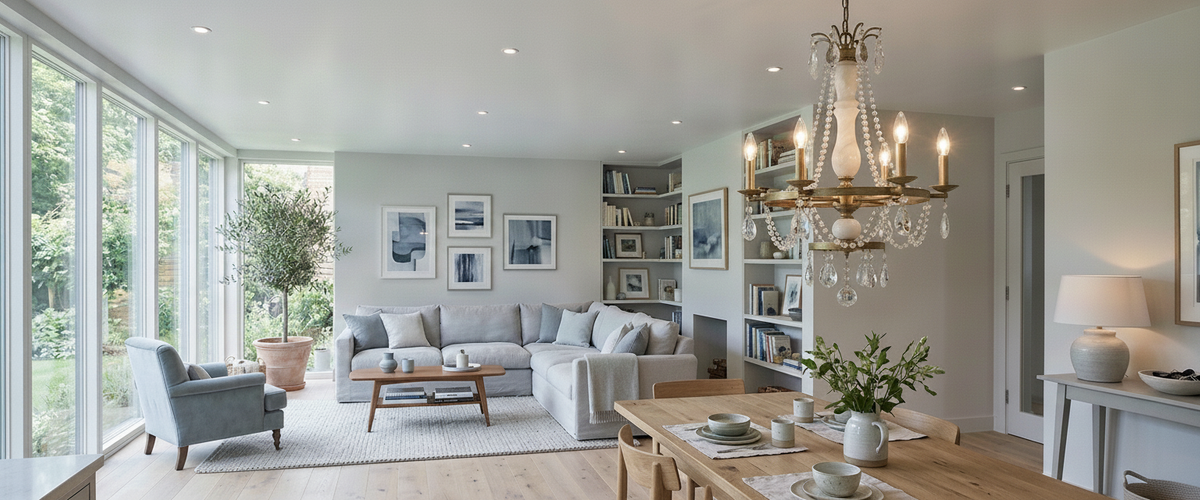

Most disappointing crystal chandeliers are not badly made. They are badly sized, hung too high, and fitted with cold bulbs that turn every facet into a hard little glare. Get those three things right and a crystal fitting does something no downlight ever will: it throws small points of light around a room and gives the ceiling a reason to be looked at. Get them wrong and you have an expensive object that nobody sits under comfortably. What follows is the short list of decisions that separates crystal chandeliers people love from the ones they quietly stop switching on.

At a Glance
The condensed version, if you are shortlisting crystal chandeliers this week:
- Scale first. Add the room's length and width in metres, multiply by roughly 10, and you have a sensible chandelier diameter in centimetres. A 4m x 5m room suits something near 90cm (about 35in) across.
- Height rules everything. Over a dining table, the lowest drop should sit roughly 75 to 90cm (30 to 35in) above the tabletop. In a hallway, keep 2.1m (7ft) of clear headroom.
- Crystal grade changes the sparkle. Lead crystal refracts more warmly and heavily than moulded glass; optical crystal such as K9 is clean and precise.
- Bulbs make or break it. Clear filament LEDs at 2700K with a high colour rendering index, on a trailing-edge dimmer.
- Consider the alternative. If you want glow rather than glitter, alabaster and onyx give diffused, honeyed light with none of the flicker-shadow effect.

What Crystal Chandeliers Suit and Who They Are For
Cut glass works hardest in rooms with height, hard surfaces and an occasion attached. Think stairwells and double-height entrance halls, formal dining rooms, hotel lobbies, private dining spaces, and reception rooms where a piece is seen from more than one level. The material needs distance to read properly; up close it becomes busy, and under a 2.4m ceiling it can feel like furniture you keep ducking around.
The buyers we talk to about crystal chandeliers tend to fall into three camps. Homeowners restoring a period property who want something that suits cornicing and tall sash windows. Designers specifying for a client who has asked, in as many words, for glamour. And venue owners who need a focal point that photographs well and survives a decade of repeat use. Each has a different tolerance for maintenance, and that is worth being honest about early, because crystal is the most cleaning-hungry fitting in the house.
Where the material struggles: low-ceilinged bedrooms, snug family rooms, and any space where you want light to feel soft on faces rather than sharply directional. That is the point where we usually steer people towards stone. Alabaster shades hold light inside the material and release it slowly, so the effect is warmth rather than sparkle. Plenty of projects end up using both, with faceted glass in the hall and stone in the rooms where people actually relax.
Sizing, Height and Placement for Crystal Chandeliers
Start with the diameter calculation above, then sanity-check it against furniture rather than the room. Over a dining table, a chandelier should measure between half and two-thirds of the table's width. A 100cm-wide table takes something in the region of 50 to 65cm across. Anything wider and diners at the ends knock their heads or lose eye contact across the surface.
Drop height is where most installations go wrong. Over a table, hang low: 75 to 90cm (30 to 35in) from tabletop to the lowest drop. It feels daring on the drawing and correct in the room. In a hallway or landing where people walk beneath, keep at least 2.1m (7ft) of clearance to the floor. In a double-height stairwell, position the body of the fitting so it sits in the middle third of the window when viewed from outside, and so the lowest point is visible from the upper landing. A chandelier you can only see from below has lost half its argument.
Two placement notes we repeat constantly. First, centre the fitting on the table, not the room; kitchen extensions are rarely symmetrical and a chandelier that splits the difference looks like a mistake from every angle. Second, check the ceiling structure before you fall in love with a nine-light piece like the Brianna 9 Light Chandelier, where the arm spread and total weight are doing real work on the fixing. Multi-arm crystal chandeliers can be genuinely heavy once every drop is hung, and a plasterboard ceiling without a noggin or a proper backing plate will not hold it. Any hard-wired installation should go through a qualified electrician working to current UK regulations; the government's Approved Document P guidance sets out which electrical work in dwellings is notifiable.
Materials, Finishes and Light Quality
Not all crystal is crystal. The drops used in crystal chandeliers fall into three broad families. Traditional lead crystal contains lead oxide, which raises the refractive index and gives that slightly warm, weighty flash of colour when light splits. Lead-free optical crystal, often sold as K9, is harder, brighter and more uniform, with a cleaner white sparkle. Pressed or moulded glass drops are perfectly usable at scale but scatter light more softly and with less definition. If a listing does not say which it is, ask.
Frames matter as much as the drops. Aged brass and antique gold warm the light before it even reaches the glass, which flatters skin tones in dining rooms. Polished chrome and nickel push cool and modern, and they show fingerprints. Blackened or bronzed metal reads more architectural and lets the crystal carry the drama alone. Distressed gold and old bronze are the finishes we are asked about most when the conversation turns to crystal chandeliers, largely because they sit comfortably in both period and new-build interiors; a mid-scale fitting such as the Kristy 5 Light Chandelier in distressed gold shows how a softened metal finish keeps the warmth in the light rather than bouncing it back cold.
The honest comparison with stone comes down to how each material handles a single bulb. Crystal takes one point of light and multiplies it into dozens of small bright points, with the shadow pattern that comes with it. Alabaster, onyx and marble do the reverse: they absorb the point source and re-emit it as a broad, even glow, with the natural veining showing through as a faint map inside the shade. If you have been scrolling alabaster lighting and cut glass side by side and cannot decide, that difference is the decision. Sparkle or glow. Hybrid pieces exist too, pairing carved stone bodies with glass detailing and brass hardware, and they tend to suit contemporary rooms better than all-out sparkle.
Bulbs and Dimming for Crystal Chandeliers
Clear candle bulbs with visible filaments are the correct choice for crystal chandeliers, because the facets need a small, bright source to refract. Frosted bulbs kill the effect. Aim for 2700K warm white, a colour rendering index of 90 or above, and dimmable LEDs from a single batch so the colour is consistent across every arm.
- Fit a trailing-edge dimmer rated well above your total load. It handles LED drivers far more smoothly than the older leading-edge type.
- Do not mix bulb brands within one fitting. Even small colour temperature differences are obvious once crystal starts splitting the light.
- On a large multi-arm piece, lower wattage across many bulbs beats high wattage across a few. Across something on the scale of the Marvele 10 Light Chandelier in aged brass, ten modest bulbs read as presence; ten bright ones read as glare.
- Give the room a second light layer. Wall lights or a stone table lamp stop the chandelier from having to do all the work at low levels.
Common Mistakes and How to Avoid Them
The recurring errors with crystal chandeliers are predictable, which is good news, because they are all avoidable.
- Buying for the photograph, not the ceiling height. Measure floor to ceiling before anything else, then work out your available drop.
- Hanging too high over a table. Fear of low fittings produces weak, distant light and a chandelier that looks stranded.
- Ignoring the shadow pattern. Faceted glass casts fractured shadows on walls. Beautiful in a hall, restless above a bed.
- Forgetting the cleaning access. If you cannot reach the fitting with a domestic ladder, you have committed to hiring access every time it needs dusting.
- Under-specifying the fixing. Weight, ceiling construction and the chain or rod length all need checking together before install day.
- Skipping a dimmer. A fully lit chandelier during dinner is an interrogation lamp.
One from the studio: a client in Suffolk specified a substantial multi-arm piece for a farmhouse dining room, having measured to the ceiling apex rather than to the beam running beneath it. The fitting was fine; the room had 40cm less clearance than the drawing suggested. We swapped to a shallower design and put a carved alabaster pendant over the adjoining island instead, which is now the part of the scheme they mention first. Measure the lowest obstruction, not the highest point.
Care and Cleaning Checklist
Crystal chandeliers show dust faster than almost any other lighting material, and hospitality clients should budget for quarterly attention rather than annual.
- Isolate the circuit at the consumer unit before touching the fitting.
- Photograph the assembly from several angles before removing any drops. Reassembly memory is unreliable.
- Wear cotton or nitrile gloves. Skin oils mark crystal and tarnish unlacquered brass.
- Dust first with a soft, dry brush. Wet-cleaning over dust just moves grime around.
- Clean removable drops in warm water with a drop of neutral detergent, then dry immediately with a lint-free cloth. Conservation practice consistently favours gentle, minimal intervention over strong proprietary cleaners; the National Trust's collections care guidance is a sensible reference for anyone cleaning historic or delicate fittings.
- Never spray liquid at the ceiling rose, lamp holders or wiring.
- Avoid ammonia-based products on brass, and keep water off any stone components. Alabaster and marble are porous and will water-mark; a dry microfibre cloth is all they need.
- Check arm fixings and chain links annually. Vibration from doors and floors loosens things slowly.
How Niori Can Help with Lighting Projects
Niori works in alabaster and natural stone, so when someone asks us about crystal chandeliers our instinct is to ask what you want the light to feel like before we talk about the object. Sometimes the answer really is cut glass, and we will say so. More often, in bedrooms, snugs, kitchen islands and hospitality spaces where guests linger, a carved stone pendant or a stone-and-brass chandelier delivers the atmosphere people were actually describing when they said the word crystal.
For designers and venue owners specifying at scale, we can advise on sizing across multiple rooms, matching finishes between chandeliers, wall lights and table lamps, and phasing deliveries around a build programme. Browse the full lighting collection to see how pendants, chandeliers and stone wall lights work as a family rather than as isolated pieces. Budget depends on material, scale, the complexity of the carving or metalwork, engineering for weight, and installation and finishing, so the sensible next step is a tailored quote with your ceiling heights and room dimensions to hand.
Crystal chandeliers reward precision. Measure honestly, hang lower than instinct suggests, buy the right bulbs, and accept the cleaning commitment. Do that, and you have a fitting that still looks considered in twenty years. Skip a step and you have a very shiny regret.