
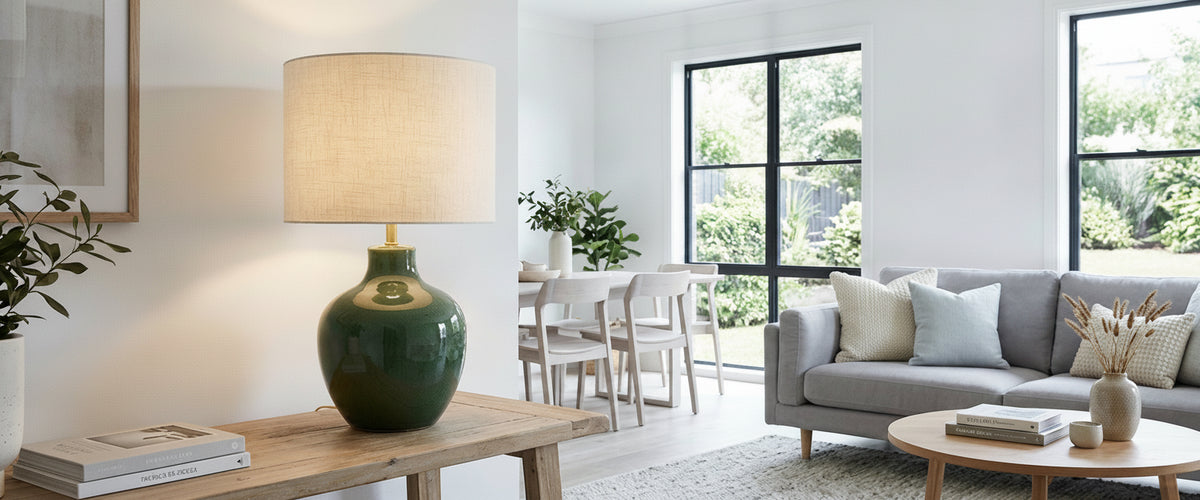

Most people buy a ceramic table lamps base-first and regret it shade-first. The base is the part you fall for in the photograph, but the base does not light anything. A ceramic body is opaque, which means every lumen the bulb produces has to escape through the shade, the top aperture or the gap at the bottom. Get that shade wrong and you own a handsome ornament that throws a hard puddle onto a side table and nothing else.
Key takeaways
- Opaque ceramic pushes all the light through the shade, so shade material, lining and diameter matter more here than on a translucent stone or glass lamp.
- Glossy glaze reflects lamplight and reads livelier after dark; matt glaze absorbs it and reads quieter and more matte-chalky in low light.
- Match colour to the wall behind it: white ceramic on pale plaster needs shape to survive, green and oxblood need contrast or good ambient light.
- Three placements, three specs: bedside (low, narrow shade), sideboard (medium, wider drum), console (tall, generous shade).
- 2700K is the safe colour temperature for glaze. Anything cooler drains warmth out of the clay body.
- Check weight, cable exit position, lampholder size and shade fitter type before you order, not after.

Why an Opaque Ceramic Table Lamp Doubles the Weight of the Shade Decision
At Niori we spend most of our days with alabaster, marble and onyx, materials that glow from within because light travels through the stone itself. Ceramic behaves in the opposite way. A glazed stoneware or porcelain body blocks light completely, so the shade becomes the entire optical system: diffuser, reflector and glare shield in one piece of fabric.
That has practical consequences. A tight black shade with a dark lining on a ceramic table lamp will give you two narrow cones of light and a base that disappears at night. A cream or ivory linen shade with a white or lightly metallic lining will lift output noticeably, wash a little light down the wall, and keep the room feeling occupied rather than spotlit. If you want the lamp to contribute to general ambient light, choose a paler shade and a wider top aperture. If you want it purely for reading, a deeper shade with a tighter top is the better answer, and you accept that the rest of the room needs help from a wall light or a floor lamp.
Where a room needs a soft diffused glow in all directions rather than two disciplined cones, the material logic changes entirely: a lit-body form such as the Dolce 1 Light Glass Table Lamp is closer to the right design language, because the glass itself does the diffusing and there is no opaque volume to work around. Ceramic is the choice when you want colour and silhouette by day and a controlled pool of light after dark.
A rough sizing rule that has served us well across hundreds of shipments: the shade diameter should be roughly one and a half times the widest point of the base, and the shade should sit low enough that the lampholder and bulb are never visible from a seated position. Stand back three metres (about 10 feet) and sit down. If you can see the bulb, the shade is too shallow.

Glossy Glaze Bounces Lamplight, Matt Glaze Drinks It
Glaze is glass. That is the short version of a long ceramic history, and it is why a high-gloss crackle or celadon body catches the spill from its own shade and throws small highlights back into the room, while a matt or satin glaze quietly swallows the same light. The Victoria and Albert Museum's ceramics material notes are a good primer on how glaze chemistry and surface finish shape the way a piece reads under light (V&A, ceramics introduction).
What that means when the sun goes down:
- High gloss: reads more reflective and more formal. Excellent in a dim sitting room because it gives the eye something to catch. Shows dust and fingerprints on the shoulder of the base.
- Satin: the most forgiving option. Enough sheen to look alive, not so much that it competes with polished brass or marble nearby.
- Matt: calm, sculptural, and noticeably darker at night. Pair with a paler shade to compensate, and keep it out of corners with no other light source.
One more thing about matt bodies: they can look chalky under the wrong bulb, which is exactly the trap we cover further down.
Green, White and Oxblood Ceramic Against Real Walls
Colour choice is where ceramic table lamps lamps buying decisions go sideways, because the swatch on screen never includes your wall.
A green ceramic table lamp in celadon, olive or bottle is the most useful colourway in British interiors right now. Against pale plaster or a warm off-white it reads jewel-like without shouting. Against deep paint (think inky blue, forest, aubergine) a green base needs a genuinely pale shade or it will vanish; the lamp becomes a silhouette. On timber panelling, olive and sage sit beautifully with oak and walnut, though a bright emerald can fight with red-toned mahogany.
A white ceramic table lamp is the quiet workhorse, but it demands form. On pale plaster, a plain white cylinder disappears entirely; a fluted, gourd, ginger-jar or ribbed profile survives because shadow does the drawing. This is the same principle that makes carved alabaster work so well against light walls, and if you want the softer, lit-from-within version of that effect, our alabaster lighting collection is the closer comparison.
Oxblood, tenmoku and other deep reds are the specialist choice. They are superb on dark timber and in rooms with plenty of ambient light, and they can look heavy in a small bedroom where the lamp is the only light source after 10pm.
Bedside, Sideboard, Console: Three Heights, Three Jobs
The same ceramic table lamp rarely works in all three positions. Treat them as separate briefs.
Bedside
The job is task light without glare into a lying eye line. You want the bottom edge of the shade at roughly seated shoulder height when you are sitting up in bed, which usually means a relatively short overall height and a narrower shade so the lamp does not crowd a book, a glass of water and a phone. Sloped or slightly tapered shades work well here because they push light forward onto the page. Where the nightstand is genuinely small and glare is the main risk, a compact piece such as the Estro Globe Glass Table Lamp, 21cm makes more sense than a tall ceramic base with a wide drum that overhangs the edge.
Sideboard and Chest
Now the job is layering. A medium-height base with a wider drum shade fills the middle of the wall, lifts a dark corner and stops the ceiling light from doing all the work. Keep at least a hand's width between the shade edge and anything hanging above it, whether that is a mirror or artwork.
Console and Hallway
Consoles carry the tallest lamps because the eye reads them standing, not seated. A generous shade is the point here; the lamp is greeting people. On a long console where a single lamp has to hold the whole surface, scale up rather than duplicate: something with the presence of the Global Globe Table Lamp, 30cm reads at standing height in a way that a 20cm base never will, and the same logic applies to a ceramic body. We shipped a pair of stone lamps to a Georgian townhouse hallway in Bath last spring where the client had originally planned a single lamp, and the corrected symmetry did more for that hall than any amount of extra wattage would have.
Buy a Pair, or Let One Lamp Do the Talking?
Pairs read as architecture. They calm a composition down and imply order, which is why they belong on symmetrical furniture: a console with a mirror over it, two bedside tables, a pair of nightstands flanking a headboard, or the ends of a long sideboard.
A single lamp reads as an object. Choose one when the surface is already busy, when the base is sculptural enough to be the focus, or when the room has an obvious asymmetry you want to lean into rather than fight. On a sideboard with a large painting slightly off centre, one lamp plus a stack of books almost always beats two matching lamps.
Commercially, there is a third answer: buy a pair for the hallway and the bedroom, buy singles for living rooms where you are building a layered scheme with wall lights and floor lamps. If you are building that layered scheme from scratch, it helps to shop across fixture types rather than lamps alone; our full lighting collection is organised that way for a reason.
Why 2700K Flatters Glaze and Anything Cooler Looks Chalky
Ceramic glazes are formulated and fired to be seen under warm light. Put a 4000K lamp behind a linen shade and a warm white or celadon body immediately looks grey and dusty; oxblood turns brown; olive turns grey-green. Stay at 2700K for almost every domestic scheme, and 2200 to 2400K if you want a candlelit register in a dining room or snug.
Other bulb notes worth specifying before you order:
- Dimming: choose a dimmable LED and confirm compatibility with your dimmer type. Cheap non-dimmable LEDs in a lamp you intend to dim will flicker or buzz.
- Colour rendering: CRI 90 or above keeps glaze colours honest. Below CRI 80 the difference on a green base is visible to anyone.
- Bulb shape: a golf-ball or candle lamp gives more clearance inside a small shade than a standard GLS bulb. Check the shade will not touch the glass.
- Warm dim: if you can specify a warm-dim LED that drops towards 2200K as it dims, ceramic and stone both benefit.
The Practical Checks before You Order Any Ceramic Table Lamp
This is the list we wish more buyers ran through, because it prevents nearly every return we see on table lamps.
- Weight and surface. Glazed stoneware is heavy for its size. Confirm the piece of furniture can take it, and add a felt or cork pad underneath to protect polished timber and to stop the base skating.
- Cable exit. Ask where the flex leaves the base: rear exit, base exit or through a channel. On a console pushed flat against a wall, a rear exit halfway up the body will hold the lamp proud of the wall.
- Flex length and colour. Measure from the socket, not from the table. Braided flex in a colour close to the base is worth asking about.
- Lampholder size. E27 gives more bulb choice; E14 suits smaller shades. Confirm which is fitted before you buy bulbs in bulk.
- Shade fitter type. A shade with a duplex fitter needs a ring or spider, a gimbal shade clips to the lampholder, and the two are not interchangeable. Match the shade to the lamp, not the other way round.
- Switch position. Inline rocker on the flex, or a switch on the lampholder? For bedside use, an inline switch you can find in the dark wins.
- Electrical work. If a lamp needs rewiring or a plug change, use a qualified electrician. The Lighting Industry Association publishes clear guidance on what compliant, safe domestic luminaires should include (thelia.org.uk).
- Care. Dust glaze with a dry microfibre cloth; a barely damp cloth for marks, dried immediately. Avoid abrasive creams, which will dull a gloss glaze and can leave a permanent haze on matt surfaces.
Where Ceramic Ends and Stone Begins
There is a reason we keep coming back to the opaque-versus-translucent distinction. A ceramic table lamp gives you colour, glaze and silhouette; a lit alabaster or onyx body gives you a glowing volume, veining that only appears once the lamp is switched on, and a much softer distribution of light because the material itself becomes the diffuser. The two work well together in the same room: ceramic on the sideboard for colour, stone on the console or bedside for that low warm glow.
If you are specifying for a hotel, restaurant or serviced apartment, factor in maintenance. Glazed ceramic chips at the rim and foot and cannot be invisibly repaired. Solid stone can usually be re-polished. That single fact often decides a hospitality order in favour of stone, and it is worth raising early with your project team. Budget on either material depends on scale, complexity, engineering, finishing and installation, so ask for a tailored quote rather than working from a headline figure. You can start from the Niori homepage to see how the range is grouped by fixture type.