
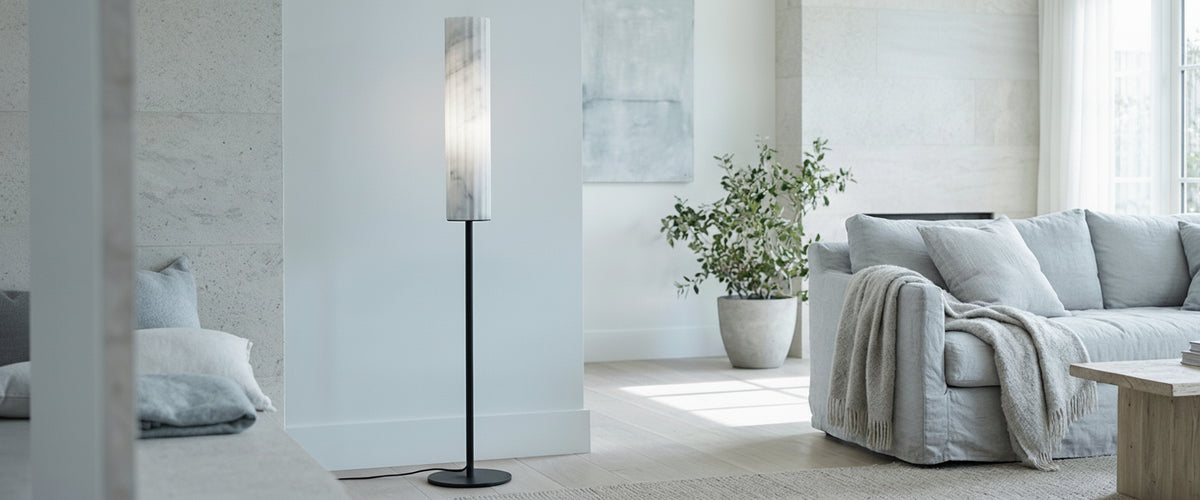

Most Led floor lamps are bought for how they look switched off in a product photo, then judged for a decade by how they look switched on at nine in the evening. That gap is where buyers get caught out. The wattage on the box tells you almost nothing about how a lamp will light your living room, and the details that do matter (driver quality, dimming floor, color rendering, shade material) are usually buried several clicks deep. At Niori we work with alabaster and natural stone, materials that are unforgiving of bad light sources, so we have learned to read LED floor lamps from the inside out.
At a glance
- A replaceable LED bulb usually ages better than a sealed integrated module, unless the integrated design has a serviceable driver.
- Shade material shapes the light more than wattage does. Stone and alabaster diffuse; metal and opaque fabric direct.
- Look for CRI 90 or above. Floor lamps sit at eye level, so poor color rendering is obvious on skin, wood and textiles.
- Test how low the lamp dims before it flickers or cuts out. That bottom 10% is where evenings happen.
- Decide whether you want uplight, downlight or diffused glow before you choose a style.

Integrated LED or Replaceable Bulb: Which Ages Better?
Integrated LED floor lamps have the light source built into the fixture, often on a circuit board with a separate driver. They allow slimmer designs and can run cooler. The catch is that when the driver fails (and drivers fail far more often than the LED chips themselves), you may be left with a beautiful object that no longer lights. Some manufacturers offer replacement modules; many quietly do not.
A lamp built around a standard lampholder, such as an E27 or E14 fitting, takes an LED bulb you can swap in five minutes. When better bulbs arrive, and they keep arriving, you upgrade. For a piece carved from stone that should outlast several generations of LED technology, we think this is the more honest architecture. If you do choose an integrated design, ask two questions before you buy: is the driver replaceable, and will the manufacturer supply one? Any rewiring or driver replacement should be carried out by a qualified electrician, not improvised at the kitchen table.

Same Wattage, Different Room: Shade Material and Lumen Spread
Put two LED floor lamps side by side, each with an 806-lumen bulb (roughly the output of an old 60W incandescent), and they can still behave like different species. One with an open-topped metal cone throws a hard pool onto the ceiling and leaves the floor dark. One with a linen drum spreads light sideways and loses some of it to absorption. One with a carved alabaster shade glows from its entire surface, softening the beam into something closer to candlelight.
We tested this in the studio with a single bulb moved between three shades. Behind alabaster, the measured output at the wall dropped, yet the room felt warmer and more evenly lit, because the stone turned a point source into a large, soft one. That is the trade-off with stone: you give up some raw brightness and gain glare-free light with visible veining. Alabaster is a fine-grained, translucent form of gypsum, and its translucency varies from block to block, which is why no two shades glow quite alike. If you are comparing stone shades in our alabaster lighting range, pick a bulb one step brighter than you would use behind fabric to compensate for the denser material.
Why Color Rendering Matters More in a Corner Than at the Ceiling
A ceiling downlight is 8 feet (about 2.4 m) or more from what it lights, and you rarely look straight at it. A floor lamp sits beside the sofa, at face height, lighting the people in the chair next to it. Color rendering index (CRI) measures how faithfully a light source shows colors compared with a reference, and in a corner lamp low CRI is hard to miss: skin turns sallow, walnut looks muddy, a green velvet cushion goes gray.
Aim for CRI 90 or higher, and check the R9 value if it is published, since R9 covers saturated reds that cheaper LEDs struggle with. Stone amplifies this. Alabaster has a faint honey warmth of its own, and a poor bulb behind it can push the glow toward a dull orange rather than a clean amber. For most living rooms a color temperature around 2700K works well; for bedrooms and late-evening reading corners, 2200K to 2400K feels calmer.
Dimming Range and the Low-End Cut-Off
Here is the specification almost nobody publishes. Plenty of dimmable LED floor lamps dim beautifully from 100% to 30%, then stutter, flicker or snap off entirely somewhere around 10%. That bottom stretch is precisely where a floor lamp earns its keep: the film, the last glass of wine, the child falling asleep in the next room.
A client restoring a Georgian townhouse in Edinburgh sent back photos of a pair of alabaster lamps that looked perfect at full power and visibly pulsed at their lowest setting. The culprit was a bulb paired with an inline dimmer it did not like. A different, higher-quality dimmable bulb fixed it overnight. Two lessons: always match bulb and dimmer, and test at the bottom of the range, not the top. Your phone camera, pointed at the lamp in slow-motion mode, will often reveal flicker your eyes only half register. Dim-to-warm bulbs, which drop toward 1800K to 2000K as they dim, suit stone shades especially well.
Uplight, Downlight or Diffused: What Beam Direction Does to a Room
Before you fall for a silhouette, decide what job the lamp is doing.
Uplight
An uplighter bounces light off the ceiling and fills the room with soft general illumination. It makes low ceilings feel taller and works well in a living room with no overhead fixture. It needs a pale ceiling to bounce off; a dark or beamed ceiling swallows the light.
Downlight
Arc lamps and task lamps aim light downward onto a chair, a reading spot or a side table. Good for focus, poor for atmosphere on their own. Position the shade so the bottom edge sits just below seated eye level, roughly 40 to 47 inches (100 to 120 cm) from the floor, so you see the page rather than the bulb.
Diffused
This is where alabaster and natural stone shine, quietly. A diffusing floor lamp glows in all directions, lighting a corner and the wall behind it while becoming a sculptural object in its own right. Use it to pull a dark corner of a living room into the space, flank a bed in place of bedside table lamps, or anchor a hotel lobby seating cluster where glare would be unwelcome. In open-plan rooms, a diffused stone lamp also helps zone the lounge area from the dining table without adding another ceiling circuit.
Heat, Driver Noise and Lifespan: Reading the Small Print
LEDs run far cooler than incandescent or halogen bulbs, but they are not heat-free. The heat collects at the base of the bulb and in the driver, and heat management largely determines how long an LED keeps its output. Inside an enclosed stone shade, choose bulbs rated for enclosed fixtures and leave space around them. A bulb pressed against the inside of a shade will age faster and can discolor softer stone over time.
Lifespan claims of 25,000 hours or more usually refer to L70, the point at which the LED has dropped to 70% of its original output, not the point at which it fails. Cheap drivers rarely last that long. They also hum, especially on dimmers, and in a quiet bedroom a faint buzz from a floor lamp is maddening. Read reviews for the word "buzz" before you buy, and listen to any lamp at low dim before it leaves the showroom.
How to Choose LED Floor Lamps: A Buyer's Checklist
- Architecture: standard lampholder, or integrated LED with a replaceable driver.
- Color quality: CRI 90+, ideally with a published R9 value; 2200K to 2700K for living spaces.
- Dimming: confirmed compatible dimmer, smooth to below 10%, no flicker on camera.
- Beam direction: uplight for general fill, downlight for tasks, diffused for atmosphere and corners.
- Shade material: stone and alabaster for soft glow, metal for direction, fabric for a middle ground.
- Stability: a heavy base matters more than ever with stone shades; check the footprint suits busy households and pets.
- Serviceability: can the cable, switch and shade be replaced or repaired without scrapping the lamp?
Budget for stone LED floor lamps depends on the material, the scale of the carving, the engineering inside the base and the finishing on details such as brass collars. For bespoke sizes or hospitality orders, request a tailored quote rather than guessing.
Living with a Stone Floor Lamp
Alabaster is soft and slightly porous. Dust it with a dry, lint-free cloth; never use water, sprays or household cleaners, which can etch or cloud the surface. Keep it out of steamy bathrooms and away from direct sun through glass, which can warm it unevenly. Marble and onyx bases are tougher but still dislike acidic spills, so wipe up wine promptly. Switch off and let the bulb cool before changing it, and keep any electrical work to a qualified electrician.
Good LED floor lamps disappear into a room's routine. You notice them only because the evenings feel right. If you are weighing stone against metal or fabric shades for a particular space, explore the wider niori lighting collection with the checklist above beside you, and choose the lamp you will still want to switch on in ten years.