
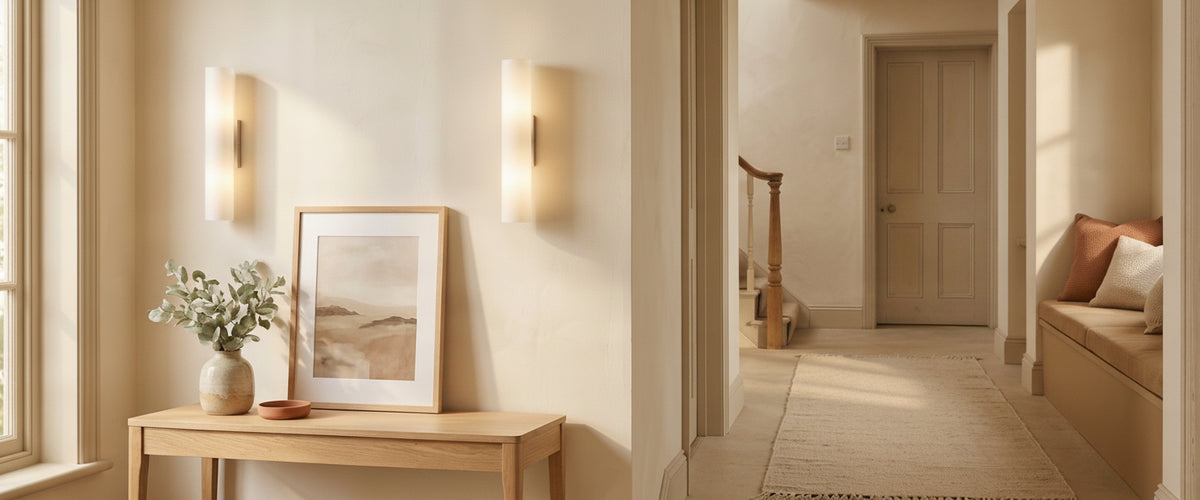

Two opal glass wall lights can hang side by side on the same wall, take the same lamp, draw the same wattage, and give you completely different light. One reads as a soft luminous panel that makes the plaster around it look warmer. The other reads as a flat bright disc with a hot spot in the middle. The difference is rarely in the product photograph, and it is almost never in the spec sheet. It sits in the glass itself, in how the fitting is built behind that glass, and in the lamp you screw into it.
At Niori we spend most of our time with alabaster and natural stone, materials that scatter light through their own body rather than through a coating. That work makes the good and bad versions of opal glass very easy to spot. Below is what we check before we would put an opal glass wall lights on a wall, and what we tell designers to look at before they commit to twenty of them for a corridor.

Key Takeaways
- Opal glass is opaque through its body, not just etched on the surface. Frosted glass is a surface treatment and behaves differently.
- Glass thickness and density control the result. Thin opal transmits and shows the lamp; dense opal diffuses and glows evenly.
- The backplate finish changes the colour of the light that comes back through the glass. Polished brass warms it; matt black sharpens the contrast.
- Respect the wattage ceiling. Enclosed shades trap heat, and heat discolours glass, cooks lampholders and shortens LED life.
- Bathrooms need an IP rating and a qualified electrician. The same fitting that flatters a bedroom can look clinical over a basin.
- An opal glass wall light gives you repeatability. Alabaster gives you character. Pick according to the brief, not the mood board.

Diffusion Versus Transmission: Two Products Wearing the Same Name
Opal glass gets its whiteness from opacifiers mixed into the batch, traditionally bone ash, tin oxide or fluorine compounds, which form microscopic crystals suspended in the glass. Light hitting those crystals scatters in every direction instead of passing straight through. The Corning Museum of Glass traces the technique back centuries, and the chemistry has barely changed in principle.
What has changed is how much of it manufacturers bother to use. A properly diffusing shade scatters the source so thoroughly that you cannot locate the lamp inside it; the whole surface becomes the light source. A transmitting shade lets a meaningful percentage of the beam through unscattered, so you get a bright core with a dimmer halo around it. Both get sold as an opal glass wall light. Only one of them does the job most buyers think they are buying.
The test is simple enough to run in a showroom. Switch the fitting on, stand two metres (about 6ft 6in) back, and look for the lamp. If you can see where it sits, you have a transmitting shade. That is not automatically wrong. Uplighters often want a little transmission so the glass has some life in it rather than reading as a dead white plate; a shape like the Torchiere 1 Light Wall Uplighter in black with etched opal glass is designed around that trace of the source showing. But you should know which one you have bought.
Why Glass Density and Thickness Matter More Than the Photography Suggests
Product photography is lit, and that is the whole problem. A studio shot fills the shade with controlled light from outside the frame, which hides exactly the flaw you are trying to find. Thin, cheap opal photographs beautifully and disappoints in a dark hallway at nine in the evening, which is where an opal glass wall light actually has to earn its place.
We keep offcuts and sample shades on the bench and hold them against a bare lamp. The difference between roughly 2mm and 4mm of opal glass takes about three seconds to see in person and never survives a photograph. Denser glass costs more, weighs more, and cuts light output, which is why some makers thin it down to hit a lumen figure. You get a brighter fitting and a worse one.
Thickness buys you a second thing: consistency across the curve. On a domed or globe shade, the glass is naturally thinner at the crown where it was blown out furthest, and poorly controlled shades go noticeably brighter at that point. Look at a lit globe from below and from the side. If the top glows hotter than the shoulders, the wall thickness is uneven, and that unevenness will be the first thing your eye finds every time you walk past.
How the Backplate Finish Changes What the Glass Appears to Do
Buyers choose the backplate for the metalwork and treat it as a styling decision. It is an optical one as well. Light bouncing off that plate passes back out through the glass, and it carries the colour of whatever it hit.
- Polished or brushed brass: reflects warm, pushing the glow towards amber. Flattering on plaster, and the closest an opal glass wall light gets to the honeyed quality of backlit alabaster.
- Brushed nickel and stainless steel: near neutral. What you get out is roughly what the lamp put in, which suits a project where fittings from several makers need to agree with each other.
- Matt black: absorbs the bounce. Less total output, but the glass reads brighter because the contrast against the plate is stronger. Strong graphic result, weak ambient result.
- Galvanised steel and coated exterior finishes: built for weather first, optics second. Expect a cooler, flatter light and specify accordingly.
Where a room needs the glass to sit warm against plaster rather than read as a graphic white circle, a brushed gold backplate like the one on the Halston 1 Light Glass Wall Light carries more of that amber bounce than chrome or matt black ever will. If you are mixing an opal glass wall light with stone pendants or table lamps elsewhere in the room, brass will hold the scheme together far better than chrome. Warm metals and translucent stone belong to the same family; you can see it across the alabaster lighting range, where brass detailing keeps the temperature consistent from fitting to fitting.
Where an Opal Glass Wall Light Wins, and Where It Loses the Argument
Against clear glass, opal wins wherever the fitting sits near eye level. Clear glass puts the lamp on display, which works for a decorative filament at high level and fails badly at 1.5m (about 5ft) on a hallway wall, where you get glare straight into the face of anyone walking past.
Against frosted glass, opal wins on evenness. Frosting is acid-etching or sandblasting applied to the surface of clear glass; it softens the edges of the source without truly dispersing it, so a hot spot usually survives. Frosted also shows fingerprints more readily, which matters beside a basin or in a kitchen.
Where opal loses is depth. It is a manufactured, uniform material, and uniformity is what it delivers: no grain, no shifting tone as the light level changes. Alabaster does the opposite. Light travels a few millimetres into the stone before it comes back out, catching veining and mineral variation, which is why an alabaster fitting looks different at full output than it does dimmed to a quarter. For a hotel corridor with twenty identical doorways, that variation is a specification headache and glass is the correct answer. For a single pair flanking a fireplace in a Georgian drawing room, the variation is the point. We shipped alabaster wall lights to a converted farmhouse in Somerset last year where the client had already tried glass and sent it back; in a room full of lime plaster and old oak, the perfectly even shades looked posted in from a different building.
Bulbs, Wattage Ceilings and the Heat Problem Inside a Sealed Shade
The enclosed shade on an opal glass wall light is a small oven. Whatever heat the lamp makes has nowhere to go, and three things suffer: the glass, the lampholder, and the lamp itself.
- Never exceed the stated maximum wattage. Overrunning an enclosed shade discolours glass over time, degrades the silicone or ceramic in the holder and can scorch the backplate.
- Check the LED is rated for enclosed fixtures. Many are not. LEDs fail from heat at the driver, not the diode, and a lamp designed for open air will lose output and die early in a sealed shade.
- Go for 2700K in domestic rooms. 3000K reads cleaner over a basin. Anything above 3500K turns opal glass grey and unpleasant.
- Insist on CRI 90 or higher. Diffused light with poor colour rendering makes skin tones and timber look flat.
- Match the dimming to the driver. Trailing-edge dimmers suit most retrofit LED lamps; pair the wrong one and you get flicker at low level, which diffused glass amplifies rather than hides.
- Prefer a small base. G9 and E14 lamps sit further from the shade wall in most shapes, which reduces the hot spot and improves evenness.
Bathroom Versus Bedroom: The Same Fitting, Two Readings
Put an opal glass wall light beside a bed and it is doing mood work. Mount it at around 1.4m to 1.5m (roughly 4ft 8in to 5ft) from the floor, slightly behind the shoulder line when you are sitting up, and it throws soft light onto the page without lighting the whole wall. Dim it to a third and the glass still looks alive, which is more than most clear fittings manage.
Move the identical fitting into a bathroom and its job changes entirely. Now it is task lighting on a face, and evenness becomes non-negotiable, because a hot spot throws an uneven shadow across one side of the jaw. Flank the mirror in pairs at roughly eye level, around 1.6m (about 5ft 3in), rather than mounting a single light above it.
The regulations matter here. UK bathrooms are divided into zones, and the fitting must carry an appropriate IP rating for the zone it sits in; Electrical Safety First sets out how those zones are defined. IP44 is the usual minimum near a basin, with IP54 or better for exterior walls. Outdoors, the construction has to change rather than just the rating on the box: a sealed flush fitting such as the Stockholm Outdoor Flush Wall Light IP54 in silver with opal glass is gasketed and shallow enough to survive weather on a porch or garden wall, which an indoor shade pressed into the same job will not. Have any bathroom or outdoor fitting installed and certified by a qualified electrician; this is not sensible DIY territory.
A Short Checklist Before You Order
- Ask for a photograph of the fitting lit in a real room, not a studio shot.
- Confirm the glass is opal through its body rather than frosted or coated clear glass.
- Check the backplate finish against your other metalwork and your wall colour, not in isolation.
- Note the maximum wattage and the lamp base, then buy an enclosed-rated LED to match.
- Confirm the IP rating if the fitting is going anywhere near water or outdoors.
- Decide whether you want the uniformity of glass or the variation of stone before you shortlist.
- Order one sample opal glass wall light first if you are specifying six or more. Corridor repetition magnifies every flaw.
- Plan the dimming circuit at the same time, not after the plasterer has gone.
Cleaning is straightforward: a dry microfibre cloth on a cold fitting, a barely damp cloth for marks, and nothing abrasive or solvent-based near painted or lacquered metalwork. Stone needs a gentler hand again, since alabaster is porous and dislikes water. If you are weighing an opal glass wall light against stone for a particular wall, browse the wider lighting collection with both in front of you; the choice usually resolves itself the moment you see how each one handles a dimmed lamp.