
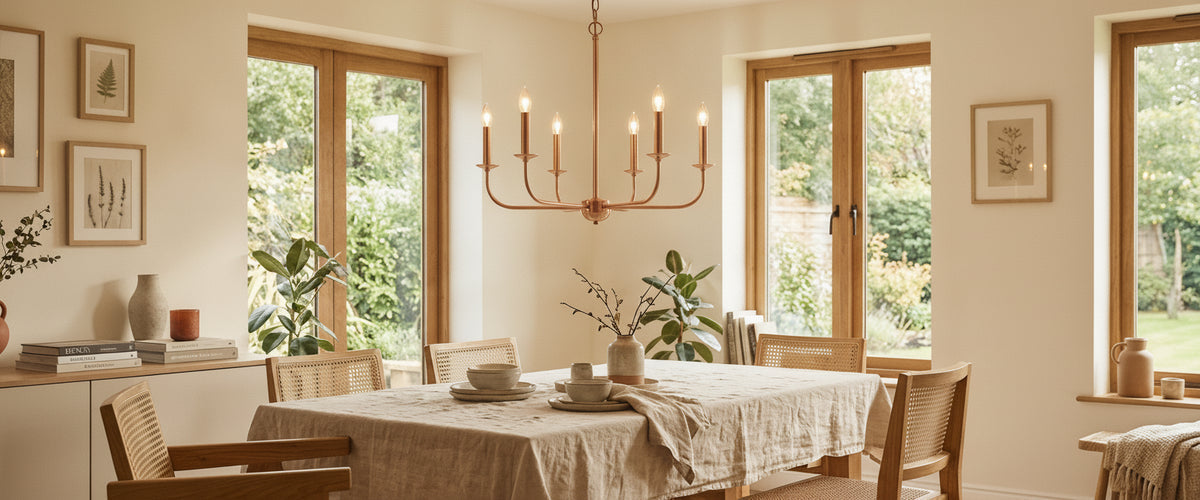

Copper is the most honest metal you can hang over a dining table, and that honesty catches buyers out. A copper chandeliers that looked rosy and bright in product photos can turn orange under warm bulbs, brown within a year beside a busy hob, or disappear into a terracotta wall. None of that is a flaw. It is copper doing what copper does, and the buyers who end up happiest are the ones who chose with that behaviour in mind.

Key Takeaways
- Copper runs redder than brass and brighter than bronze once lit, so it pushes a room warmer than you may expect.
- "Antique" and "vintage" are finish descriptions far more often than statements of age. Ask which one you are buying.
- Size to ceiling height first, then to floor area and table size.
- A 3000K bulb keeps copper reading as metal; 2700K melts it into the glow.
- Unlacquered copper will darken. Decide on day one whether you want to polish it or let it age.

How a Copper Chandelier Reads Against Brass and Bronze Once Lit
Switched off, the three metals can look closer than they are. Switched on, the differences become obvious. Brass reflects a yellow-gold light that sits comfortably with most whites and creams. Bronze is darker and absorbs more than it bounces, so it reads as outline and silhouette. Copper sits in between but leans pink and red, and it throws that tint onto nearby surfaces: the underside of a ceiling rose, a pale tablecloth, the faces of people sitting beneath it.
That reflected warmth is the reason people fall for copper, and also the reason it needs a partner. In the studio we often pair copper hardware with alabaster or onyx diffusers, because the stone softens the glare off each arm and turns the whole fixture into a single, even source. Bare copper arms with exposed bulbs give you sparkle and hard reflections. Copper framing a translucent stone shade gives you a gentler, candle-coloured wash. If you are drawn to that second look, the alabaster lighting collection is the place to see how stone diffusers change the character of a warm metal frame.
Antique, Vintage and Contemporary: What the Labels Signal and What They Conceal
An antique copper chandeliers in a retail listing is usually a new fixture with a chemically darkened or hand-rubbed finish, often lacquered to lock that look in place. A genuinely old piece is a different purchase altogether: it will almost certainly need rewiring, the arms may carry old solder repairs, and the patina will be uneven in ways that no factory can fake. Both have their place, but they should not be priced or judged against each other.
A vintage copper chandelier sits in murkier territory. Sometimes the word means mid-century, sometimes it means "looks a bit worn". Ask for the construction method, whether the metal is solid copper or copper plate over steel or brass, and whether the finish is sealed. Plated pieces wear through at the high points, which is charming on a lamp base you touch and less charming on arms twelve feet (3.7 metres) above a stair.
A contemporary copper chandelier tends to be cleaner in line and brighter in finish, sometimes brushed, sometimes polished and lacquered. This is where the copper modern chandelier lives: linear bars, geometric cages and the copper drum chandelier, where a shallow cylinder hides the bulbs and shows copper as a band of colour. If you are searching for a copper chandelier modern enough for a minimal interior, the drum is usually the safest choice, because it gives you the colour of copper without the busyness of multiple arms.
Dining Room, Hallway and Kitchen: Where Copper Settles and Where It Creates Friction
Dining Room
The copper chandelier dining room pairing works because meals happen in the evening, under dimmed light, when copper's warmth is most flattering to skin and food. It settles well against dark timber, green or deep blue walls, linen and natural stone. Friction starts with warm-toned walls: terracotta, peach or very orange oak can make the fixture vanish, so the room reads as one flat amber shade. A reliable fix is a pair of pale alabaster wall lights on the chimney breast or opposite wall, which gives the eye a cooler, cream-coloured point of contrast and brings the copper back into focus.
Hallway
Hallways are seen in passing and often by daylight, which is the least forgiving light for a patinated finish. Copper in a hall wants a simple form (a lantern shape or a single drum) and enough height that people are not staring into the underside of it on the stairs.
Kitchen
Kitchens are hard on unlacquered copper. Steam, cooking fat and frequent cleaning speed up tarnishing, and they do it unevenly: the side nearest the hob darkens first. If you want copper over an island, choose a lacquered finish or accept that you are buying a living surface.
Outside
A copper outdoor chandelier on a covered terrace or loggia is one of the few places where letting the metal weather makes complete sense. Over time it will move towards brown and, in exposed coastal positions, towards green. If it is that settled brown stage you are really after, a fixture already finished in dark brown, such as the Sawyer 6 Light Outdoor Chandelier, Dark Brown, gives you the aged tone from the first evening and suits a compact loggia or a small outdoor table. Over a longer terrace table, the extra arms of the Sawyer 9 Light Outdoor Chandelier, Dark Brown spread light further without needing a second fixture. Check the IP rating, never assume an indoor fixture can go under a porch roof, and have any outdoor connection installed and certified by a qualified, registered electrician such as those listed with NICEIC.
Scale and Arm Count: Start With Ceiling Height
Most sizing advice starts with floor area. That is useful for diameter, but it ignores the dimension that matters most with a multi-arm fixture: height. A six-arm chandelier with a deep body in a room with a 2.4-metre (about 8-foot) ceiling will crowd the space even if the diameter is technically correct.
- Standard ceilings (around 2.4 m / 8 ft): choose a shallow body, a drum or a flush-mounted form. One tier of arms at most.
- Taller ceilings (2.7 to 3 m / 9 to 10 ft): a single tier with a longer drop, or a compact two-tier design.
- Double height and stairwells: this is where a large arm count and multiple tiers earn their place, because the fixture has vertical room to fill.
Over a dining table, aim for the bottom of the fixture to sit roughly 75 to 85 cm (30 to 34 inches) above the tabletop, and keep the diameter around 30 cm (12 inches) narrower than the table's width so nobody clips it when they stand. Where a long rectangular table sits under a standard-height ceiling, a linear form such as the Zuma 6 Light Linear Chandelier, Satin Black/Gold spreads light along the length of the table rather than adding depth, and the same logic holds when you look for that shape in copper. Arm count also changes how much copper you see. More arms mean more reflective surface, so a twelve-arm copper piece will tint a room far more strongly than a brass one of the same size.
What a 2700K Bulb Does to Unlacquered Copper That a 3000K One Does Not
Bulb colour is the detail most buying guides skip, and it makes a large difference. At 2700K the bulb light is already amber. Reflected off unlacquered copper, it becomes deeper and redder, and the metal loses definition; you see a warm glow rather than a crafted object. Some people want exactly that for a candlelit dining room. Many are disappointed by it.
At 3000K there is just enough separation between the colour of the light and the colour of the metal for copper to read as copper. The brushed grain shows, the darker patina in the recesses stands out, and the fixture keeps its shape. Our usual advice for bare-arm designs is 3000K with a colour rendering index of 90 or above, on a dimmer. If you want the lower, cosier effect later in the evening, a warm-dim LED that drops towards 2200K as you dim gives you both moods from one fixture. Check that your bulbs and dimmer are compatible before installation, and if the fixture uses alabaster or onyx shades, remember the stone adds its own warmth, so 2700K behind stone will look noticeably warmer than the same bulb left bare.
Patina Over Time: When to Clean a Copper Chandelier and When to Leave It Alone
Unlacquered copper oxidises. It moves from salmon-pink to brown, and in damp or salty air it may eventually develop the blue-green verdigris seen on old roofs. The Copper Development Association's guidance on architectural finishes sets out how that natural weathering progresses and why it protects the metal beneath. For most interiors the brown stage is the attractive one, and it arrives unevenly, darkest where hands and heat reach.
Leave it alone if the darkening is even and you like the depth it adds. Clean it if you see green spots indoors (a sign of moisture or residue), fingerprints etched into the surface, or grease from cooking. Never use abrasive polish on a lacquered finish; it cuts through the seal and exposes patches of bare metal that tarnish while the rest stays bright. On an antique copper chandelier with a deliberately darkened finish, polishing will remove the effect permanently.
Buyer's Checklist Before You Commit
- Confirm solid copper or copper plate, and whether the finish is lacquered.
- Measure ceiling height and table width, not just the room.
- Hold a copper sample against your wall colour in the evening, not at midday.
- Decide on 3000K or 2700K based on whether you want to see the metal or the glow.
- Check dimmer compatibility and the maximum bulb wattage.
- For outdoor or bathroom positions, check the IP rating and use a qualified electrician.
- Decide, with anyone you live with, whether the patina stays or goes.
Budget depends on material, scale, how complex the arms and joints are, the engineering behind heavy stone shades, installation and finishing. If you are planning a project with several fixtures, request a tailored quote rather than working from a single listing. And if copper turns out to be too insistent for your room, look through the wider niori lighting collection: alabaster, marble and brass pieces give a similar warmth with a quieter surface.