
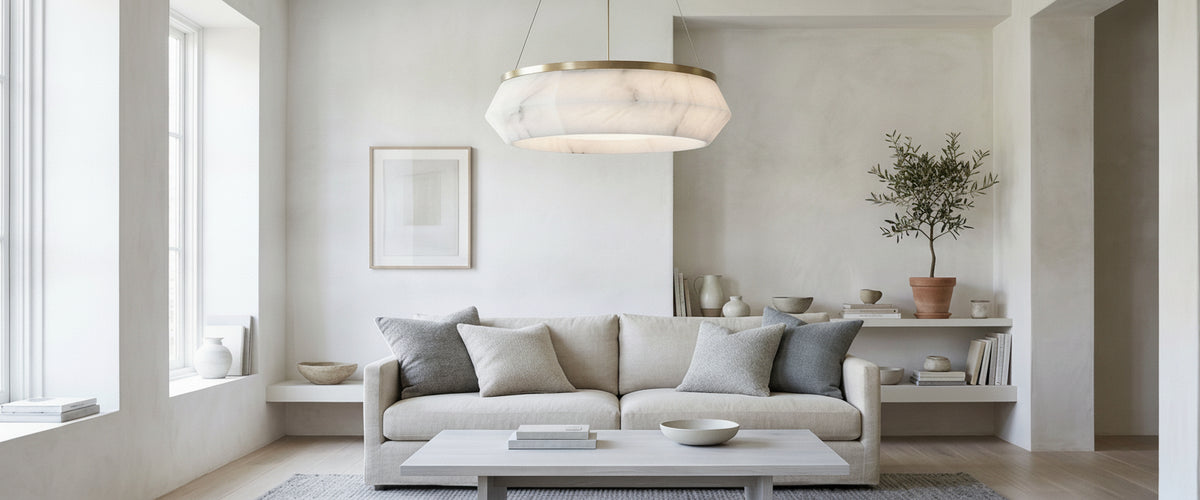

White is the default answer on half the lighting schedules we see, and it is the finish most likely to disappoint once it is up. A modern white lighting can anchor a room or apologise for being there, and the difference has almost nothing to do with the colour itself. It comes down to what the white is made of, how much light passes through it, and whether the shape has enough weight to register against a pale wall. At Niori we work mostly in alabaster, marble, onyx and other natural stone, which means we spend a lot of time explaining why two modern white light fittings of identical size can behave like completely different objects.

Key Takeaways
- Opaque white throws light down; translucent white becomes the light source. That single distinction drives everything else.
- Bulb temperature matters more with white than with any other finish. Cool LEDs turn painted white grey, especially in north-facing rooms.
- Proportion rescues white. A slightly larger, heavier silhouette reads architectural; a timid one reads absent.
- White needs a partner. Warm brass, dark walls or a natural stone surface give it an edge to push against.
- Finishes age differently. Painted metal chips at the fixings, plaster crazes, older plastics yellow. Alabaster deepens in tone rather than going sour.

What "Modern White Light" Actually Covers
Modern white light is a label stretched across five or six materials that share a colour and nothing else. Powder-coated or painted metal is the most common: flat, opaque, matte or satin, and completely reliant on the light it reflects off surrounding surfaces. Opal and acid-etched glass transmit light evenly but with almost no internal character. Plaster fittings, popular in contemporary British interiors for their chalky flatness, absorb light rather than transmit it and can be painted to match the wall. Composite "stone-effect" finishes imitate the look at a distance and give themselves away at close range, because they have no depth behind the surface.
Then there is the genuine article. Alabaster is a gypsum stone, soft enough to carve finely and translucent enough that a lamp inside it lights the material itself. Hold a hand behind a thin alabaster panel and you see the shadow through it. That translucency is why medieval carvers in the English Midlands worked the stone so heavily for altarpieces and tomb effigies, a tradition documented in the sculpture holdings at the Victoria and Albert Museum. White marble behaves similarly at thinner sections; onyx is more dramatic, with banding that reads as movement when lit.
For a buyer, the practical question is whether you want a white object in the room or a white glow in the room. A painted pendant is an object. An alabaster pendant is a glow with an object around it. Both are valid, and they cost different amounts to make, because carving stone to an even wall thickness is slow work. Price for a modern white light depends on material, scale and complexity, so ask for a quote rather than assuming stone and steel sit anywhere near each other.
Warm or Cool? Bulb Temperature for Modern White Light
Nothing undermines a modern white light faster than the wrong lamp. Fit a 4000K LED behind an opal shade in a north-facing sitting room and the whole fitting reads blue-grey, which then drags the wall colour with it. The same shade at 2700K looks like a lit thing rather than a cold one. Guidance from the Energy Saving Trust puts domestic warm white broadly in the 2700K range, and for white fittings in living spaces we would rarely go above 3000K.
Aspect changes the calculation. A north-facing room receives cool, flat daylight for most of the year, so warm lamps do useful corrective work. A south or west-facing room already picks up golden light in the late afternoon, and you can hold 3000K without the space feeling yellow. Kitchens and utility areas tolerate slightly cooler light because the task demands it; bedrooms almost never do.
Three specifications are worth insisting on. Ask for CRI 90 or above, because low-CRI LEDs make white finishes look chalky and dead. Ask whether the driver is genuinely dimmable and compatible with your dimmer type, since mismatched trailing-edge dimmers are the most common cause of the flicker complaints we hear about. And consider dim-to-warm lamps for alabaster, which shifts the stone from pale cream at full output to something close to candlelight at 10 per cent. Any hardwired fitting should be installed by a qualified electrician; in the UK that means someone competent under Part P of the Building Regulations.
Silhouette: Proportion Makes a Modern White Light Read Architectural
A modern white light has no colour contrast to work with, so form carries the entire load. This is where most schemes go wrong. Designers size a white pendant the way they would size a black one and end up with something that photographs as a smudge.
Go up a size. Over a dining table, a pendant or linear fitting of roughly one-third to one-half the table width holds its ground; below that, white simply dissolves. Where a single white shade would get lost at that width, a multi-arm frame such as the Balance 5 Light Chandelier in White & Polished Nickel spreads the same pale finish across a wider footprint and keeps an outline against the ceiling. Hang it around 75 to 85cm (30 to 33 inches) above the tabletop so the underside sits in your field of view rather than floating near the ceiling. For wall lights flanking a bed or a fireplace, mount at roughly eye level when standing, around 1.5 to 1.6m (about 5 feet), and choose a profile with real depth rather than a flat disc.
Carved detail also helps. Fluting, stepped rims, ribbed columns and chamfered edges all catch raking light and create self-shadowing, which is what stops a white surface from flattening out. That is a structural advantage of stone: it takes a carved profile that sheet metal cannot. Browsing the alabaster lighting collection is a fast way to see how much a fluted or banded surface changes the way a pale fitting sits against a pale wall.
Where Modern White Light Recedes Usefully and Where It Vanishes
Recession is sometimes the goal. In a low-ceilinged flat with white walls, a white flush fitting or a white picture light above artwork lets the room read as one continuous surface and keeps attention on the art. When the fitting should read as part of the wall rather than as a separate object, a slim white profile like the Alton Large LED Picture Light in White is closer to the right design language than a brass arm that competes with the frame; the smaller Alton suits anything under roughly a metre wide. Corridors, boot rooms and stairwells all benefit from lighting that does its job quietly.
Vanishing is different, and it is a failure. The test we use in the studio is simple: photograph the space in grey daylight with the lights off, then squint at the image. If the fitting has no discernible outline, it will contribute nothing when switched off, which is most of the day. A pendant over an island in a white kitchen is the classic casualty of a modern white light chosen on colour alone. The fix is usually a change of material rather than a change of colour, because a veined alabaster shade holds a visible outline through its own tonal variation even when unlit.
We shipped a pair of alabaster pendants to a converted barn in Hampshire last year, where the client had already tried two sets of white metal shades over a pale limestone island. Her note back was that the stone versions were the first ones she could actually see in the morning. That is the whole argument in one sentence.
Pairing White With Metallics, Dark Walls and Natural Materials
A modern white light needs something to push against. Antique or brushed brass is the most forgiving partner, because its warmth stops cream-toned stone from reading as builder's magnolia. Polished nickel and chrome give a crisper, more contemporary result and suit marble better than they suit honeyed alabaster.
Dark walls are where white fittings perform best. Against a deep green, ink blue or charcoal, an alabaster wall light stops being a pale shape and becomes a piece of illuminated sculpture, with the glow reading far stronger for the same output. If you are working with dark joinery in a study or a hotel bar, this is the pairing to reach for.
The same contrast can be built into a single fitting rather than borrowed from the room. On a console or a desk where the wall behind is already pale, something like the Ascent Table Lamp with its black column and white shade carries its own dark base, so the shade reads as a lit surface instead of merging with the plaster; the floor lamp version does the same job beside a pale sofa.
Natural materials do the same job more subtly. Oak, rattan, wool bouclé, unpolished limestone and plaster walls all carry texture that gives white something to sit against. What tends not to work is white on white on white with no tonal shift anywhere, which is how rooms end up looking unfinished rather than serene. If you are assembling a scheme across several rooms, the wider lighting collection is useful for checking that pendants, wall lights and table lamps share a consistent white tone rather than drifting between cool and warm whites.
How Modern White Light Finishes Age in Real Use
Painted and powder-coated metal chips first, usually at the fixing points where a spanner has slipped, and touch-up paint rarely matches the original satin level. Plaster fittings are matte and beautiful on day one, but they mark from fingerprints, craze slightly with building movement, and cannot be wiped clean. Older acrylic and some early polycarbonate diffusers yellow with heat exposure over years, which is far less of a problem with LED than it was with halogen, but not zero.
Alabaster and marble behave differently. They do not yellow; they deepen very slightly in tone, which most owners read as improvement rather than wear. The vulnerability is chemical. Gypsum alabaster is soft and reacts badly to acids and moisture, so vinegar, lemon-based sprays, ammonia cleaners and damp bathroom air are all worth avoiding. Dry-dust with a soft brush or microfibre, use a barely damp cloth with plain water for marks, and dry immediately. Never soak a socket housing or let water run down an internal flex.
A Buyer's Checklist for Modern White Light
- Decide object or glow. Opaque finish for reflected light, translucent stone for a lit surface.
- Match white tone to your walls. Cool paint whites clash with warm cream alabaster; test samples in the actual room.
- Specify 2700K to 3000K, CRI 90+, dimmable driver. Confirm dimmer compatibility before ordering.
- Size up, not down. One-third to one-half table width over dining tables; check hanging heights against sightlines.
- Run the squint test. If the unlit fitting has no outline against the wall, change the material.
- Give it a contrast partner. Brass, dark paint, oak or textured stone.
- Check weight and fixings. Stone fittings need a suitable ceiling structure and a qualified electrician.
- Plan the cleaning routine. Dry dusting only for stone; no acidic or ammonia-based products.
Choose a modern white light for the right reason and it becomes the calmest, most flexible finish in a scheme. Choose it because it felt safe, and you will spend the next five years looking past it. If you are weighing painted metal against carved stone for a specific room, the Niori team is happy to talk through aspect, ceiling height and lamp choice before you commit.